A Unified Vision for Dryland Crop Improvement: Global NARS and CGIAR Centers Strengthen Ties at ICRISAT Meet
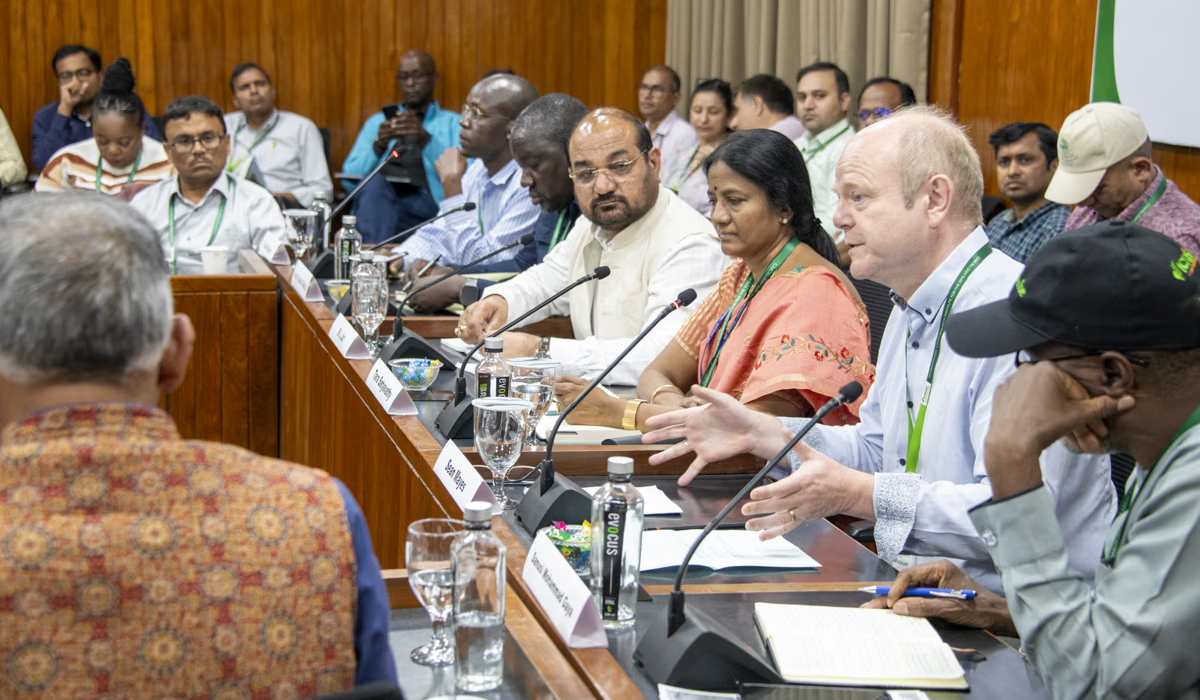
Dr Sean Mayes, Director of Accelerated Crop Improvement at ICRISAT, moderates the discussion on the 'Way Forward for Dryland Crop Improvement in the Global South'.
Media Release
Thursday January 30, 2025
Hyderabad, India – The Global Dryland Networking and Partnership Meet, hosted by the International Crops Research Institute for the Semi-Arid Tropics (ICRISAT) provided a unique platform for key stakeholders to build networks, break silos, and come together in a spirit of collaboration.
With over 60 breeders and seed systems specialists from National Agricultural Research Systems (NARS) of more than 20 countries across Africa, South and Southeast Asia, and Australia, alongside leaders from ICAR, ICARDA, CIMMYT, and ICRISAT, the event proved to be a pivotal moment for building stronger relationships and networks across the global dryland community.
Dr Stanford Blade, Director General-Interim at ICRISAT, stated: “This gathering represents a critical opportunity to renew our collective energy and commitment. By building and extending partnerships, we can better address the challenges faced by smallholder farmers in dryland regions.”
A key highlight of the meeting was the Panel Discussion on the “Way Forward for Dryland Crop Improvement in the Global South” where panelists and participants emphasized the development of the Global Dryland Crop Improvement Network.
The demand-side assessment of NARS served as the foundation for the panel discussion, focusing on the challenges and opportunities in global dryland crop improvement.
Notable Takeaways from the Panel Discussion:
Holistic Approach & Partnerships
Emphasizing the need for a systems approach to tackle emerging challenges.
Calling for stronger partnerships and innovative strategies to drive progress and the inclusion of the International Institute of Livestock Research (ILRI) in future discussions, as livestock are a critical component of dryland farming.
Recommending work with a range of dryland crops and cropping systems focusing on millets, chickpea, pigeonpea, groundnut, lentils, and grasspea, among others.
Aligning Priorities & Avoiding Duplication
Urging alignment of global and national priorities for maximum impact.
Highlighting the importance of leveraging technology efficiently.
Stressing the need to avoid duplication and optimize resource use.
Collaboration Over Competition
Noting that CGIAR centers and NARS should complement rather than compete.
Focusing on identifying shared goals and refining them as conditions evolve.
Equitable & Inclusive Approaches
Advocating for equitable collaboration and improved seed systems.
Recommending shifting from top-down approaches to context-specific solutions.
Innovative & Technology-Driven Solutions
Highlighting key themes:
Climate-smart agriculture
Ecosystem services
Speed-breeding
Precision farming
Emphasizing the integration of Artificial Intelligence, Machine Learning, and robotics into crop improvement efforts.
Dr Sean Mayes, Director of Accelerated Crop Improvement at ICRISAT, moderates the discussion on the ‘Way Forward for Dryland Crop Improvement in the Global South’.
Dr Sean Mayes, Director of Accelerated Crop Improvement at ICRISAT, moderates the discussion on the ‘Way Forward for Dryland Crop Improvement in the Global South’.
Dr ML Jat, Acting Deputy Director General-Research and Director of Resilient Farm and Food Systems at ICRISAT, led the panel discussion. The panelists included NARS partners Dr Tara Satyavathi, David Kalule Okelo, and Dr Sanusi Mohammad Gaya; Dr Shiv Kumar Agarwal from ICARDA; Dr Chris Ojeiwo from CIMMYT; and Dr Sean Mayes from ICRISAT.
“By fostering a setting conducive to open dialogue, the meeting enabled all stakeholders to forge valuable connections, enhance mutual trust, and work collectively towards shared goals in dryland crop improvement,” asserted Dr Jat in his closing remarks.
Participants of the meet visited ICRISAT facilities to gain firsthand knowledge of the Institutes’ work and updated technologies, and to identify areas for collaboration. Other important speakers at the event included Dr Aladdin Hamweih from ICARDA, Dr Harish Gandhi from CIMMYT, Dr GP Dixit from IIPR, Dr Sandip Kumar Bera from IIGR, Dr Nazmun Nahar Karim from ED-BARC Bangladesh, Dr Dhojraj Khanal for ED-NARC Nepal and Dr Victor Afari Sefa from ICRISAT. Dr Zainab Gwadabe, CEO The Seed Project Co Ltd., presented a learning seminar to ICRISAT staff.