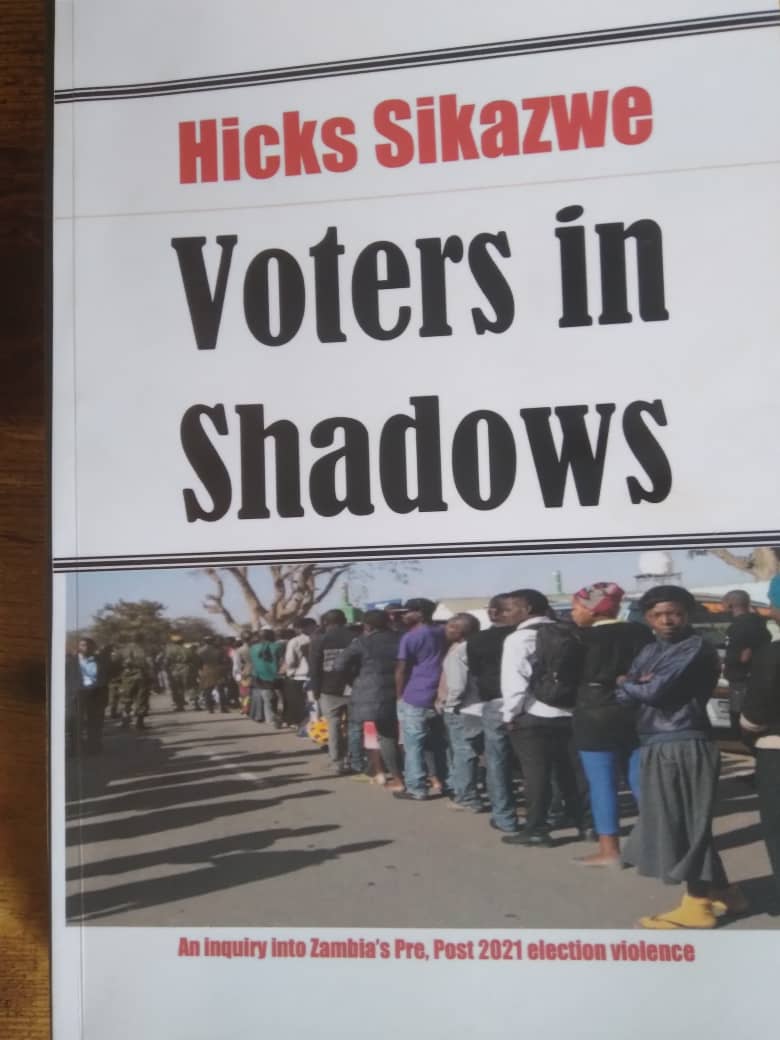
Voters in Shadows by Zambian author Hicks Sikazwe

Book Review
Title: Voters in Shadows
Author: Hicks Sikazwe
Publishers: HPS Communications
Pages: 323
WHILE many scholars argue that only ethnicity drives voting behaviour in Africa, recent quantitative work finds government performance also matters.
But under what conditions do Africans use ethnicity or performance to inform their vote?
Veteran journalist and author Hicks Sikazwe answers all these electoral intricacies in his classic latest book Voters in the Shadow by arguing authoritatively that the importance of ethnicity and performance is conditional on whether voters evaluate co-ethnics and incumbent candidates.
In chapter one under the title Violence, murder, fraud, intimidation in Africa politics, Mr. Sikazwe first gives a broader picture of what elections entail in Africa and their attendant controversies that usually mask tribal and regional sentiments.
Sikazwe cites an example of presidential elections held between 2019 and 2020 especially those held in Ethiopia, Malawi, Madagascar and Zambia which saw opposition parties emerge victorious in controversial circumstances.
At the end of the chapter, he observes that while Zambia has scored a first by recording peaceful political transitions since independence, many people have wondered why there was so much violence before and after the elections of 2021.
Sikazwe probes this question further by asking what was new about the August 12 vote to differentiate it from the multiparty polls that were held since 1991.
This is the question other preceding chapters answer with careful analysis of unseen events that have influenced the electoral process in the country for decades.
Like his other earlier books Zambia’s Fall Back Presidents and Wasted Years, Sikazwe’s latest book is another authoritative chronicle of what has shaped the country’s history from the political green years of pre-independence Zambia to date.
Divided in 15 chapters of revelatory information, the author uses his acute journalistic writerly skills not just to reveal but explain the background circumstances of every epoch of Zambia politics from the inter-party violence between the African National Congress (ANC) and the United National Independence Party (UNIP) through to the time the country banned plural politics through the Choma Declaration of 1973, the reversion to multiparty politics period, up to the present date when ethnic considerations have once more become prime in politics albeit being highly masked.
The author also draws from personal experience and that of people close to him including his late father Amon Kanyelele Sikazwe who was accused of being a member of African National Congress ANC, when the ANC/ United National Independence Party (UNIP) rivalry reached its peak leading to violence and deaths that mocked the attainment of independence and the fallacy of national unity.
Once more, I would straight away recommend the book as a must read for historians, academicians, students, politicians and ordinary readers who want to understand the events that have shaped Zambian politics.
Like his other earlier books, Mr. Sikazwe does not just reveal information that is in public domain but goes a step further in disclosing fresh information most of it unknown to historians of Zambian politics.
This he does in almost in all chapters especially early ones when he traces the history of electoral violence both in pre-independence and post-independent Zambia.
In chapter four under the heading of Patriotic Front (PF) afraid to lose, United Party for National Development (UPND) desperate to win, the author discusses how both parties treasure holding political office mainly for what it can offer and what it means in benefitting them and those in their strongholds.
Under the same chapter, he discusses at length how the Mapatizya formula was mooted to challenge what its architect called the MMD trickery in consistently stealing UPND presidential victory.
Under chapter six titled Voters in the shadow, Mr. Sikazwe analyses how desperate political parties become during elections as evidenced in both parties accusing each other of using both child and foreign voters.
What the reader will get from the book is the unspoken truth that from the pre-independence era, voting behaviour in Zambian elections usually determines the manner in which a particular group of people vote for a specific political party or candidate.
The importance of this book also lies in the fact that analysis of voting behaviour and political party alignment in Africa’s young multi-party regimes – whether democratic or hybrid – is an almost completely ignored research topic.
The book unravels this problem by advancing the notion that voting behaviour is usually explained predominantly by factors such as ethnicity.
Mr. Sikazwe does Zambian politics a great service by opening up discussions of political structure and agency, questioning age-old debate about elections, representation and the influence of ethnicity.
That, and his considerable and well-presented historical research, make this book well worth reading.
Mr. Sikazwe who boasts a journalism career spanning almost half a century has experienced the events he is writing about and who else can explain them better.
AK