UPND TAXATION PLAN (Policy)
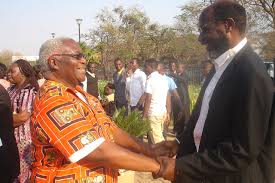
Akashambatwa Mbikusita Lewanika with Fresher Siwale
By Fresher Siwale, President, New Labour Party (NLP)
In recent times we have heard of tax measures introduced by the UPND administration. Among them is the requirement to obtain a Tax Clearance Certificate from Zambia Revenue Authority (ZRA) before a person can apply for a passport and driver’s licence. It is also a requirement for any person who wants to apply for any license to engage in business. The New Dawn Administration has also increased the Property Transfer Tax (PPT) from 5% to between 8 and 10%.
In 1992, during the first Movement for Multi-Party Democracy (MMD) Budget presentation the then Honourable Minister of Finance, the late Mr Emmanuel Kasonde provided for Temporal Revenue Measures among other things the driver’s license and the passport were included. Many Local Authority functions were transferred to Central Government.
When you analyse both sides of the mission statement you will find a common denominator being TAX. Simply put the IMF was asking the government of the Republic of Zambia to make a complete paradigm shift of the taxation policy from Capital to Production. Among other things the program provided for Business Reforms to be instituted.

The Implementation Program of the Structural Adjustment Program under business reforms provided for among other things the the definition of the relationship between central government and local authorities which is based on three (3) grants namely;
1. Recurrent Grant – for remuneration of
civil servants attached to local
authorities
2. Capital Grant – for maintenance and
repair of infrastructure operating under
local authorities ordinarily for central
government
3. Equalisation Grant – this is a
developmental grant and is supposed
to be a Mid-term plan for 25 years. If
Kabwe is developing faster than
Mazabuka then the difference
between Kabwe and Mazabuka in
public goods and services is what
Mazabuka is qualified for and divided
in 25 lots. This arrangement allows for
Mazabuka to catch up with Kabwe in
25 years’ time.
When levy Mwanawasa took over from Frederick Chiluba he abondoned the implementation program of the Structural Adjustment Program without reviewing it and straight away embarked on the Highly Indebted Poor Country program (HIPC) under the same International Monetary Fund (IMF) Mwanawasa fell for the program because it debit relief at the end of it. And indeed debt relief was granted when Zambia qualified.
And at the end of the HIPC program in 2006, the IMF in a letter addressed to the Zambian government advised that government embarks on Budget Reforms because Zambia had enough resources to prosecute its development agenda. What Levy Mwanawasa and his administration failed to do was to understand what budget reform was. Budget Reform is simply business reforms which also is Decentralization.
Here we are 18 years later we have failed to implement budget reforms/decentralization. A feeble attempt at decentralization under Mwanawasa ended up in setting up the famous Decentralization Secretariat. Under UPND, a smaller and minute component of the Equalisation Grant the Constituency Development Fund (CDF)without any plan whatsoever has been disguised as decentralization for political expediency.

UPND administration is failing to reign in inflation because they have failed to take advantage of the conflict in the finances of central government and local government which is such that when central government spends money it induces inflation and when local government spends the same money it induces production. And of massaging inflation in offices it could have resulted in Productive Inflation for infrastructure development.
Failure by the UPND administration to understand what the economy is has led to higher taxation of citizens and poverty under their watch. What do economists say about what the economy is? The economists say that the size of your population is the size of your market and the size of your market is the size of your economy and what they say is that the population is the economy itself. It is population activities that induce production (GDP) for government to tax and failure by the UPND administration to induce population activities has to punitive taxes on the citizens and their corporate entities. The economy is shrinking very fast under UPND and therefore, the tax base is also contracting but the pressure to collect is escalating hence the desperate to increase taxes. Increased taxes means an increase in cost of production and will be passed on to consumers which leads to higher prices and a spiral effect on Inflation.