MUNA: “We believe in people taking moments of freedom and love where they can find it”
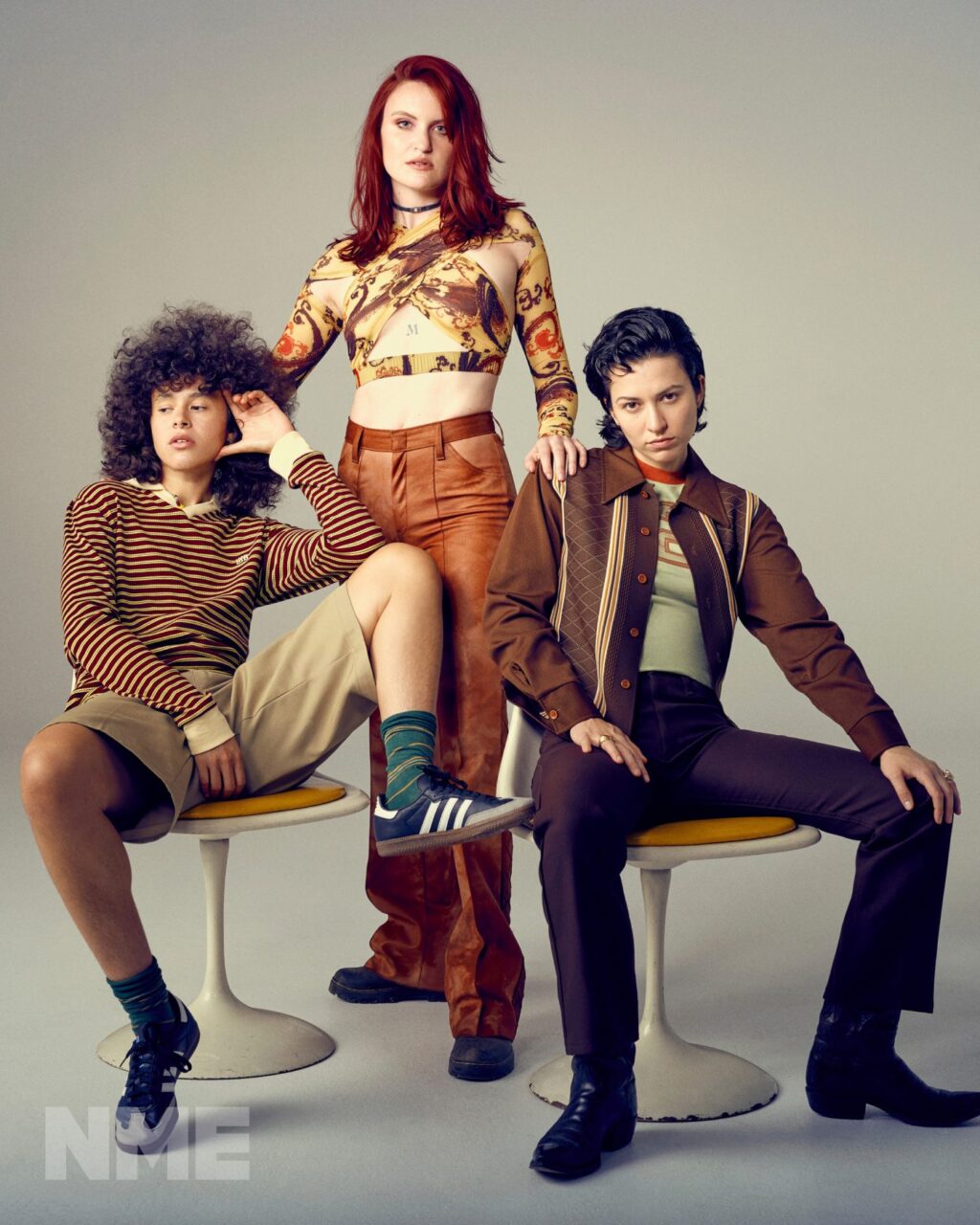


MUNA: “We believe in people taking moments of freedom and love where they can find it”
After being dropped by a major, the US trio bounced back by signing with Phoebe Bridgers’ label for their self-titled third record. With support dates with Taylor Swift beckoning, NME heads down to the tour that dreams of a “joyful queer revolution”
Any way you look at it, 2022 has been MUNA’s best ever year. In June, the LA alt-pop trio dropped their self-produced, self-titled third album, a nonstop bopathon. It became their first to crack the UK albums chart, and its lead single ‘Silk Chiffon’, a spangly romantic banger featuring their new label boss Phoebe Bridgers, has racked up 34 million Spotify streams – more than any other MUNA song, including 2017’s galvanising LGBTQ anthem ‘I Know A Place’. And they’ve just wrapped a UK tour, which featured their biggest ever headline show at London’s iconic Roundhouse a fortnight ago. Everything is going their way.
“To see the songs have a bigger audience when we’re playing rooms of this size, it’s what we’ve dreamed about,” says guitarist Josette Maskin, reflecting on the shows. “I think we need a moment to collect ourselves now, so we can recentre and work out, like, ‘What is MUNA’s next target?’”
Actually, some of MUNA’s next targets are already lined up. Next year brings two super-high-profile support slots: first with Lorde in Australia in March, then with Taylor Swift’s feverishly-anticipated ‘The Eras Tour’ in the US in July. Maskin says the sheer scale of the dates hit her when she went to an Arsenal match recently in London, and realised the club’s 60,000-capacity ground, Emirates Stadium, was slightly smaller than the enormous venues they’ll be playing with Swift. “It’s gonna be really fun and we feel really honoured to be part of that group of artists that [Taylor] wants to take out on tour,” adds singer Katie Gavin. They join an astonishing supporting cast, which includes Bridgers, Paramore, Haim, Beabadoobee and Girl in Red.

NME first meets MUNA in London, then catches up with the band as they complete the tour in Birmingham a week later. On both occasions, they’re warm, thoughtful and funny, as anyone who’s paid attention to their stage patter will know. Like all the best bands, MUNA are a gang that you want to be part of – a proudly LGBTQ gang: all three members are queer and guitarist Naomi McPherson is non-binary. Judging from these conversations – where Gavin, Maskin and McPherson contribute equally and bounce off one another pretty effortlessly – this is definitely a band where everyone’s voice is heard.
They’re also a band that prioritises self-care. ‘What I Want’, a euphoric celebration of post-pandemic partying from their latest album, features the instantly iconic lyric: “I wanna dance in the middle of a gay bar!” But, according to the trio, this isn’t really an option when they’re on the road: “Wherever we are is the gay bar, man,” deadpans McPherson. “Katie’s actually playing a lot of Solitaire these days,” interjects Maskin, “or I’m crocheting and Naomi’s being the TV boss. And we chill, so that’s the gay bar.”
“That’s the most stereotypically like, lesbian thing about our band – to take care of ourselves,” Gavin adds. “I’m sure ‘What I Want’ is misleading as a song. People are like, ‘You should come out and party after the show!’ It’s like, no honey, we are being grandmas.” McPherson says the band love partying with fellow members of the LGBTQ community, but it has to wait until after a tour “otherwise we run the risk of getting very tired”.
“We feel honoured to be part of that group of artists that Taylor Swift wants to take out on tour” – Katie Gavin
In fact, during our second interview, all three band members apologise for being “exhausted” and less articulate than normal. The plan for the next few months is to put their feet up and regroup. “We’ve been pretty nonstop for a very long time now,” says Gavin, “so it will be good to have some time to turn inward and not have our focus be just on work. And I think that’s also really necessary for knowing whatever actually comes next for MUNA.” This isn’t a band that makes snap decisions: “We always want to be really self-directed and intentional with whatever comes next,” adds Gavin.
They’ve certainly earned their rest after a fruitful few months in which they’ve also recorded covers of Britney Spears’ ‘Sometimes’ – for the soundtrack to hit LGBTQ movie Fire Island – and Taylor Swift’s ‘August’. The latter appears on ‘Live At Electric Lady’, a five-track EP they dropped last month. The most heartwarming thing about MUNA’s stellar year is the fact it looks – at least to outsiders – like a proper, against-the-odds comeback. After being dropped by their label during the pandemic, something that might have caused less purposeful and close-knit units to implode, MUNA have bounced back and levelled up.
Let’s recap the story so far: Gavin, Maskin and McPherson met as students at the University of Southern California in 2013. The two guitarists had previously played in ska and prog-rock bands, but singer Gavin steered them in a different direction. “Katie just said, ‘I’m pop, deal with it,’ and walked away. It was very funny,” Maskin later recalled. The following year, they self-released a four-track EP, ‘More Perfect’, then landed a major label deal with RCA Records. In 2016, they began attracting attention with brilliant singles including ‘I Know A Place’, a heady celebration of the safe space provided by LGBTQ venues, then dropped their debut album ‘About U’ in February 2017.
During this era, MUNA’s melodic, emotionally literate and life-affirming music was often branded ‘dark-pop’ – perhaps a little reductive, but by no means misleading. One of the standout tracks from their debut album was ‘Crying On The Bathroom Floor’, a stunning sadbanger that features the lyrics: “And the drugs don’t work and I don’t know why / But when you hurt me, I go higher, higher, higher, higher.” When NME mentions the fact it was later covered by British pop idol Will Young, who clearly connected with its sentiments, Gavin deadpans: “Well, that sucks [for him]… But we send him our love!”

‘About U’ was a cult hit rather than a mainstream one, but it built enough buzz to land MUNA a coveted support slot on Harry Styles’ 2017 tour. Two years later, they returned with ‘Saves The World’, an excellent second album on which they sharpened their pop hooks and Gavin honed her gift for writing hyper-specific lyrics. “You’re gonna cut off your hair with dull scissors from the desk in your dorm room,” she sings on the album’s wistful closing track ‘It’s Gonna Be Okay, Baby’. Dark-pop was still the order of the day, but the album also had humour: its deliriously catchy lead single ‘Number One Fan’ framed a timely message of self-love in oh-so-2019 internet terminology: “Oh my God, like, I’m your number one fan / So iconic, like big, like stan!”
Though MUNA were growing musically and continuing to expand their fanbase, they were unceremoniously dropped by RCA in 2020 for “not making enough money”. It must have felt brutal at the time, but ultimately proved to be a blessing in disguise. Soon afterwards, they were picked up by Saddest Factory Records, Bridgers’ imprint of respected indie label Dead Oceans, also home to bedroom pop artist Claud. Today, McPherson says it’s “easier in certain ways” to be independent, but stops short of bashing the major label system.
“We want to be really intentional with whatever comes next” – Katie Gavin
“It’s hard to compare,” they say, “because we’ve had such anomalous experiences at both labels, to be honest. At our old label, no one was creatively stifling us or telling us what kind of music we should make. And our departure from that label wasn’t really even contentious.”
Now MUNA are signed to Saddest Factory, they have a “lot of creative freedom” once again. McPherson believes there is one way in which being on an indie has made a difference, but they’re careful to make their point tactfully.

“You’re more likely to find people who you align with in terms of taste,” they say. “You’re maybe less likely to find those people in a more, like, large corporate structure. That’s not to say those [major label] people don’t care about art, but they just might not have the same taste.”
One such like-minded ally is Bridgers, who played an important role in shaping their third album. “I mean, she’s our A&R person,” Gavin says. “We would send her songs and she would usually say which ones she was excited about.” Bridgers picked the gleaming midtempo ‘Anything But Me’ as a single even though the band were “divided” about whether it should even make the album. “And to be honest, that’s one of the songs that our fans resonate the most with,” says Gavin.
At one point in the recording process, Gavin asked Bridgers why she hadn’t given them any “critical feedback”, but Bridgers replied: “Well, if I had critical feedback, I would have given you it, but I just didn’t.”
“It’s funny,” Gavin continues, “because I do think you can tell that we come from a major label background, because we almost are like, ‘Where’s the bad thoughts?’ We’re hyper-critical and have this desire for things to be as good as they can be.”
Being hyper-critical has evidently paid off because MUNA’s latest album is their most hooky and musically varied yet. Gavin says she’s particularly pleased with the way fans have embraced ‘Kind Of Girl’, a country-pop ballad on which she grapples with her own evolution as both a musician and a person. “I’m not some kind of minor trope who’s never gonna change – that’s so derivative,” she sings tenderly.
“On [Phoebe Bridgers’ label] Saddest Factory, we have a lot of creative freedom” – Naomi McPherson
“That song is a little bit about my history of really, really sad songwriting and in some ways, self-reproachful songwriting,” Gavin says. “I’m expressing a desire to be kinder to myself and to experience sweet parts of life that I haven’t experienced before. That was a new thing to put into song – it felt like this very innocent, vulnerable thing.” Gavin thought ‘Kind Of Girl’ might receive a more muted response in the UK, where country music has a smaller audience, but she needn’t have worried: “The audience really put a lot of feeling into that song on this tour,” she says. “You can feel it in the room when we play it live.”
“Feeling” is an apt word because for many fans, MUNA isn’t just a band, but a community as well. One tweeted midway through their UK tour that it is “crazy” that the band wrote ‘I Know A Place’ about an “imaginary place they hoped would one day exist”, then went on to create that beautifully unifying place at their shows.

“We don’t feel necessarily like a band that are looked up to for specific attributes that we might have as individuals,” McPherson says. “It does feel like more of a collective experience, which gives what we do meaning and brings a sort of spiritual peace to, like, trying to be a musician in the public eye. Which can feel kind of conflicting at times”.
For this reason, they fully embrace their power as LGBTQ people with a platform. “I am out and I feel safe being out because the three of us are a little army for one another. I don’t feel afraid to be myself,” McPherson said in 2016. “That makes me proud to be queer. That’s the whole point of why we do this. We want a safe haven.” MUNA gigs have really become that safe haven, and in March they’ll perform at Sydney WorldPride 2023, one of the year’s biggest LGBTQ events.
One of the band’s main aims now is to eviscerate the “sad gay person” trope that’s still perpetuated by some portions of society. With songs like ‘Silk Chiffon’, a shimmering love song on which Gavin swoons over a girl who’s “so soft like silk chiffon“, they want to replace this pernicious message with one that’s more uplifting.
“There is a lot of joy in being queer” – Josette Maskin
“I have observed that sometimes homophobia and transphobia can be kind of couched in this idea of concern for young people – for their wellbeing,” Gavin says. “And [couched in] saying, ‘Well, it’s not that I don’t support you. I’m just worried that you won’t have a good life or I’m worried that if you transition, you’ll regret it.’” Gavin points out that in reality, this is simply a way of making homophobia and transphobia appear to come from a “caring” place. It’s a way of delegitimising the queer experience by equating it with loneliness and a sense of struggle.
“I think we understand that it’s important for us as queer adults who did make a choice to come out or make a choice to transition – like, Naomi’s non-binary and socially been in the process of transitioning – just to represent the fact that we’re very happy that we did that,” Gavin continues. “We’re happy we got a chance to live the way we want to live, and it doesn’t make our lives harder.” Indeed, while raving about the latest season of RuPaul’s Drag Race UK – in particular, a highly political runway look worn by standout contestant Cheddar Gorgeous – Maskin says plainly: “There is a lot of joy in being queer.”
And so, as they approach their 10-year anniversary in 2023, MUNA know exactly what they stand for as a band. As Gavin notes, they’ve been delivering a quasi-manifesto at the end of every show. “We say MUNA is here for the joyful queer revolution,” she explains. “And MUNA is not here for the policing of women’s bodies, trans bodies, [or] the policing of people of colour. Or the policing of any marginalised community. And we believe in people taking moments of freedom and love where they can find it. And then we say, ‘We’re gonna play ‘Silk Chiffon’, everybody scream it with us.’”
And of course, everybody does scream it with them – loud and proud, which is very much the MUNA way.
MUNA’s self-titled album is out now on Saddest Factory