
Zambia at COP11: A Missed Opportunity and the Shadow of Tobacco Industry Influence
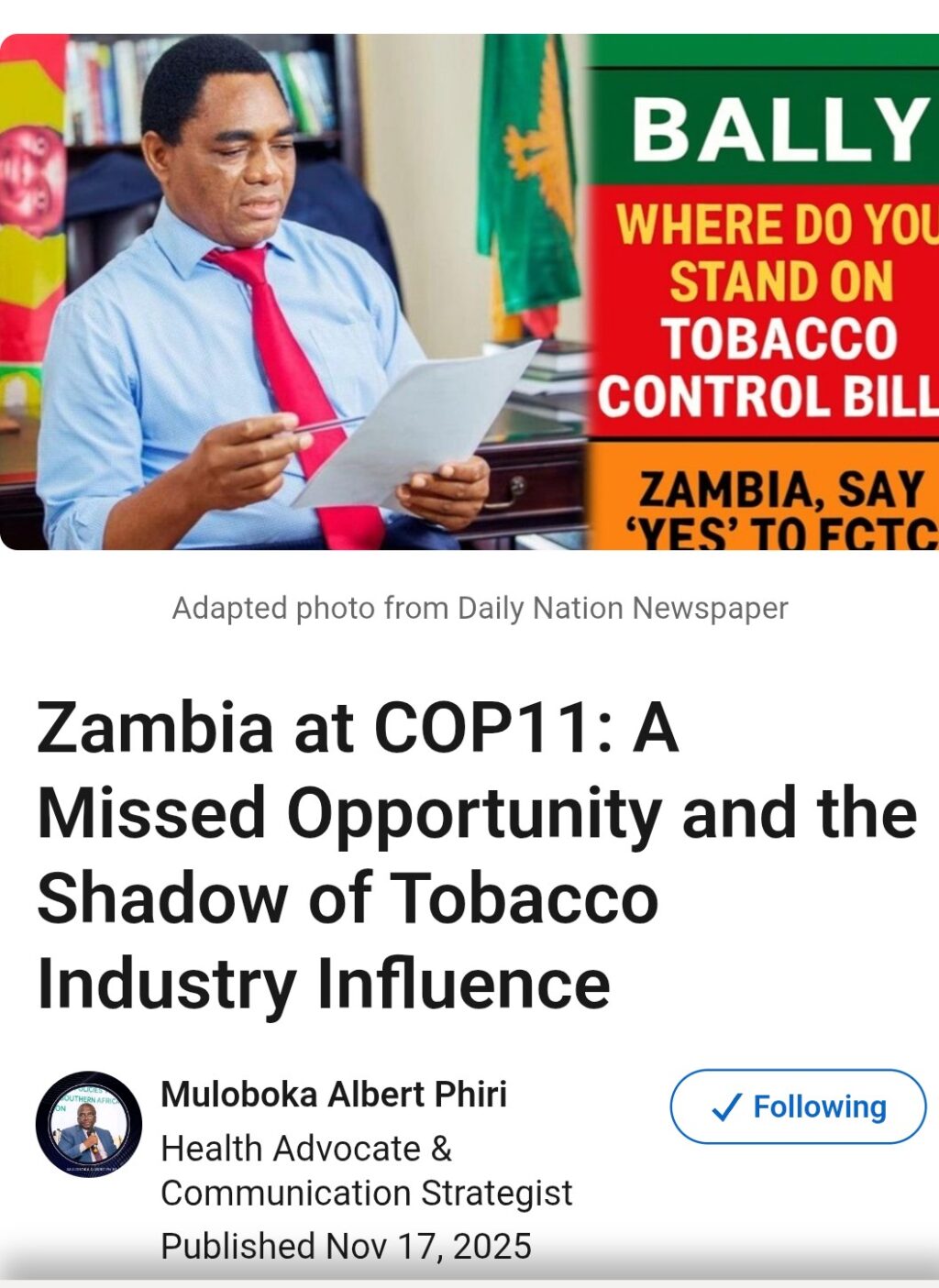

Zambia at COP11: A Missed Opportunity and the Shadow of Tobacco Industry Influence

Muloboka Albert Phiri
Health Advocate & Communication Strategist
Where Does the President Stand?
By Muloboka Albert Phiri
At the opening of COP11, Zambia’s delegation had a golden opportunity to lead. Since ratifying the WHO Framework Convention on Tobacco Control (FCTC) in 2008, our country has yet to domesticate it into law. This was the moment to pledge comprehensive legislation—smoke‑free environments, advertising bans, graphic warnings, and taxation that reduces affordability.
Instead, the speech leaned on “livelihoods,” “feasibility,” and “cost.” These are familiar refrains—not from public health advocates, but from the tobacco industry itself. When government representatives echo such narratives, it raises legitimate concerns about state capture: the quiet alignment of policy with corporate interests at the expense of citizens’ health.
Zambia’s declining score on the Global Tobacco Industry Interference Index only deepens the alarm. Without Article 5.3 safeguards to insulate policy from industry influence, our progress will remain fragile. And without domestication of the FCTC, we risk leaving loopholes wide open for exploitation.
Civil society has already spoken with clarity. The Tobacco Control Consortium of Zambia and ZANACODA recently held a press conference urging decisive leadership. The question now is not what civil society demands—it is what the President himself believes.
As Head of State, President Hakainde Hichilema is Zambia’s public health defender number one. He must tell the nation whether the COP11 speech represents his stance. Does he stand with the youth, the mothers, the teachers, and the health workers burying loved ones lost to tobacco‑related disease? Or does he stand with delay and industry narratives that compromise our future?
The Tobacco Control Bill has been deferred for nearly two decades. Each year of silence means more preventable deaths, more families pushed into poverty, and more children targeted by aggressive tobacco marketing.
Mr. President, the time for ambiguity is over. The nation deserves clarity:
- Will you champion the domestication of the FCTC?
- Will you insulate policy from industry interference as Article 5.3 requires?
- Will you expedite the Tobacco Control Bill and treat it with the urgency it deserves?
Silence is no longer neutrality—it is complicity. Zambia’s credibility at COP11 and beyond depends on your answer.
Mr. President, where do you stand?
#TobaccoControl
#PublicHealth
#Accountability
#Zambia
#FCTC
#KwenyuTheTo#TobaccoControl


More articles by this author
Explore content categories



Health Advocate & Communication Strategist
2d
Tagging, His Excellency President of the Republic of Zambia -Mr. Hakainde Hichilema alongside key allies in tobacco control: World Health Organization African Region,Ministry of Health of Zambia, @Ministry of Foreign Affairs and International Relations Zambia, African Tobacco Control Alliance (ATCA)Campaign for Tobacco-Free Kids, NCD Alliance, centre for trade policy development ctpd,Centre For Primary Care Research – CPCR,Fastone Goma, Bintou Camara Bityeki, Master Chimbala, Brenda Chitindi, Zunda Chisha, PhD,cosmas zyambo, McCabe Centre for Law & Cancer and colleagues engaged in #COP11 advocacy. Together, we call for decisive leadership on the Tobacco Control Bill. Silence is no longer neutrality—it is complicity. #TobaccoControl #FCTC #PublicHealth #Zambia#Accountability #YouthAdvocacy #KwenyuTheTobaccoControlBill