UN International Day for South–South Cooperation: Global Leaders Converge at ICRISAT Webinar and Pledge to Share Scalable Solutions
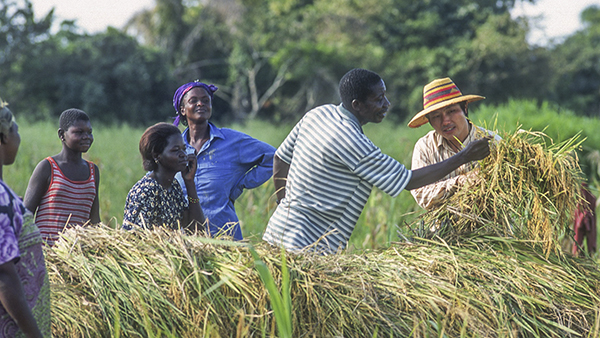
12 November 2004, Ghana - Rice harvest. FAO Project: UTF/CHINA/027/GHA - Special Programme for Food Security Phase I. The Objectives are to increase smallholders' productivity and improve household food security at selected sites representing the different farming/irrigation systems through sustainable use of improved agriculture technologies; Develop management capacities of farmers and farmers associations; Demonstrate, test and adjust a process for assisting farmers to benefit from improved technology on a sustainable basis.
Monday September 15, 2025
To mark the United Nations Day for South–South Cooperation 2025, ICRISAT organized a high-level webinar on “Scalable Solutions for Crop Improvement and Production Technologies for the Global South” under the aegis of the ICRISAT Center of Excellence for South–South Cooperation in Agriculture (ISSCA) on 12 September 2025.
Chaired by Dr Himanshu Pathak, Director General, ICRISAT, the inaugural session set the tone for collaboration and knowledge exchange. In his opening remarks, Dr Pathak welcomed global leaders and over 1000 participants, highlighting the Global South’s role in driving scalable agricultural solutions. He emphasized that “It’s not just the scientific output but how we share and inspire each other.”
Special messages from eminent leaders underscored the urgency of collective action:
Congratulating ICRISAT for organizing this webinar, Dr Qu Dongyu, Director-General, FAO commented, “On this occasion, let us reaffirm our commitment that no region, no country, no community, and no farmer should be left behind. The innovations of the Global South are powerful, and our collective responsibility is to scale them further, faster, and more equitably.”
Wishing all the participants a fruitful and engaging session, Dr Ismahane Elouafi, Executive Managing Director, CGIAR, stated, “South–South collaboration is central to our work. Together with our partners, CGIAR is co-developing scalable technologies and agricultural solutions that address national priorities and putting them into the hands of those who need them most.”
Dr M.L. Jat, Secretary, Department of Agricultural Research and Education (DARE) and Director General, Indian Council of Agricultural Research (ICAR), highlighted the Government of India’s strong focus on advancing South–South collaboration. He emphasized, “We cannot afford to reinvent the wheel. Some solutions are already proven in certain regions, and South–South Cooperation provides the platform to adapt and scale them. India remains strongly committed to South–South Cooperation.”
Professor Sachin Kumar Sharma, Director General of the Research and Information System for Developing Countries (RIS), a policy think tank of the Global South, commented, “The Global South doesn’t wait for solutions; it creates them. The task before us is clear—we must create linkages and platforms that enable innovation to move swiftly and effectively across the Global South.”
Adding to these high-level remarks, leaders from CGIAR centers shared their perspectives on the role of the Global South in driving agricultural transformation.
Dr Aly Abousabaa, Director General of ICARDA, emphasized the critical importance of homegrown solutions, noting that innovations developed within the Global South are often the most relevant.
Dr Yvonne Pinto, Director General of IRRI, highlighted the power of collaborative innovation and shared solutions to advance research and ensuring food and nutrition security for millions.
Dr Bram Govaerts, Director General of CIMMYT, called for a new paradigm of Food Sovereignty 2.0, underlining that tackling global challenges such as climate change, conflict, and trade disruptions requires collaboration and generosity across borders to build resilient and equitable food systems.
The technical session brought together senior leadership from CGIAR and national agricultural research systems (NARS), including Dr Devendra Kumar Yadava, Deputy Director General (Crop Science), ICAR; Dr Hugo Campos, Deputy Director General for Science and Innovation, CIP; Dr Becerra Lopez-Lavalle Augusto, Deputy Director General – Research, ICARDA; Dr Sankalp Bhosale, Director, Breeding Division, IRRI and Dr Yashpal S. Saharawat, Director – Resilience and Environment, IFDC. Each speaker showcased scalable research outputs and shared strategic insights to advance crop improvement, breeding innovations, resilience building, and sustainable production technologies.
Dr Stanford Blade, Deputy Director General – Research & Innovations, ICRISAT, provided an overview of ICRISAT’s ISSCA platform, highlighting ICRISAT’s key contributions such as the development of heat-tolerant pigeonpea, the establishment of the Dryland Academy, and pioneering work on resilient farming systems. He also moderated the Q&A session, facilitating an engaging dialogue with participants.
Submit Your Scalable Solution to ISSCA
The lively discussions highlighted practical pathways for accelerating impact, supported by successful examples of regional collaboration. Mr Sanjay Agarwal, Assistant Director General, ICRISAT presented the vote of thanks and closed the session with a strong reaffirmation of the ICRISAT Center of Excellence for South-South Cooperation in Agriculture (ISSCA) to serve as a hub for sharing knowledge, co-developing innovations, and scaling proven solutions across geographies. With over ninety scalable innovations from CGIAR institutions and NARS partners already featured on the ISSCA platform, the discussions concluded with a strong global call to submit additional scalable innovations that can advance agricultural cooperation.
The voices of global leaders collectively highlighted that ISSCA is not just a platform but a movement—where collaboration, trust, and shared innovation will shape the future of resilient and equitable food systems in the Global South.
This work aligns with SDGs 2, 17, 1,12 and 13.
For media inquiries, please contact:
Director – Communications
ramon.peachey@icrisat.org
www.icrisat.org
Parkavi Kumar
Parkavi Kumar
Senior Communications Specialist – Asia
parkavi.kumar@icrisat.org
+91 (40) 30713296
www.icrisat.org