The fallacious, dangerous logic of “Chinese overcapacity” rhetoric
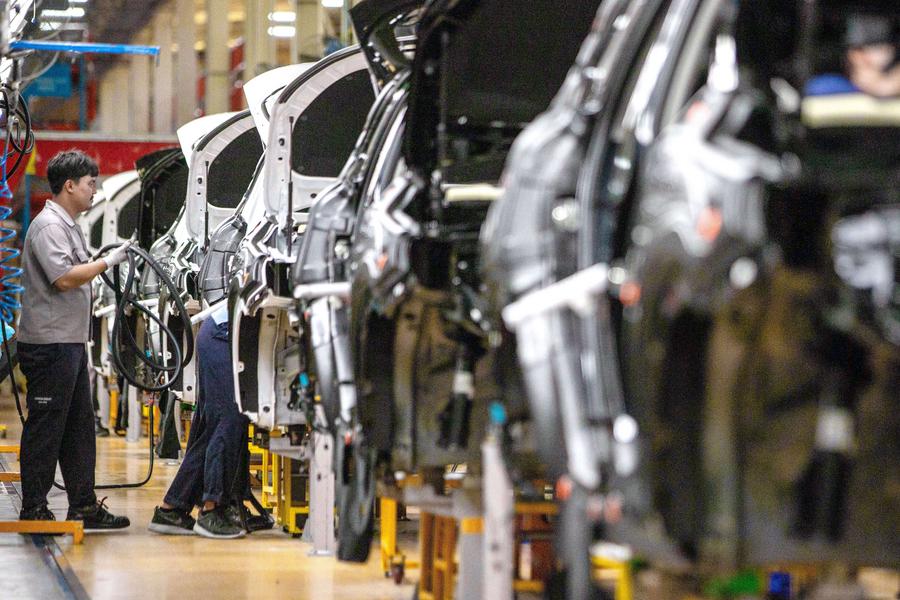
(240520) -- BEIJING, May 20, 2024 (Xinhua) -- A man works at the SAIC Motor-CP manufacturing plant in Chonburi, Thailand, Sept. 7, 2023. (Xinhua/Wang Teng)
Source: XinhuaEditor: huaxia2024-05-20 21:46:33
* The rhetoric of “Chinese overcapacity” contradicts factual evidence and fundamental economic principles.
* At a time when the world is grappling with climate change and economic stagnation, the burgeoning new energy sector in the world’s second-largest economy holds profound significance for global development.
* Trade protectionism disrupts the stable operation of the global NEV industry chain and could impede the progress of sustainable development worldwide.
BEIJING, May 20 (Xinhua) — China’s booming new energy vehicle (NEV) sector recently drew scrutiny for purported “Chinese overcapacity” from certain Western nations.
To provide clarity on the industry’s landscape to a global audience, three government officials and an industry expert joined the fifth episode of the China Economic Roundtable, an all-media talk platform hosted by Xinhua News Agency.
They elucidated why such assertions lack merit, outlined the significance of Chinese NEVs in the global shift towards sustainability, and disclosed the political underpinnings of Western containment strategies and protectionist measures.
THE OVERCAPACITY FALLACY
The rhetoric of overcapacity contradicts factual evidence and fundamental economic principles upon a closer examination of the supply-demand relationship, global labor division, and future developmental trajectories, the panelists said.
In 2023, China’s NEV sales reached 9.49 million units, slightly lower than the production of 9.59 million units. Nonetheless, Huo Fupeng, a National Development and Reform Commission (NDRC) official, clarified that this slight production surplus does not signify overcapacity. Instead, it fosters competition and technological advancements.
Huo explained that as innovative firms upgrade technologies to capture larger market shares, outdated capacities will naturally phase out, leading to a dynamic equilibrium. Assessing the NEV sector’s condition solely through a supply-demand lens fails to align with economic principles, he said.
While certain Western nations have portrayed China’s escalating NEV exports as evidence of overcapacity, the speakers refuted this narrative, asserting that export-based reasoning also cannot hold water.
He Hailin, a Ministry of Industry and Information Technology official highlighted that a nation’s production capacity surpassing domestic demand is a common phenomenon globally as it mirrors comparative advantages and results from labor division.
“For instance, 80 percent of U.S.-manufactured chips are exported, 50 percent of Japanese cars are sold overseas, and nearly 80 percent of Germany’s auto output is shipped to foreign markets,” Ding Weishun, a Ministry of Commerce official, said.
In contrast, China predominantly caters to its domestic market and China’s NEV exports constitute a small portion of its total production. While approximately 9.59 million NEVs were manufactured in the country last year, only about 12 percent of them were exported.
Looking ahead, amidst a global push for sustainability, there is a huge demand for China’s new energy products. As a proactive response to the global green and low-carbon transition, China’s thriving sectors like NEVs, wind power, and photovoltaics have gained more prominence, Huo said.
This photo taken on May 11, 2024 shows wind turbine blades at a wind power equipment manufacturer in Baotou, north China’s Inner Mongolia Autonomous Region. (Xinhua/Lian Zhen)
GLOBAL BENEFITS
The speakers said that at a time when the world is grappling with climate change and economic stagnation, the burgeoning new energy sector in the world’s second-largest economy holds profound significance for global development.
Last year, Chinese-made NEVs were exported to over 180 countries and regions, including France, Thailand, and Indonesia, showing their appeal among global consumers.
Ding said Chinese-made NEVs are a cost-effective option for prospective car owners. These vehicles have extended the convenience of personal transportation to more people and met the surging global demand for eco-friendly transportation solutions.
Globally, the pursuit of green growth necessitates access to high-quality, affordable, and sustainable products and technologies, Huo said, pointing out that China has made its share of contribution through the development of new energy vehicles.
Huo noted that China’s NEV industry has grown rapidly over the past years, coinciding with the country’s announcement of its dual carbon goals and a global acceleration towards a green economy.
During the process, China has also played an exemplary role in enhancing global climate governance, as it has facilitated global climate governance and provided practical experience for other countries, according to Qu Fengjie, a researcher with the Academy of Macroeconomic Research under the NDRC.
The speakers said the rise of China’s NEVs could catalyze an upgrade in the global auto industry, fostering an ecosystem that embraces both collaboration and competition.
Huo observed that leading automakers in the world have opted to establish manufacturing plants and research facilities in China. This strategic move is advantageous for their NEV technology innovation and the shift towards NEV production.
Through competition and cooperation with overseas peers, Chinese automakers have cultivated a robust competitive environment, Qu said, citing the case of Tesla as an example of healthy rivalry among domestic and foreign car manufacturers.
With the swift expansion of the new energy industry, a surge in job creation is anticipated, and related sectors are expected to experience faster growth. As a strategic emerging industry, the sector is poised to become a new engine for global economic expansion, Qu said.
People visit the 2024 Beijing International Automotive Exhibition in Shunyi District, Beijing, capital of China, April 25, 2024. (Xinhua/Cai Yang)
REAL DANGER: TRADE PROTECTIONISM
In recent years, globalization and trade multilateralism have faced some headwinds due to slowing economies and domestic politics in some countries, thereby giving rise to trade protectionism.
The specter of trade protectionism has cast a shadow over the global economy, with critics arguing that such policies contradict the principles of open markets and international cooperation.
Huo was forthright in his criticism, stating that trade protectionism fails to resolve internal industrial issues and disrupts the stable operation of the global NEV industry chain.
The fallout from protectionist policies extends beyond economic disruption. Huo warned that such measures are not conducive to global low-carbon transformation. With China contributing significantly to the global renewable energy capacity, protectionism could impede the progress of sustainable development worldwide.
Ding also voiced concerns, arguing that it impacts the green transformation and undermines the global collective efforts to address climate change.
“It is like waving the banner of green development on one hand while brandishing the club of protectionism on the other,” Ding said. “This is a classic case of contradiction, which can be described as ‘double-standardism.’ Ultimately, it will also harm the realization of global green, low-carbon development and climate goals.”
Qu added a critical perspective on the political motivations behind U.S. protectionism, suggesting that it is used as a tool to criticize China’s economic system and development model, creating ideological opposition and weakening China’s influence and reputation in the international community.
(Video reporters: Du Rui, Guan Guifeng, Li Linxin, Xiao Zhengqiang, Li Chang, Yang Zhigang, Hao Xiaojiang, Liu Yang, Dong Shuo and Ruan Shuai; Video editors: Zhang Li, Li Qin and Wei Yin) ■
You may like
Lake Namtso to enter tourism season in Xizang
Aerial view of terrace in SW China’s Guizhou
China’s Fujian accelerates development of clean energy
Forbidden City and Palace of Versailles: witnessing Sino-French cultural exchanges
New museum on Qin, Han dynasties opens in China’s Shaanxi
Artists stage performances during 8th China-Russia Expo in China’s Harbin