Israel partnerships in Africa: Are there benefits?
“Projects in countries like Ethiopia, Zambia, and Angola illustrate how infrastructure and agricultural programmes have resulted in significant debt and under-deliverance, with local social services and development budgets squeezed to meet repayments”
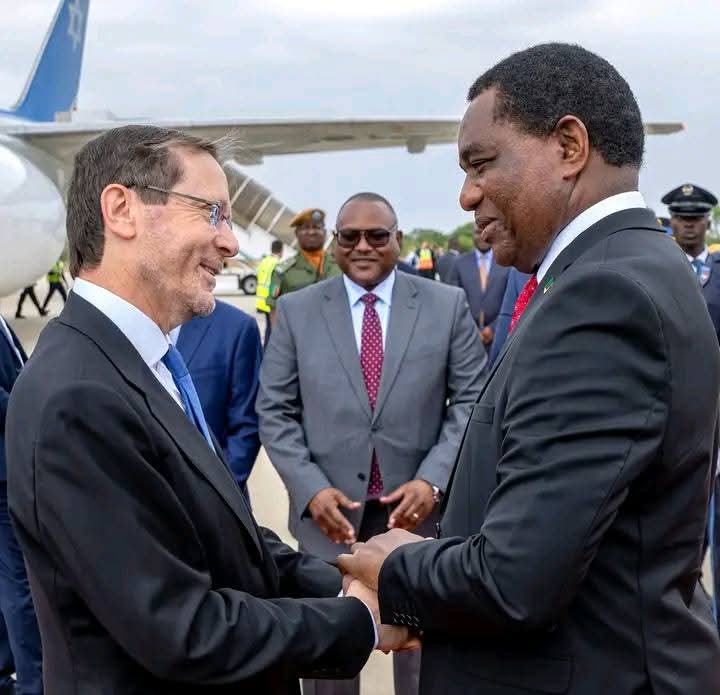
Foreign Affairs and International Relations Minister, State Counsel Mulambo Haimbe (centre), witnessed Israeli President Isaac Herzog welcomed by Zambian President Hakainde Hichilema at Kenneth Kaunda International Airport (KKIA) on a 2025 bilateral visit strengthening collaboration in key sectors such as agriculture, health, education, technology, trade, and investment, built upon the General Framework Agreement of Cooperation signed in June 2023.
By Correspondent
In most cases Israel implements its foreign policy strategy in the guise of helping out developing countries, especially in Africa, when in fact the motive is strategically to reinforce its position and have a preferential treatment to its investment interest.
This approach has been deployed by most western developing countries over decades but it has proven to be a bad debt trap to poor and struggling economies like Zambia and others.
Israel methodology towards Africa promotes usage of the United States dollar, they impose loans in US$ on sovereign guarantees on Africa governments.
Furthermore, insurance of Israel projects in Africa is done by Israel’s Export Credit Agency.
This is strategically so in that in an event that an Israel project in Africa fails, all Israel investors can retain their money with the help of the Israel Credit Agency and African governments have to pay their loans in full with interests.
“This financing methodology is already happening in some African countries, for example, Angola, Ethiopia, Uganda and Zambia,” the expert analyst said.
But how useful is the Israel partnership to African nations and is Israel aid nothing more than a debt trap for the struggling nations it claims to assist?
…as reported by the Mail and Guardian in its September 30, 2025 edition.
Strategic engagement under the guise of development:
Israel has expanded diplomatic, economic, and parliamentary ties across Africa—opening embassies and fostering Israel Allies Caucuses—framing this as “development cooperation,” but with underlying aims for political support and economic advantage.
In its latest move, Israel opened a new embassy in Zambia’s capital, Lusaka, after a 50-year absence. Foreign Minister Gideon Sa’ar called it part of the “alliance of believers,” adding that, “strengthening our engagement with Africa is a strategic priority.”
Debt-linked aid structures:
Israeli “aid” often takes the form of buyer’s credits (financed in hard currency and insured by Israel’s export credit agency), which guarantee Israeli firms and banks upfront payment while shifting long-term debt burdens onto African states, potentially exacerbating fiscal strain.
Case examples of imbalance:
Projects in countries like Ethiopia, Zambia, and Angola illustrate how infrastructure and agricultural programmes have resulted in significant debt and under-deliverance, with local social services and development budgets squeezed to meet repayments.
Technology, security, and sovereignty costs:
Beyond agriculture, deals involving surveillance, cybersecurity, and military equipment create ongoing financial liabilities and raise concerns about political repression, human rights abuses, and erosion of sovereign policy space.
Geopolitical implications and criticism:
The article in the Mail & Guardian frames these partnerships as asymmetrical and extractive rather than mutually beneficial, warning that engagement with Israel may compromise African economic resilience and ethical foreign policy, especially amid global scrutiny of Israel’s actions in Gaza.
As the world increasingly unites in criticizing the Zionist regime’s occupation and war on Gaza, amplified by the UN declaring it a “genocide of the Palestine people,” Israel is looking to Africa as a soft power destination. It hopes the pivot to the continent will translate to UN votes and economic benefits.
This explains the radical intensification of its diplomatic efforts in Africa, which saw six new Israel Allies Caucuses launched in African parliaments in Ethiopia, Cote d’Ivoire, Lesotho, Seychelles, Gabon and Guinea-Conarkry in July 2025. In April 2024, Malawi opened an Embassy in Israel and the Africa-Israel Parliamentary Summit was held in Addis Ababa in September.
Alternative partnership for Africa
Economic, Trade and Investment benefits for African countries from engagement with BRICS and the SCO
Nonetheless, as the global south pushes in developing a world order that balances both geo political and economic power, world economic and investment blocs such as the BRICS and the Shanghai Cooperation Organisation (SCO), offer far much better investment and financial alternatives to Africa with a win-win situation.
Since its formation, the BRICS has kept on growing in membership, Indonesia officially recently joined as a full member, becoming the first Southeast Asian nation to do so.
Several countries—Belarus, Bolivia, Kazakhstan, Cuba, Nigeria, Malaysia, Thailand, Vietnam, Uganda, and Uzbekistan—were welcomed as BRICS partner nations.
Based on Purchasing Power Parity (PPP)
The BRICS collective economic size, Gross Domestic Product (GDP) is now hovering around 40 percent of the entire global growth. The combined BRICS’ GDP is now surpassing that of the whole developed western world put together.
The BRICS countries together — Brazil, Russia, India, China, South Africa (and in some expanded definitions including newer members and partners) — accounting for this 40 percent of global GDP (PPP) means the rest of the world accounts for the remaining 60 percent of global GDP (PPP).
According to the International Monetary Fund (IMF) projection for the close of 2025, global GDP will be around $117 trillion. Meaning the BRICS economies will contribute $46.8 trillion.
African countries’ engagement with BRICS and the SCO offers strategic opportunities to diversify economic partnerships, strengthen trade, and mobilise investment beyond traditional Western markets.
Economic and Development Finance Benefits
Access to alternative development financing, particularly through BRICS institutions such as the New Development Bank (NDB), which focuses on infrastructure, energy, transport, and industrialisation. Reduced dependence on traditional lenders and greater flexibility in development financing terms.
Support for South-South cooperation aligned with Africa’s development priorities.
Trade Expansion and Market Access
Enhanced access to large and fast-growing markets representing over 40% of the global population.
Opportunities to increase exports of value-added goods, agricultural products, and minerals to BRICS and SCO member states.
Improved trade corridors, logistics, and customs cooperation that support intra-African trade under the AfCFTA.
Investment and Industrialisation Opportunities
Increased foreign direct investment (FDI) in manufacturing, mining beneficiation, energy, digital infrastructure, and agro-processing.
Technology transfer, skills development, and industrial cooperation with emerging economies.
Opportunities to participate in global value chains and regional industrial hubs.
Currency and Financial System Diversification
Potential use of local currencies in trade settlements, reducing exposure to exchange rate volatility and dollar dependency.
Strengthened financial resilience through diversified monetary and trade arrangements.
Geopolitical and Strategic Advantages
Greater bargaining power in global economic governance and multilateral negotiations.
Ability to pursue a non-aligned, multi-partner approach to development and trade.
Enhanced cooperation on energy security, infrastructure development, and regional stability.
Overall Impact Engagement with BRICS and the SCO can support Africa’s goals of industrialisation, economic diversification, infrastructure development, and increased trade competitiveness, while complementing continental initiatives such as Agenda 2063 and the African Continental Free Trade Area (AfCFTA).
At the last 17th BRICS Summit held in Rio de Janeiro, Brazil on July 6-7, 2025, a joint declaration titled “Strengthening Global South Cooperation for More Inclusive and Sustainable Governance” was signed by leaders, committing to multilateralism, international law, and a fairer global order.
Over 126 commitments were made across areas including global governance, finance, health, AI, climate change, hunger eradication, and technology.
The Declaration outlined three pillars of cooperation: political and security, economic and financial, and cultural and people-to-people exchange.
Clearly, the African governments have more to benefit from the partnership or indeed membership with the BRICS and interactions with SCO.