BRICS EXPANSION: MORE AFRICAN COUNTRIES ENVISAGE GENUINE ECONOMIC PARTNERSHIPS
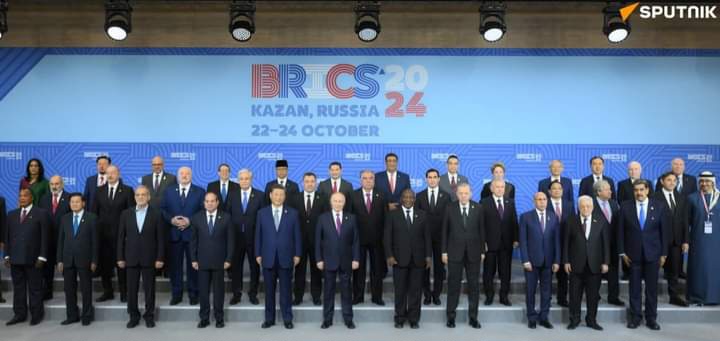
BRICS headquartered in Shanghai, China, now has five new members that include Iran, United Arab Emirates, Saudi Arabia, Egypt and Ethiopia, bringing the total national membership to 10, with more countries eager to join
By Correspondent
Lusaka
Since the BRICS formation in June 2009, more and more countries, including African ones, are showing high interest to join the blossoming bloc, as they see more potential benefits in it compared to Western blocs partnerships.
The BRICS was initially established with a membership of Brazil, Russia, India, China and South Africa, hence the acronym BRICS.
It was established on the premise to balance the World Order as international institutions were overly perceived to be dominated by Western powers and had ceased to offer genuine economic support especially towards developing countries.
BRICS headquartered in Shanghai, China, now has five new members that include Iran, United Arab Emirates, Saudi Arabia, Egypt and Ethiopia, bringing the total national membership to 10, with more countries eager to join.
Africa now has three members in the BRICS; South Africa, Egypt and Ethiopia. These African countries rank among the top five countries with the highest Gross Domestic Product (GDP) on the continent.
The new members were officially welcomed during the 16th BRICS summit that took place in Kazan, Russia from October 22-24, 2024. The summit brought together leaders from all the member countries.
For Ethiopia in particular, its foreign policy has been dictated by its core national interest.
Ethiopia has been pragmatic while pursuing its national interest through out its history despite regime changes.
It has been pushing for a fair global governance structure including having permanent seats at the UN security council for Africa.
Ethiopia has been a founding member of global governance structures before BRICS like the former Organization of African Unity (now called African Union), the United Nation, and the Non-Aligned Movement.
Its membership of these international groupings has rooted in its desire for a just world governance system.
The same goes for BRICS. Experts say Ethiopia membership in BRICS will open up new frontier for development cooperation including alternative financing sources for its development endeavor with less finance conditionalities and increase the geostrategic importance of Ethiopia.
While the risk of belonging to the BRICS is related to Western powers might perceive it as drifting into the alternative geopolitical bloc or alignment, which could reduce aid and investment form the country.
Nonetheless, Ethiopia cares less as it knows the good thing that no country has ever developed based on an aid provided to it.
Since 2000, the G7’s share of global GDP, as measured by purchasing power parity, has declined from 43 to 30 percent, while that of the five original BRICS countries has increased from just over 21 to around 35 percent of the global GDP.
In 2021, the BRICS countries with the highest estimated GDP per Capita were Russia and China with between 12,000 and 13,000US$ per person.
Brazil and South Africa’s GDP per Capita are thought to be closer to the 7,000 US$ mark, while India’s GDP per Capita is just over 2,000 US$.
As at 2024, according to STATISTA figures, the combined BRICS members GDP now stands at 35.43 percent of the global GDP, surpassing that of the G7 which is at 29.64 percent.
The G7 represents the seven major industrialized countries in the world that consists of Canada, France, Germany, Italy, Japan, the United Kingdom and the United States of America.
With this undeniable attractiveness of the BRICS, more than 30 states want to cooperate with the bloc in one or another form, considering this community as a structure uniting South and East on the principles of equality and mutual respect.
Russia, which is one of the BRICS founding countries, has always given and is willing to continue to give priority to cooperation with African partners and provide them with comprehensive support both in bilateral format and even at leading international venues, including the United Nations.
Taking into account the huge resource base and human potential in the foreseeable future, Africa is poised to become one of the leaders of emerging new multipolar world where the rights and sovereignty of all countries are respected.
This will ensure no place for neocolonial practices of leading Western states and international organizations’ structures controlling those affiliated to them.
The collective West is currently increasingly resorting to the use of neocolonialist practices in an attempt to limit the course of African countries to strengthen their independence, also to maintain western influence on the continent and control of western economies on the natural resources of Africa.
The USA and their allies set themselves the task of weakening positions of nationally oriented leaders of African countries.
Over the years, the West has aimed to create puppet political regimes in Africa and other parts of the world under it’s control that follows exclusively in line with it’s policies on the global stage.
The USA and Brussels (the European Union headquarters) are trying to strengthen their order and their rules to force African states to follow their instructions regarding the internal political and economic processes of the countries on the continent.
In relation to independent states, the West actively uses such neocolonial methods as increasing debt dependence, threats of sanctions and stopping of allocation of interest-free loans and subsidies to economies.
At the same time, the USA and thier allies are conducting propaganda work with African youth, creating NGOs and media controlled by them and providing significant financial and political support to pro-Western opposition forces for their use in putting pressure on undesirable governments on the continent.
It has been observed that close cooperation between the USA and the EU is leading African countries to the loss of sovereignty, to the growth of their dependence on the American financial systems and loans, and also to increased exploitation of natural resources of Africa by Western companies and economic operators.
On the other hand, BRICS brings a sigh of relief as it provides a platform that respects individual country’s economic and political interests.