Digital Innovations Take Center Stage in the Global Fight Against Red Palm Weevil
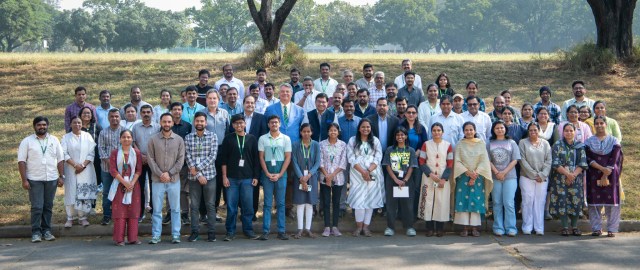
Launch of Workstream 3 – Digital Innovations under the Consortium for Red Palm Weevil Control at ICRISAT, Hyderabad

“In many communities in the Middle East, date palms are spoken of as a mother—so we can imagine the devastation when this pest destroys them,” said Dr Stanford Blade, Deputy Director General – Research and Innovation, ICRISAT.
“Through this consortium, we’re directing science to turn this crisis into practical solutions and new opportunities,” he added.
Led by ICARDA (International Center for Agricultural Research in the Dry Areas), C4RPWC is structured around five workstreams: 1-Innovative bio-based solutions, 2-Biotechnological innovations, 3-Digital innovations, 4-Good Agricultural Practices/GAP innovations, and 5-Driving adoption and scale-up. The Hyderabad event specifically marked the start of Workstream 3, focused on building and validating digital monitoring and early warning tools that can detect the infestation.

“Leading this workstream, ICRISAT will harness its multidisciplinary strengths from remote sensing, IoT, citizen science, and its five decades of expertise in dryland agriculture, to build a unified early-detection and early-warning framework for red palm weevil,” said Dr Srikanth Rupavatharam, Senior Scientist, Digital Agriculture, ICRISAT
“By bridging science with digital innovation and strengthening partnerships, we will ensure the outcomes remain affordable, operationally feasible, and ready for use in the field,” he added.
The workstream brings together experts from ICRISAT and ICARDA and CGIAR’s Digital Transformation Accelerator, in collaboration with Prof Christian Nansen, Professor, University of California, Davis, and Founder, Spectral Analytix, to reframe RPW management with a special focus on prediction.
“Despite decades of research and investment, we still do not have a single solution that can contain this pest. This consortium, therefore, is both timely and necessary,” said Dr Ajit Govind, Senior Climate Scientist and Systems Modeler, ICARDA.
“If we continue to look for the problem only where it is visible, we will always be late. The ambition is to detect ‘Stage minus two’, to identify vulnerability before infestation happens,” added Prof Christian Nansen from UC Davis & founder of Spectral Analytix.

Reinforcing the urgency, ElShafie Hamadttu, Red Palm Weevil (RPW) expert, ICARDA, joined the event virtually and underscored the need to detect infestation before damage becomes irreversible. Dr Debi Sahoo, digital agriculture expert, ICRISAT, presented a multi-stage digital methodology to track infestation progression from early, symptom-free stages, sparking multidisciplinary discussions spanning entomology, epidemiology, socioeconomics, indigenous knowledge, and farmer-centered design.
Connecting the initiative to CGIAR’s broader agenda, Mr Ram Dhulipala, Interim Director, CGIAR Digital Transformation Accelerator, linked the workstream to CGIAR’s 2030 Research and Innovation Strategy, emphasizing how digital systems can integrate data streams, accelerate access, and improve delivery at scale.
Over the next three years (2026–2028), partners will move from algorithms to field trials and from pilots to scalable platforms, combining in-situ sensors, UAVs, satellite imagery, weather data, and analytical models to generate actionable early warnings. The goal is to develop a field-usable, affordable package of practices and tools to prevent and manage RPW infestation—protecting palms, livelihoods, and ecosystems.


About Consortium of Red Palm Weevil Control (C4RPWC) Program: A Global Program to Protect Palms, Livelihoods, and Ecosystems: The proposed three-year program is an ambitious, international, and multi-institutional program (Consortium for Red Palm Weevil Control (C4RPWC) Program) designed to combat the Red Palm Weevil (RPW), a devastating pest that threatens palm cultivation globally. Led by ICARDA, the program aims to develop, test, adapt, and pilot innovative, sustainable science-based and environmentally friendly solutions to manage and contain RPW infestations. With the United Arab Emirates (UAE) as a focal point, the program will develop and establish scalable strategies that can extend to other low- and middle-income countries (LMICs) affected by this invasive pest. Read more
Share
Get updates in your mailbox
About The International Crops Research Institute for the Semi-Arid Tropics
The International Crops Research Institute for the Semi-Arid Tropics (ICRISAT) is a pioneering International Organization committed to developing and improving dryland farming and agri-food systems to address the challenges of hunger, malnutrition, poverty, and environmental degradation affecting the 2.1 billion people residing in the drylands of Asia, Sub-Saharan Africa, and beyond.
ICRISAT was established under a Memorandum of Agreement between the Government of India and the CGIAR on the 28 March 1972. In accordance with the Headquarters Agreement, the Government of India has extended the status of a specified “International Organisation” to ICRISAT under section 3 of the United Nations (Privileges and Immunities) Act, 1947 of the Republic of India through Extraordinary Gazette Notification No. UI/222(66)/71, dated 28 October 1972, issued by the Ministry of External Affairs, Government of India.
Our offices:
Asia: India (Headquarters – Hyderabad)
East and Southern Africa: Ethiopia, Kenya, Mozambique, Malawi, Zimbabwe
West and Central Africa: Mali, Niger, Nigeria
For all media inquiries, please email: info.comms@icrisat.org
Contact
Hyderabad, Telangana, India