UN World Soil Day 2025: Healthy Soils for Healthy Cities
UN World Soil Day 2025: Healthy Soils for Healthy Cities
Opinion piece by Dr Himanshu Pathak Director General, International Crops Research Institute for the Semi-Arid Tropics (ICRISAT)

On this UN World Soil Day, we are reminded that healthy soils are not only the foundation of life in rural drylands but are equally essential to the health and resilience of our cities.
This year’s theme, ‘Healthy Soils for Healthy Cities,’ highlights a simple yet powerful reality that the condition of rural soils shapes the water we drink, the food we eat, and the green spaces that make cities livable.
Even the most urban communities depend on the soils that sustain both smallholder farms and the broader food systems on which we all depend.
For billions of people living in the drylands of Asia and Africa, soil health is the first line of defence against hunger, climate stress and land degradation.
Yet dryland soils are under enormous pressure. Erratic rainfall, intensive land use, poor nutrient balance, and soil compaction steadily erode fertility and threaten long-term productivity.

As part of the CGIAR network, ICRISAT’s mission is to address these challenges through science, innovation, and practical action, ensuring that the soils sustaining rural communities can, in turn, support the cities that depend on them.
One of the clearest lessons from ICRISAT’s five decades of work across the semi-arid tropics is that soil knowledge must reach the people who manage the land every day, a principle reflected in many of our on-the-ground initiatives.
In Telangana, India, ICRISAT helped catalyse a remarkable shift through the state’s first Mobile Soil Health Testing Bus. This lab on wheels, built in partnership with the Laurus Charitable Trust, continues to serve rural villages.

It has already reached 22 communities in its initial phase and tested more than 2,400 soil samples.
The personalised soil health cards it provides empower farmers with information on nutrient balance, including often-ignored micronutrients that are crucial for crops like sorghum, millet, chickpea and groundnut.

The success of this approach offers a practical model that other States, and indeed other nations, can readily adopt, enabling soil management solutions to reach farmers more quickly and effectively.
Schools have also welcomed the mobile lab with enthusiasm. More than 1,500 students have participated in its hands-on learning activities, cultivating a new generation of soil-aware citizens.
These children will become future stewards of our food systems, influencing how urban and rural landscapes support one another.

Across Africa, a long-standing awareness of soil’s central role in agriculture is meeting a new wave of innovation and investment, supported in part by ICRISAT’s research and partnerships, aimed at restoring and managing dryland soils more effectively.
In Niger, farmers using improved millet and sorghum varieties, supported by better soil fertility management, coupled with fertilizer microdosing and natural regeneration techniques, have significantly increased yields in the Sahel and doubled yields even under harsh conditions.
In Kenya, ICRISAT’s climate-smart village initiatives are helping farmers adopt practices such as zai pits, composting, and residue retention to restore degraded soils.
In Malawi and Tanzania, efforts to blend organic manure with precision fertilizer use are helping farmers overcome chronic nutrient deficiencies while reducing input costs.

These stories are signs of a continent reclaiming the productivity and dignity of its dryland soils, mirroring the same determination we see in the drylands of India.
This shared progress underscores ICRISAT’s leadership in soil management and its commitment to advancing global knowledge systems.
Reflecting this commitment, soil scientists from eight institutions gathered last year at the CompacSol workshop, hosted by ICRISAT and organised by the Institut de Recherche pour le Développement (IRD), the French National Research Institute for Sustainable Development, to address soil compaction, one of the most overlooked threats to soil health.
Compacted soils restrict root growth, reduce water infiltration, and ultimately weaken agricultural systems, but the problem does not end on the farm.
Soil compaction is increasingly common in peri-urban and urban areas where heavy construction, poor landscaping, unplanned expansion, and vehicle pressure degrade the thin soil layers that support trees, recharge water, and regulate temperature.
Through CompacSol, ICRISAT is supporting regional efforts to standardise compaction assessment and build shared data repositories, contributing to the Global Soil Laboratory Network and strengthening soil science across Asia, Africa and beyond.
Better data means better decisions, and better decisions mean stronger soils that benefit both farmers and city residents.
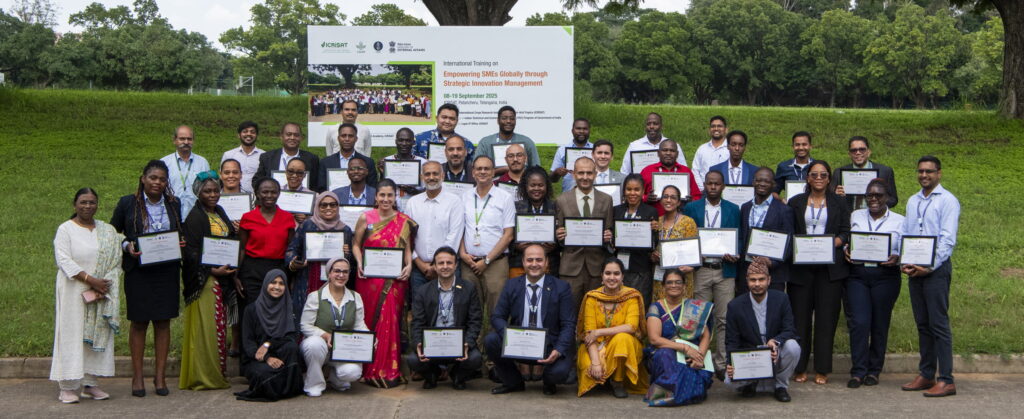
This commitment to practical and accessible innovation also shapes ICRISAT’s work with the next generation. Through Indian Technical and Economic Cooperation (ITEC) training delivered by ICRISAT’s Dryland Academy, the institute strengthens skills and deepens understanding in sustainable dryland agriculture.

This learning pipeline is further reinforced by the newly launched ICRISAT Centre of Excellence for South-South Cooperation in Agriculture (ISSCA), which equips agricultural policymakers with proven, scalable solutions in soil management and related areas, reflecting how diverse stakeholders can come together to advance stronger, more resilient soils for the future.
Building on this educational foundation, ICRISAT is also developing tools that resonate with today’s learners.
To make soil stewardship tangible for young people and farmers, ICRISAT developed MRIDA, an educational game app that enables users to explore how choices regarding fertilizer, crop diversity, residue management, or organic additions impact soil carbon and long-term fertility.
Across all this work, the message remains clear. Healthy soils sustain healthy rural communities, and these, in turn, strengthen the cities connected to them.
On this World Soil Day, ICRISAT urges governments, development partners, civil society, and farmers to deepen their commitment to soil stewardship and stands ready to work alongside them in advancing healthier, more resilient soils.
As part of the CGIAR system, ICRISAT is proud to champion soil health across the drylands. Our work, from village farms to global platforms, is guided by the belief that caring for soil means caring for people and the planet, because when we restore soil, we restore the promise of a better future for all.

Share
Get updates in your mailbox
About The International Crops Research Institute for the Semi-Arid Tropics
The International Crops Research Institute for the Semi-Arid Tropics (ICRISAT) is a pioneering International Organization committed to developing and improving dryland farming and agri-food systems to address the challenges of hunger, malnutrition, poverty, and environmental degradation affecting the 2.1 billion people residing in the drylands of Asia, Sub-Saharan Africa, and beyond.
ICRISAT was established under a Memorandum of Agreement between the Government of India and the CGIAR on the 28 March 1972. In accordance with the Headquarters Agreement, the Government of India has extended the status of a specified “International Organisation” to ICRISAT under section 3 of the United Nations (Privileges and Immunities) Act, 1947 of the Republic of India through Extraordinary Gazette Notification No. UI/222(66)/71, dated 28 October 1972, issued by the Ministry of External Affairs, Government of India.
Our offices:
Asia: India (Headquarters – Hyderabad)
East and Southern Africa: Ethiopia, Kenya, Mozambique, Malawi, Zimbabwe
West and Central Africa: Mali, Niger, Nigeria
For all media inquiries, please email: info.comms@icrisat.org
Contact
Hyderabad, Telangana, India