FROM THE REED MAT TO STATE HOUSE: THE EXTRAORDINARY JOURNEY OF PRESIDENT HAKAINDE HICHILEMA From a Village Cattle Herder to Zambia’s Highest Office A Philosophical Tribute on Resilience, Conviction, Tenacity and Leadership
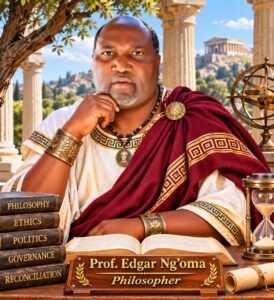
By Prof. Edgar Ng’oma
Philosopher and Distinguished Good Governance Fellow
INTRODUCTION:
- MY PERSONAL MESSAGE TO ZAMBIANS AND READERS ACROSS THE WORLD
Before paying this tribute to His Excellency President Hakainde Hichilema, Zambia’s seventh Republican President, allow me to sincerely address my fellow citizens and readers across the world.
I am conscious that I am writing at a sensitive moment in our country’s political history, following the August 2026 general elections and the disputes and differing political opinions surrounding their outcome.
I sincerely apologize to those who may consider the timing of this tribute inappropriate.
Let me emphasize that this article is not intended to pacify anyone, dismiss legitimate grievances, overlook political concerns or endorse every decision of the current administration.
As a philosopher, I believe we must distinguish between documenting an individual’s extraordinary life journey and evaluating his performance as a political leader.
Having previously documented the lives and leadership journeys of ten Presidents from the SADC and East African regions, I consider it appropriate to extend the same intellectual consideration to the President of my own country.
Political differences should never prevent us from acknowledging another person’s achievements, just as admiration should never prevent us from recognizing shortcomings.
I therefore write neither as a spokesperson for the ruling party nor as an opponent of the opposition, but as a philosopher interested in the lessons that human experience offers society.
My ultimate desire remains a Zambia founded upon truth, justice, forgiveness, reconciliation and peaceful coexistence.
- THE VILLAGE BOY WHO DEFIED HIS CIRCUMSTANCES.
History teaches us that greatness does not always begin in palaces, wealthy families or privileged surroundings.
Sometimes, extraordinary human journeys begin in the humblest environments imaginable.
Such is the story of President Hakainde Hichilema.
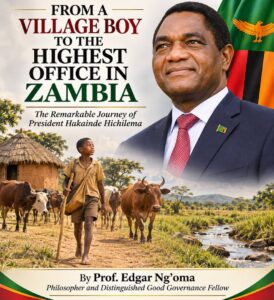
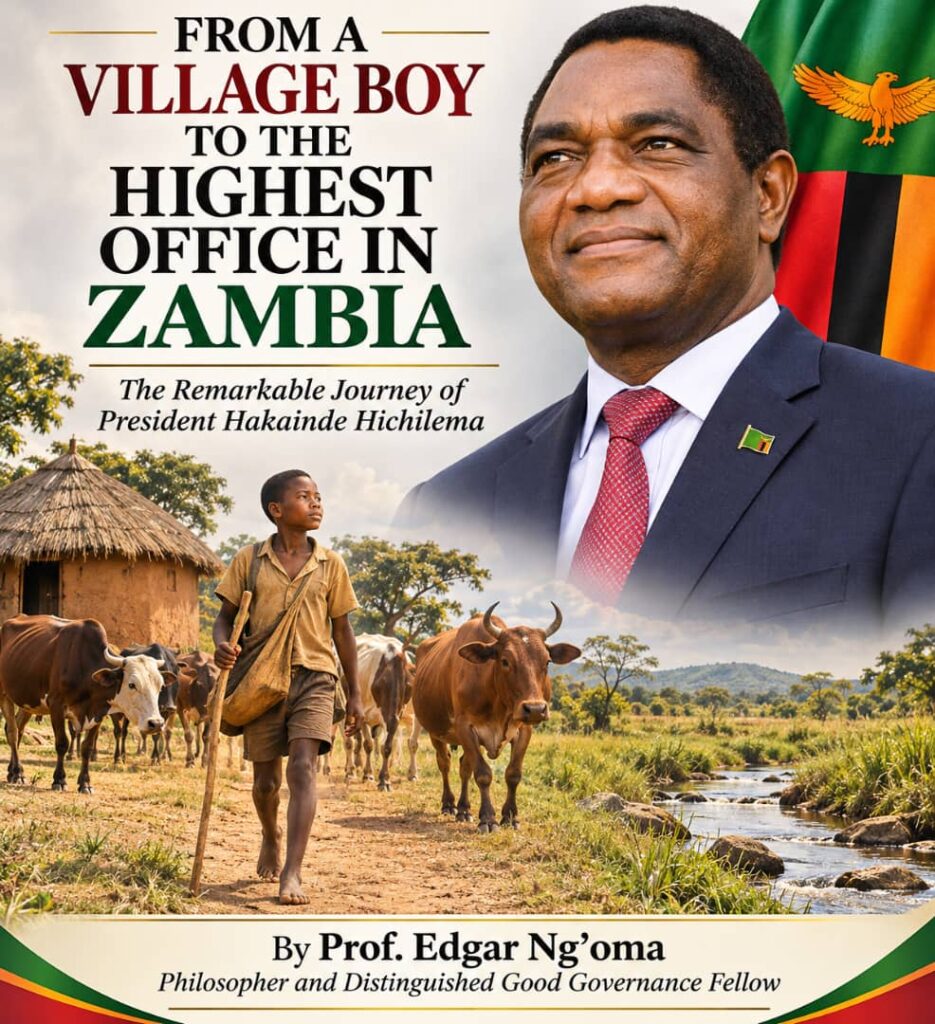
Imagine a little village boy born on 4 June 1962 in Hachipona Village, in the Chiefdom of Chief Hamusonde, Monze West, Monze District, Southern Province, in what was then Northern Rhodesia, two years before Zambia attained independence on 24 October 1964.” sleeping on a traditional reed mat spread across the earthen floor of a grass-thatched hut. A boy who woke up each morning to herd cattle, walked barefoot to primary school and drank water from a village stream also used by domestic animals and wildlife.
These are the humble childhood circumstances through which I wish to illustrate the remarkable distance between Hakainde Hichilema’s beginnings and his eventual achievements.
The same village boy who once slept on a reed mat would eventually occupy the highest office in the Republic of Zambia.
From a reed mat beneath a thatched roof to State House.
From walking barefoot along village paths to walking through the corridors of international institutions.
From herding cattle in the countryside to presiding over the affairs of an entire nation.
From drinking water drawn from a rural stream to sitting at the same table with Presidents, Prime Ministers and other world leaders.
Who could have imagined that this little village boy would one day become the seventh Republican President of Zambia?
This is the philosophical significance of his journey:
The circumstances of our birth do not necessarily determine the limits of our achievements. Poverty of material possessions must never be confused with poverty of intellect, character or potential.
- FROM A VILLAGE SCHOOLBOY TO AN INTERNATIONALLY EDUCATED ECONOMIST
Despite his humble rural beginnings, Hakainde Hichilema pursued education with determination.
He attended Mooya Primary School (1969–1972): He attended Grades 1 to 4 at Mooya, near his home village of Hachipona in Monze West, Southern Province.
He then attended Nkandela Primary School (1973–1975): He transferred to Nkandela, near Pemba, where his uncle was teaching, and completed Grades 5 to 7.
For secondary school he attended Kalomo Secondary School before proceeding to the University of Zambia, where he graduated in Economics and Business Administration in 1986.
He subsequently obtained a Master of Business Administration in Finance and Business Strategy from the University of Birmingham in the United Kingdom.
What a remarkable transformation!
The village boy who once walked barefoot to school had become an internationally educated economist.
His journey demonstrates that education can become a powerful instrument of personal transformation and social mobility.
A child may sleep on a reed mat while carrying within his mind the intellectual capacity to become a scholar, economist, entrepreneur or President.
- FROM HUMBLE BEGINNINGS TO BUSINESS SUCCESS
Following his education, Hakainde Hichilema entered the corporate world and rose to become Chief Executive Officer of Coopers & Lybrand Zambia, a predecessor firm of PricewaterhouseCoopers, and later Grant Thornton Zambia.
Through his professional career and investments, particularly in agriculture and other sectors, he became one of Zambia’s most prominent and wealthy business personalities.
The young boy who once herded cattle would eventually become a substantial cattle rancher and successful businessman.
His achievements demonstrate the importance of knowledge, discipline, enterprise and perseverance.
Nevertheless, wealth alone should never define human greatness.
The greatest value of personal success lies in the opportunities it creates for others. - THE MAN WHO REFUSED TO SURRENDER HIS POLITICAL DREAM
In 2006, following the death of Anderson Mazoka, Hakainde Hichilema became President of the United Party for National Development.
He subsequently contested five presidential elections without success: 2006, 2008, 2011, 2015 and 2016.
Many individuals would have abandoned their ambitions after repeated defeats.
But Hakainde Hichilema persevered.
He maintained his political convictions, kept his party together and continued participating in Zambia’s democratic process.
His political journey included considerable challenges, including a period of imprisonment in 2017.
Then came August 2021.
On his sixth presidential attempt, he emerged victorious and became Zambia’s seventh Republican President.
Five electoral defeats did not extinguish his ambition. His determination eventually carried him from opposition politics to State House.
Regardless of political affiliation, his journey offers an important lesson about resilience, conviction and the refusal to surrender one’s aspirations.
- WHAT THE YOUNG PEOPLE OF ZAMBIA MUST LEARN
My dear young people of Zambia,
President Hichilema’s journey offers lessons that transcend political differences.
Never despise your humble beginnings. Being born in a village does not make you intellectually inferior to someone born in a wealthy urban household.
Value education. Knowledge can open doors that poverty and difficult circumstances appear to have closed.
Never allow failure to destroy your determination. A setback may be painful, but it need not become the final chapter of your story.
Combine ambition with discipline and integrity. Success requires preparation, patience, effort and responsible choices.
Remember your origins when you succeed. Those who rise from difficult circumstances should strive to create opportunities for others facing similar hardships.
Above all, remember:
Your birthplace may explain where your journey began, but it does not have to determine where your journey ends. - A PHILOSOPHER’S REFLECTION: WAS HIS JOURNEY SCRIPTED?
As a philosopher, President Hichilema’s life invites me to reflect upon my proposition that human beings exist within a larger unfolding universal script.
Why did this particular village boy possess the determination to pursue education, succeed in business and persevere through repeated political defeats?
Why did his presidential breakthrough occur in 2021 rather than during his earlier attempts?
From my philosophical standpoint, his journey may be interpreted as an illustration of how circumstances, individual effort, opportunities and historical events converge to shape human destiny.
This is a philosophical interpretation, not a scientifically established law of predestination.
Nevertheless, his life reminds us that whatever our understanding of destiny, discipline, preparation and perseverance remain essential to human achievement. - MY PHILOSOPHICAL ADVICE TO PRESIDENT HAKAINDE HICHILEMA
Your Excellency,
You have already achieved what millions of people may only dream about.
You rose from humble rural beginnings to become an educated economist, a successful businessman and eventually President of the Republic of Zambia.
However, I respectfully submit that your greatest achievement should not merely be how far you have risen, but how many people will rise because of your leadership.
Never allow the grandeur of State House to erase the memory of the village from which you came.
Remember the reed mat upon which you slept, the thatched hut that sheltered your childhood, the bare feet that carried you to school and the stream from which you quenched your thirst.
For millions of Zambian children still face difficult circumstances today.
Let your leadership create opportunities for those children to access clean water, decent shelter, quality education, healthcare and meaningful economic opportunities. I would like to applaud for taking a bald decision as government to inact a law to allow primary and secondary education to be free.
Your Excellency, political power is temporary, but the consequences of leadership can endure for generations.
I therefore humbly encourage you to uphold justice, protect constitutional democracy, respect differing political opinions and remain receptive to constructive criticism.
Above all, I encourage you to make truth, forgiveness, reconciliation and national healing part of your enduring legacy.
A National Truth and Reconciliation Commission, established through an inclusive and constitutionally appropriate process, could provide an opportunity for Zambians to address historical grievances and strengthen national unity.
Such an undertaking should belong to all Zambians, irrespective of political affiliation.
A truly great President should seek not merely to win political contests, but to help build a nation in which political differences never destroy our common humanity and I strongly believe you are such a leader who can make Zambia great again. - THE GREATEST LEGACY IS A GOOD NAME
Your Excellency,
There is a profound difference between becoming a successful individual and being remembered as a great leader.
Wealth may bring comfort.
Political victory may bring authority.
But justice, humility, compassion and service establish an enduring moral legacy.
One day, your presidency will become a chapter in Zambia’s history.
When that chapter is written, may future generations remember not only the village boy who became President, but also the President who remembered the village boy.
May they remember a leader who respected the rights of those who disagreed with him, understood the struggles of ordinary citizens and worked towards a peaceful and united Zambia.
For the greatest monument a leader can build is not a structure bearing his name, but a good name preserved in the hearts of the people.
CONCLUSION:
FROM THE REED MAT TO STATE HOUSE
The extraordinary journey of President Hakainde Hichilema demonstrates the possibilities of human resilience, education, conviction and perseverance.
From a village cattle herder to an internationally educated economist.
From a successful businessman to an opposition leader who endured five electoral defeats.
And eventually, from humble rural beginnings to the Presidency of the Republic of Zambia.
His story offers encouragement to young people regardless of their political beliefs.
I conclude with this philosophical reflection:
“Your Excellency, you have already demonstrated that a village boy can rise from a reed mat beneath a thatched roof to become President of Zambia. May your greatest legacy now be to demonstrate that a President can lift the hopes of every village boy and girl in Zambia. For the true greatness of a leader is not measured by how high he rises above his people, but by how many people are able to rise because of his leadership.”
May wisdom guide your decisions.
May humility accompany your authority.
May justice strengthen your leadership.
And may truth, forgiveness and reconciliation contribute to the enduring unity of our beloved Republic.
ONE ZAMBIA, ONE NATION.
Prof. Edgar Ng’oma
Philosopher and Distinguished Good Governance Fellow
Proposer of the National Truth and Reconciliation Commission of Zambia