ECZ names the long awaited 70 new constituencies
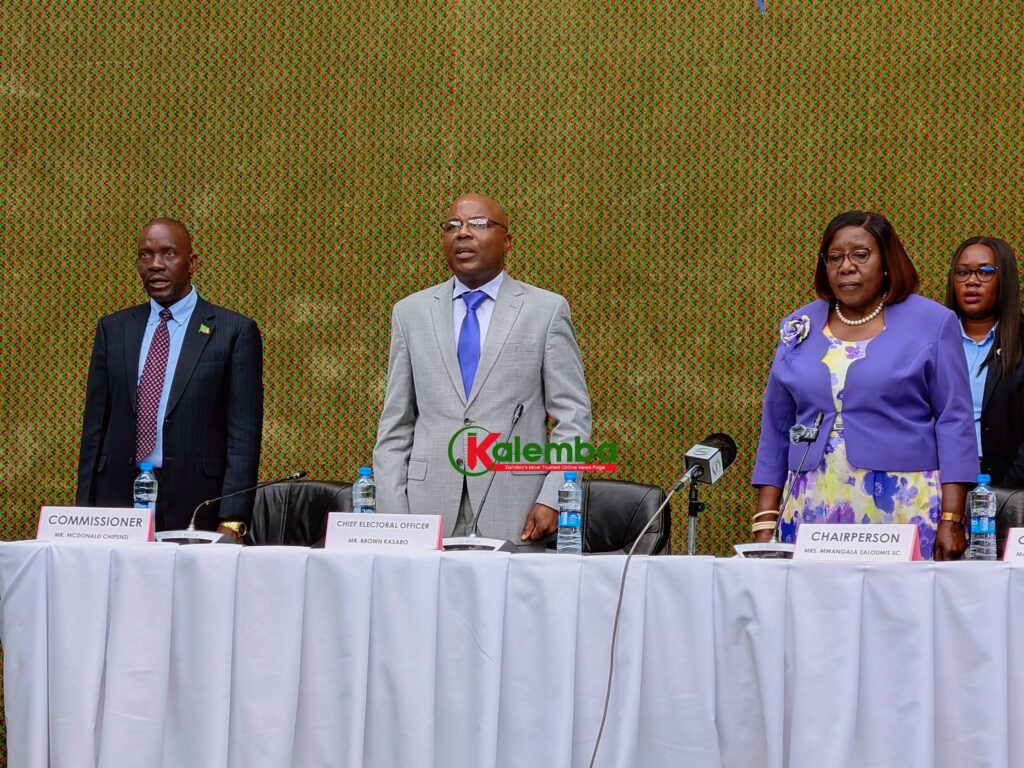
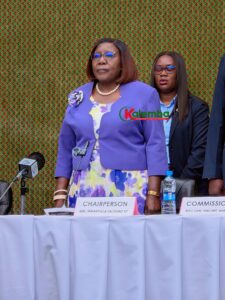
ECZ Chairperson Mwangala Zaloumis (right) with MacDonald Chipenzi (left)
…156 to 266 parley seats
By Juliet Makwama
The Electoral Commission of Zambia (ECZ) has announced the seventy newly created constituencies spread out in all the ten provinces, marking a significant milestorm, as this is the first time the country has over thirty constituencies being added to the electoral landscape at once.
With the newly created 70 constituencies, Zambia now has 226 constituencies which will come into effect after the dissolution of parliament on May 15, paving the way for Zambians to elect more representatives to the national assembly, a move that is aimed at encouraging fair distribution of resources across the country.
Announcing the names of the constituencies, ECZ Chairperson Mwangala Zaloumis reminded stakeholders that democracy is strongest when representation grows with the people and institutions work within the law, with national decisions being explained honestly and accepted peacefully.
Zambia had 75 constituencies at Independence in 1964, with 30 being added in 1968, 20 in 1973, 25 in 1991 and 6 in 2014, bringing the total then to 156.
The delimitation exercise has seen Central province having 8 more constituencies bringing the new total to 15, Copperbelt province has 7 bringing the total to 29, Eastern Province has 9 bringing the total to 29.
Luapula Province has 5 new constituencies bringing the total to 20, Lusaka Province has 6 bringing the new total to 18 and Muchinga Province has 6, bringing the total to 14.
Others are Northern Province with 6 new constituencies bringing the total to 19, Northwestern Province has 7 bringing the total to 19, Southern Province has 9 bringing the total to 29, and Western Province has 7, bringing the total to 26.
Ms Zaloumis explained that consultations were conducted in all the 116 districts across the country, and stakeholders identified issues related to delimitation such as surface area, remoteness, accessibility, geography, community cohesiveness, population growth, history and the practical challenges of representation.
“It is the Commission’s hope that the announcement we have made today shall strengthen confidence, deepen inclusion and reaffirm that in Zambia, constitutionalism remains the foundation of our democracy. Let us all be counted into Zambia’s democratic architecture starting with 2026 General Election,” Ms Zaloumis said.
She said the process of delimitation endeavours to improve representation by taking leadership closer to people and responding to changing settlement patterns including population growth.
“In determining the 70 constituencies, the Commission was guided by the factors as outlined in the Constitution which place a duty on the Commission to consider the history, diversity and cohesiveness of communities; population density, trends and projections; geographical features; means of communication; the need to keep constituencies within districts; and the need to pursue approximate equality of population while still protecting adequate representation for urban and sparsely populated areas,” Ms Zaloumis added.
And ECZ Chief Electoral Officer (CEO) Brown Kasaro said the names and boundaries of the new constituencies will be published in the government gazette, and that the commission will avail information related to the delimitation in various platforms.
The delimitation has seen Eastern Province having 9 more constituencies has Chadiza East, Chama Central, Chasefu North, Chipangali West, Chipata North, Lumezi South, Lusangazi Central, Malambo West and Nyimba North.
Lusaka has Lima as a new constituency born from Matero, with others in the province being Chilanga North, Chongwe West, Kafue East, Makeni and Roma, bringing the new total to 18.
Luapula Province has been given Kalungwishi, Chifunabuli North, Luongo, Mansa East and Mweru as new constituencies, with the total now standing at 20.
The newly created constituencies in Southern Province are Choma South, Itezhi-Tezhi West, Kalomo South, Kazungula North, Maramba, Magoye West, Monze East, Namwala East and Kariba.

And Bishops Council of Zambia President Martin Silungwe commended the ECZ for carrying out the delimitation exercise.
Bishop Silungwe called on stakeholders not to politicise the matter, as it is meant to ensure development is evenly distributed in the country, for the benefit of future generations.
On the Copperbelt Province, Konkola, Chingola West, Chambishi, Lufwanyama East, Kalalangabo, Mpongwe East and Dag Hammerskjoed are the new constituencies.
Others are Keembe West, Mwomboshi, Bwacha South, Kapiri Mposhi West, Mkushi South, Mumbwa West, Nkundalila and Mwembezhi West in Central Province.
In Muchinga Province, the new constituencies are Chilinda, Nkombwa, Lwitikila, Mafinga South, Mpika South and Mwezo.
Meanwhile, in North Western Province, the newly created constituencies are Kabompo West, Lumwana, Mufwashi, Dongwe, Mwinilunga East, Solwezi North and Zambezi Central.
The new constituencies in Western Province are Kalabo South, Luampa West, Lukulu South, Mongu East, Senanga North, Sesheke West and Shangombo North.
And in Northern Province, the new constituencies are Kundabwika, Kasama North, Luwingu Central, Saise, Mpulungu South and Mpanda.
Meanwhile, the ECZ CEO Mr. Kasaro emphasised that voters do not need new voters’ cards, as the polling stations indicated are still valid.