A generation at a crossroads: Addressing the growing pains of Zambia’s New Education Reforms

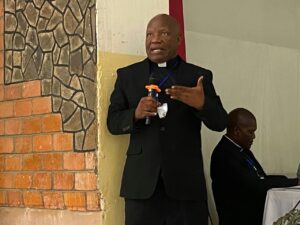
Samuel Kasankha (left) New Heritage Party (NHP) President Chishala Kateka (right).
By Bishop Dr Samuel Kasankha
INTRODUCTION
There is a quiet unease settling over staff rooms and school yards across Zambia. While the intentions behind modernising education, expanding access, and improving nutrition are widely supported, a chorus of concern is growing louder from those on the front lines.
Based on interviews with education authorities at various levels, teachers, learners, academics, parents, and independent observers, a clear picture emerges: well-intended programs may have been implemented too quickly, and without that urgency being matched by preparation, the very future of our learners is being placed at serious risk.

I write this not with anger but with a sense of deep, sober, ‘concerned’ responsibility. I appeal directly to the human hearts of our leaders in the Ministry of Education to look beyond the statistics and see the reality inside the classroom.
THE CORE CHALLENGE: A curriculum that came before its time?
The new School Curriculum, which is now replaced by the Competence-Based Curriculum (CBC) was last reviewed in 2013, so indeed, a reform was due. However, multiple education professionals have confirmed that the rollout was rushed. The result is a system operating without a complete map.

Teachers spoken to are not opposing the idea of competency-based learning. They express uniform alarm over the chaos of its implementation. According to several classroom educators, teaching guides and learner materials for Term 1 of Form 1 were only delivered at the start of the recently ended term, when learners were already moving into Form 2. There are no materials for the coming term. As one teacher put it: “We are not sure what pioneers will get out of this because we are doing things the way we understand them, not the way they ought to be done.”
Even the monitors cannot monitor properly. Education Standards Officers, Heads of Departments, and Head Teachers admit they do not have the proper instruments to evaluate the CBC lessons. They do not know what to look for during inspections. It is not unusual for Subject Associations and Subject Specialists to openly disagree on basic issues such as whether assessments should include multiple choice questions. In response, a flurry of what appear like panic-reaction workshops and conferences are consuming resources that should have gone to classroom equipment and general administration of schools.
THE INFRASTRUCTURE GAP: research, science, and ICT

The new curriculum demands research, hands-on science, and digital literacy. Yet the reality in most government schools tells a different story.
Parents with children in Form 1 and 2 are urged to ask their wards simple questions. Ask your child in a large government school of over 100 pupils per class whether they have ever touched a functional computer. Ask your child in a boarding school whether the library has internet access for research. Ask science learners when they last conducted a real experiment. In most cases, the answer will be uniform: NEVER.
There is a definite contradiction between policy ambition and physical reality which is rapidly becoming the norm.
One teacher in a Grade 10 class of 120 pupils explained the impossible choice: “We are told to teach. _So nikuphunzisa chabe._ There is nothing that can be done about the numbers. We just move forward and teach.” Quantity has unquestionably replaced quality. Without adequate laboratories, apparatus, or digital tools, the phrase “hands-on curriculum” becomes a cruel irony.
FREE EDUCATION AND SCHOOL FEEDING: noble goals, uneven delivery
The free education policy has rightly brought millions of children into the classroom who would otherwise be at home. That success must be acknowledged. However, the implementation has created a new crisis. School grants have suddenly become a mockery. Some institutions receive less than K100,000 (one hundred thousand kwacha) per quarter, an amount that can hardly cover the costs of school administration.
Teachers report that replacement staff trickle in but it takes long for them to appear on the payroll, causing them to work on very low morale. They need their salaries! Some schools which were upgraded to offer secondary classes had to be closed because they had no qualified teachers, no equipment, and no infrastructure. Learners were thus transferred in mid-stream to other schools, and forced to start new subjects in Form 2 after missing foundational work.
The school feeding program is a compassionate policy that fights hunger and improves attendance. But its current implementation is uneven. In many districts, the program operates mainly in schools near district centres or along main roads. In most rural primary schools, the program is run by international NGOs like Mary’s Meals. This creates a two-tier system where a child’s access to a midday meal depends entirely on location and external donor presence. It definitely should not be postured as being a universal and successful program.
THE HUMAN TOLL: confusion, exhaustion, and silence
The psychological state of the system solicits genuine concern, alarm. Teachers have openly confessed to being confused. Many have maintained the old curriculum teaching methods simply because they know no other way. Some have given up on understanding the new assessment models.
This is where a special appeal must be made to teacher unions. Unions have historically fought for salaries, working conditions, and labour rights. Those battles remain important. But silence on such a massive, countrywide pedagogical collapse is downright unacceptable. When an entire generation’s future is at high risk, staying quiet on curriculum failure, material shortages, and classroom overcrowding becomes complicity in an injustice for which we may all be answerable in future. Unions must therefore vociferously speak to the challenges teachers are experiencing with the new curriculum, the lack of teaching guides, the absence of monitoring instruments, and the impossible learner-to-teacher ratios. Labour rights and quality education are two sides of the same coin.
Parents, too, have been largely silent. This is not because they do not care. It is because they have been told that pass rates are rising and that free education and feeding programs mean progress. But pass rates can be misleading without the full context. The integrity of the Examinations Council of Zambia is respected, but celebrating results without examining the crumbling foundation beneath them helps no learner in the long run.
THE WAY FORWARD: remedying the pitfalls without blame
None of this means the new curriculum or the reforms are beyond saving. The intentions remain very good. The need for change was always real. But good intentions without preparation can translate into neglect. Concerned Zambians should therefore loudly appeal to the Minister of Education and all senior officials, as fellow citizens who want what is best for these children, to take urgent remedial steps.
My proposals, based on interviews with academics and concerned observers, are a three-step remedy.
First, find a balanced compromise on resources. Syllabi may already be printed, but teaching guides and learner materials remain in short supply. The current wave of panic-based workshops and conferences must not starve schools of their administrative and operational funds. Both teacher training and school-level resources need financing, but the present imbalance is hurting classrooms directly. A review of how workshop budgets compare to school grant disbursements would be a transparent first step.
Second, conduct an honest infrastructure and staffing audit. Many schools lack laboratories, libraries, computers, internet access, and even basic apparatus for science experiments. Teacher shortages are severe, and in too many cases, replacement staff are approved on paper but not present on payroll. The audit must lead to a concrete timeline for recruiting adequate numbers of qualified teachers, completing infrastructure development, and procuring all necessary materials and equipment.
Third, ensure that deployment and promotion of staff prioritise competence and need. Education insiders have noted patterns where promotions and transfers appear influenced by personal connections rather than professional merit. This erodes morale and leaves the most challenging schools with the least experienced teachers. A transparent, merit-based system for teacher deployment would restore faith and place the right people in front of our learners.
The children in Form 1 and 2 today will be voters, workers, and parents tomorrow. They deserve a system that is ready for them. Let us pause, correct course, and do this right. The time to listen is now.
[Bishop Dr Samuel Kasankha is the Vice President (Admin), New Heritage Party. He is presiding Bishop, Lusaka Central Apostolic Kingdom Community, People of Destiny Churches.]