
Africa urged to seize UK Vaccine Plant as Strategic Health Security Asset
“Pandemics are no longer hypothetical events. They are recurring global risks, and Africa must position itself accordingly,” – Africa Manufacturers Foundation (AMF) Chief Executive Officer Mr Lebo Radebe

Africa Manufacturers Foundation (AMF) chief executive officer Mr Lebo Radebe.
Thursday, February 19, 2026 – Lusaka
African governments and investors are being encouraged to view a vaccine manufacturing facility in the United Kingdom not merely as a commercial acquisition, but as a strategic health security investment capable of reshaping the continent’s pandemic preparedness.
The former Vaccine Manufacturing Innovation Centre (VMIC), located at the Harwell Science and Innovation Campus, has been placed on the market following its sale or lease listing in late 2025. 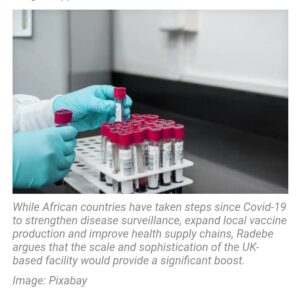
The site spans 171,619 square feet and was originally developed to bolster rapid-response vaccine production during global health emergencies.
The African Manufacturing Foundation (AMF) says the availability of the facility represents a rare convergence of industrial capability and public health strategy.
AMF chief executive officer Lebo Radebe warned that Africa risks repeating past vulnerabilities if it fails to act decisively.
“This is not simply about acquiring infrastructure — it is about securing Africa’s future health resilience,” Radebe said from his base in Johannesburg, South Africa.
“Pandemics are no longer hypothetical events. They are recurring global risks, and Africa must position itself accordingly,” he said.

The VMIC facility was designed specifically for pandemic response and has the capacity to manufacture up to 2.56 billion vaccine doses annually.
Its production systems are tailored toward respiratory vaccines, including those targeting Covid-19, influenza, and Respiratory Syncytial Virus (RSV).
Health policy analysts note that Africa’s greatest challenge during Covid-19 was not scientific knowledge but manufacturing independence.
Vaccine nationalism and supply bottlenecks left many countries dependent on delayed shipments and expensive procurement agreements.
Radebe argues that securing advanced manufacturing assets abroad could complement ongoing efforts to build domestic pharmaceutical capacity.
“While Africa continues investing in local production hubs, facilities of this scale and sophistication could immediately accelerate research, skills transfer, and supply security,” he said.
The foundation also emphasized the potential alignment with continental health institutions, particularly the Africa Centres for Disease Control and Prevention (Africa CDC), which has been leading initiatives to strengthen disease surveillance and vaccine manufacturing networks across the continent.
Industry observers suggest the Harwell-based facility could function as a transitional anchor — providing Africa with rapid manufacturing capability while regional plants mature.
Beyond production capacity, the Harwell campus itself is regarded as a globally recognized centre for scientific innovation, hosting research institutions and high-technology companies.
AMF believes this ecosystem offers Africa indirect access to cutting-edge collaboration and technological expertise.
Radebe framed the opportunity as part of a broader shift in how Africa approaches global industrial partnerships.
“For decades, Africa has largely been a consumer in global health supply chains. The future requires Africa to act as a producer, innovator, and strategic stakeholder,” he said.
Radebe called for a consortium-style approach involving governments, development finance institutions, and private investors.
“No single country needs to carry this alone. Collective investment could transform this facility into a continental asset serving all African nations,” he said.
The AMF maintains that acquiring or leasing the facility would send a strong signal about Africa’s long-term commitment to health security, economic diversification, and technological advancement.
“The next global health crisis is a matter of when, not if. Preparedness is no longer a policy discussion — it is an investment decision,” said Radebe.
Zambia like many other African countries need to tap into the UK vaccine innovation to enhance preparedness for any pandemic outbreak.