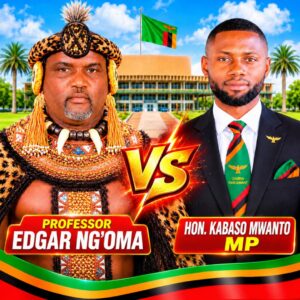
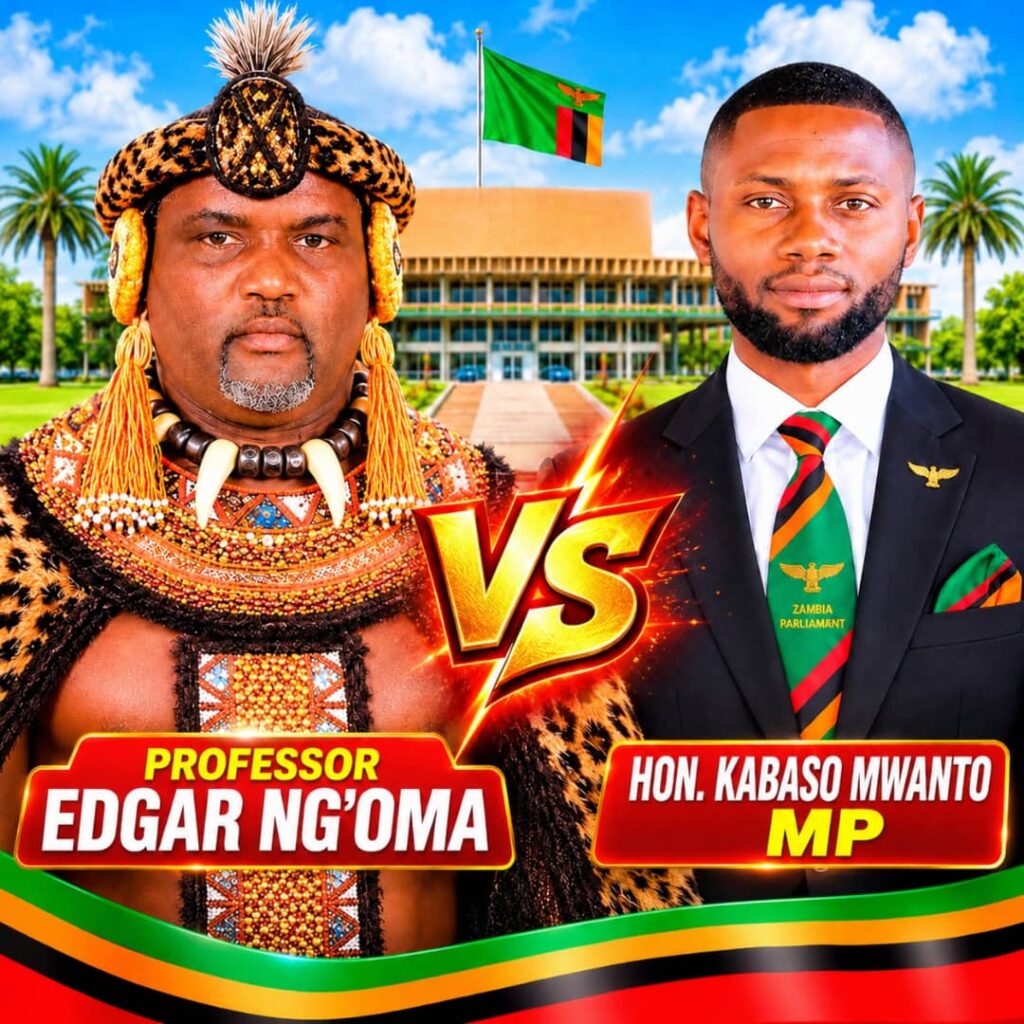
Prof. Edgar Ng’oma Vs Hon. Kabaso Mwanto Member of Parliament – Youth Proportional Representation in Parliament of Zambia
SHOULD PRESIDENTIAL TERM LIMIT BE REMOVED IN ZAMBIA??
Wednesday, 4th November 2026
Without Fear or Favour
I have taken time to listen attentively to the address to Parliament by this vibrant young Honourable Member of Parliament, and I have this to say after a very serious reflection.
First, I would like to commend the idea of proportional representation in the Zambian Parliament, because it has brought an entirely different ball game into the House. For the first time in our history, our youths now have a direct voice in Parliament. So too do persons living with disabilities and women, whose representation has been significantly enhanced.
Secondly, the quality of debate itself has been taken to another level. It is refreshing, for example, to listen to an Honourable Member ably representing the interests of those who live with disabilities — a voice that was for a long time missing or muted in our national discourse.
It is in this spirit of constructive engagement that I have found it necessary to respond to Hon. Mwanto’s assertion.
Hon. Mwanto’s Argument: Let the Ballot Box Decide
The young Honourable Member, Hon. Kabaso Mwanto — the former UNZASU President, popularly known as “Shuwa Shuwa” — spoke in favour of removing presidential term limits.
He argues that it is better to leave the decision to the people, rather than to the Constitution, to decide whether a particular President should continue in office.
In his view, if a President has performed well and the people still want him to continue, the people should be free to keep voting for him. Term limits, he suggests, unfairly deny voters that choice and can cut short good leadership simply because a fixed number of years has elapsed.
In short, his position is: let the ballot box decide, not the term limit.
The Counter-Argument: Why Term Limits Were Introduced
Zambia introduced the two-term limit — a maximum of 10 years for a President — in the 1991 Constitution, after 27 years of one-party rule under Dr. Kenneth Kaunda.
It was introduced for four specific reasons:
1. To Prevent Life Presidency
Kaunda had ruled from 1964 to 1991. The fear was that without limits, a President would entrench himself, change the rules, and never leave. The limit was meant to guarantee that power must change hands.
2. To Protect Democracy
Democracy is not just about voting, it is about the possibility of change. If the same person can stand forever, elections become a formality because the incumbent controls state resources, the media, the police and the electoral machinery.
3. To Prevent Abuse of Power and Corruption
The longer a President stays, the more networks of patronage, corruption and fear he builds around himself. Term limits force a President to account, knowing he will one day become an ordinary citizen again.
4. To Give Room for New Leadership
Zambia is a young country. Term limits were meant to allow new generations, new ideas and new parties to emerge, rather than having one generation dominate forever.
This is why even President Frederick Chiluba, who championed the limit in 1991, was blocked in 2001 when he tried to seek a third term. The people said: the rule must apply to everyone, even to a performing President.
Hon. Mwanto’s argument sounds democratic — “let the people choose.”
The Counter-Argument: The People Already Chose — But The People Can Also Re-Choose
The counter-argument is: the people already chose — they chose to limit the President.
An election chooses a President for five years. A Constitution chooses the rules for all elections forever. When Zambians adopted term limits in 1991, they were making a long-term decision. They were saying: “Even if we love a President, he must go after 10 years.”
That choice was not made lightly. It was made after 27 years of one-party rule, to protect the country from life presidency, abuse of power, and the unfair advantage of an incumbent who controls state resources.
However, if the people are free to make that choice, they must also be free to review it.
A Constitution is not a prison. It is a living document. If the people, at a particular time in their history, come to believe that term limits no longer serve their aspirations — that they are blocking good leadership rather than protecting democracy — then the people have every right to revisit that position.
The key question, therefore, is not whether the people can change the rule. They can.
The key question is how and why they change it:
1. How? Not by one President, one party, or one Parliament acting for its own benefit, but through genuine, wide and inclusive consultation, where all voices — including dissenting voices — are heard.
2. Why? Not because a current leader wants to stay longer, but because the nation has soberly concluded, on principle, that the rule no longer serves Zambia’s democratic interest.
In other words, term limits should not be removed to serve a person. They should only be reviewed to serve the people.
If the review is done honestly, openly, and for the nation — and not for an individual — then the people exercising their right to re-choose is itself an act of democracy.
Furthermore, performance is subjective. Who decides that a President “has performed well”? The President himself and his supporters will always say yes. The opposition will always say no. Term limits remove that subjective debate and replace it with a clear, neutral rule.
Finally, the incumbent advantage makes elections unfair. A sitting President does not compete on equal ground. He can use government projects, CDF, appointments, and state media to campaign. After 10 years, that advantage becomes almost impossible to defeat, even if the people want change. Term limits level the playing field.
Nearly every African country that removed term limits — Uganda, Rwanda, Cameroon, DRC, Burundi — slid towards authoritarianism, suppression of opposition and constitutional manipulation. Zambia was praised in Africa precisely because it respected term limits in 2001, 2006, 2011, and 2021.
Conclusion
However, it is important to note that countries such as Britain and Russia do not apply presidential term limits in the same way Zambia does, yet their people continue to decide, through elections, whether to retain a particular leader in perpetuity.
In Britain, there is no term limit for a Prime Minister. A Prime Minister can continue for as long as his party retains the confidence of Parliament and the people continue to vote for that party. The check is not a fixed number of years, but the constant accountability to Parliament and to the electorate.
Similarly, in Russia, the leadership question has largely been left to the will of the electorate and the political system, rather than to a rigid two-term rule.
Zambia, as a sovereign nation, must be free to decide what works best for Zambia at this particular time in its history. That decision should not be imposed by precedent alone, but should be made by the people through their elected representatives in Parliament, after wide consultation and sober reflection.
If the people of Zambia, through Parliament, feel that the current term limit no longer serves the democratic interest, then Parliament is within its right to review it. If, on the other hand, the people feel it must remain, then it must remain. The ultimate authority must rest with the Zambian people.
I submit.
Prof. Edgar Ng’oma
Philosopher and Distinguished Good Governance Fellow