By Prof. Edgar Ng’oma Philosopher and Distinguished Good Governance Fellow Lusaka, Zambia
Sunday 08th November 2026.
DEEP CRITICAL ANALYSIS
Without fear or favor There are moments in the life of a nation when the future does not knock — it walks in, stands up, and speaks.
That moment happened on Sunday, 2nd November 2026, inside the Chamber of the National Assembly of Zambia in Lusaka.
It was not the main Parliament. It was the Sixth Session of the Youth and Students Parliament, organised by the National Council of Student Unions (NACOSU) in partnership with the National Assembly of Zambia.
The Presiding Officer called the next speaker. The Parliament TV lower-third read:
RONALDO MWIIKISA — DUNDUMWEZI.
A young man in a dark suit stood up. He was not yet a Member of Parliament in the real National Assembly. He was a student. A youth. A son of Dundumwezi.
But what followed was not a student performance. It was a statesman’s address.
His full names are Hon. Ronaldo Fain Mwiikisa.
Constituency Represented: Dundumwezi, Southern Province Institution: Rusangu University Platform: NACOSU — Youth and Students Parliament Occasion: Sixth Session of Student and Youth Parliament Recognition: Best Male Speaker / Best Male Proposer
And on that day, Zambia listened.
THE ADDRESS — AS DELIVERED IN PARLIAMENT
Mr. Speaker,
Thank you for this opportunity.
Mr. Speaker, I stand here today to speak in support of this motion, and to express my gratitude to the President for the actualization of the Mixed Member Proportional System.
Mr. Speaker, our current system — the First-Past-The-Post system — has excluded many. It has excluded the youth. It has excluded women. It has excluded persons with disabilities.
Mr. Speaker, we need a Parliament that does not only represent geography. We need a Parliament that represents the people in their full diversity — in geography, in gender, in age, and in ability.
That is why I stand on two principles.
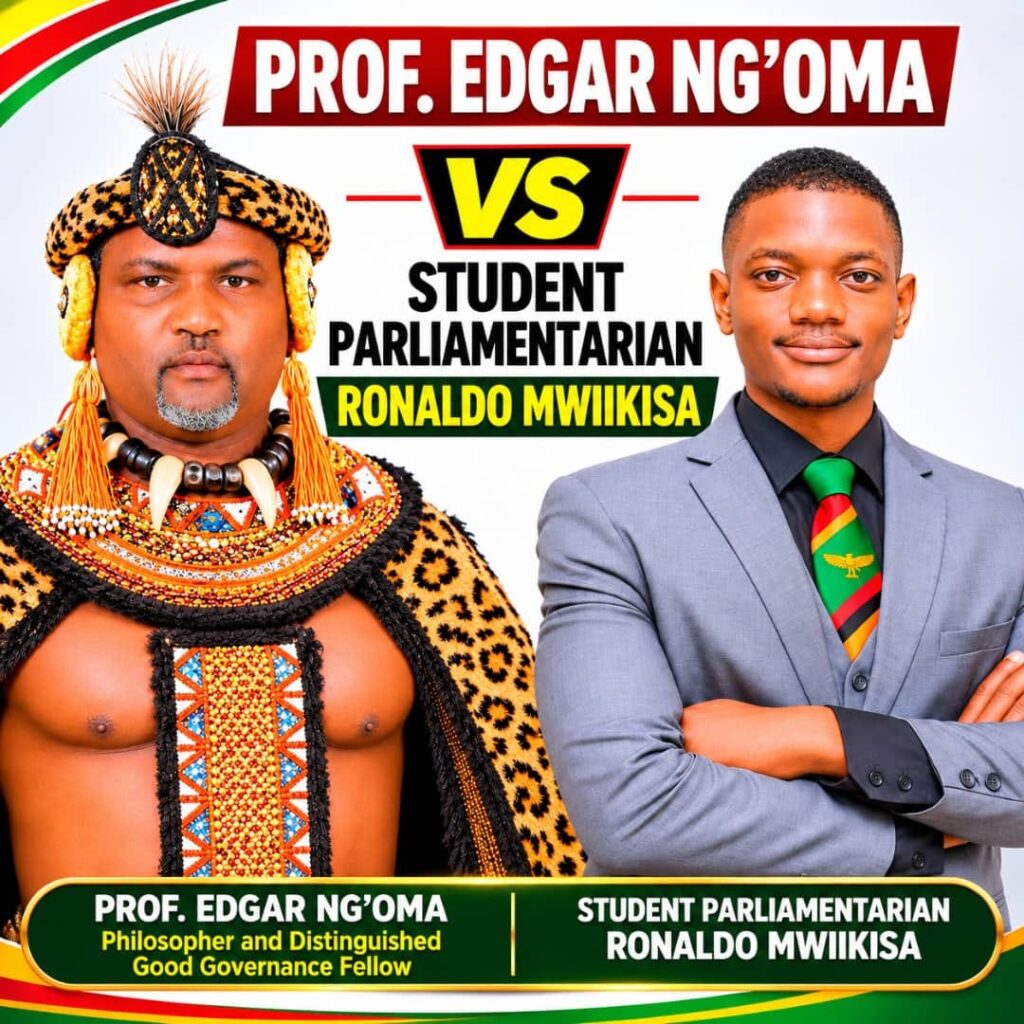
Professor Edgar Ng’oma (left) acknowledges the debate prowess exhibited by Hon. Ronaldo Fain Mwiikisa
First, substantive representation.
Substantive representation means Parliament must not just look like Zambia. Parliament must speak for Zambia. It must speak for the young person in Dundumwezi. It must speak for the woman. It must speak for the person living with disability.
Second, institutional complementarity.
Mr. Speaker, the constituency Member and the proportional Member must not compete. They must complement each other. One brings the voice of the constituency. The other brings the voice of the nation. Together, they make Parliament complete.
Mr. Speaker, that is why I say:
“Youth bias, women bias, disability bias equals a government motivated to speak on its own important issue.”
Bias plus plus equals balance.
Mr. Speaker, when we deliberately include those who have been left out — the youth, the women, the persons with disabilities — we are not creating imbalance. We are creating balance.
Mr. Speaker, age alone does not determine capability. The youth of today are the leaders of today. Give us a seat, and we will speak. Give us a voice, and we will represent.
Mr. Speaker, I thank you.
[Chamber applauds]
That was the moment the chamber erupted. Fellow youth MPs smiled, clapped, and later congratulated him. He was later recognised among the Best Male Proposers and Best Male Speakers of the session.
But the applause was not for volume. It was for depth. Zambia had just heard a philosophy.
MY DEEP CRITICAL ANALYSIS: WHY THIS WAS NOT JUST A GOOD SPEECH
As a Philosopher, I do not judge a speaker by how loud he speaks. I judge him by how deep he thinks. By that measure, Ronaldo F. Mwiikisa spoke above his age, above his status, and above his station — and he spoke directly into the future of Zambia.
1. The Calibre: A Student Who Thought Like A Statesman
Zambia has seen many students who can shout. We have seen many who can debate. We have rarely seen one who can think.
Ronaldo did not go to Parliament to perform. He went to Parliament to philosophize. That is the difference between a politician and a statesman. A politician speaks to win applause. A statesman speaks to build a nation.
He showed five marks of a rare calibre:
Discipline of Language: He did not insult. He used parliamentary language: “Mr. Speaker, thank you for this opportunity.” In good governance, language is character. He who cannot control his tongue cannot control a nation.
Discipline of Thought: He did not speak on everything. He spoke on two principles only. A mature mind knows that depth is better than noise.
Discipline of Posture: He stood, he respected the Chair, he waited for his turn, he thanked the House. Leadership is first posture before it is power. Many adults in the real Parliament have lost this posture. A student restored it.
Discipline of Gratitude: He thanked the President for the actualization of the Mixed Member Proportional System. He did not begin with bitterness. He began with acknowledgement. In philosophy we call this recognition — you cannot reform what you do not first recognise.
Discipline of Vision: He did not speak about himself. He spoke about the excluded — the youth, the women, the persons with disabilities. A small leader speaks about “me.” A great leader speaks about “us who are not in the room.”
2. The Philosophy: Two Principles That Changed The Debate
First Principle: Substantive Representation
In philosophy, there is a difference between presence and representation.
Presence is: “There is a youth in Parliament.” Substantive Representation is: “That youth in Parliament actually speaks for the youth outside Parliament.”
Ronaldo said Parliament must not just LOOK like Zambia. It must SPEAK like Zambia.
Zambia has had many Parliaments that looked diverse in photos but were silent in substance. He is demanding a Parliament where representation is not decoration, but duty.
In my philosophy of existence — Existence = People + Institutions + Legitimacy + Accountability — Substantive Representation is the Accountability, the consciousness of the State. Without it, Parliament exists on paper, but not in the hearts of people.
Second Principle: Institutional Complementarity
This was his masterstroke.
Many Zambians fear the Mixed Member Proportional System because they think it will create two kinds of MPs who will fight — the constituency MP and the proportional MP.
Ronaldo corrected this fear with one word: Complementarity.
He said: One brings the voice of the constituency. The other brings the voice of the nation. Together, they make Parliament complete.
This is pure philosophy. The eye and the ear do not compete. They complement. The left hand and the right hand do not fight. They complete the body. He taught Zambia that institutions must not compete for power. They must complete each other for service.
This is the philosophy of Ubuntu in Governance: I am because we are. No one institution is complete alone.
The Formula: Bias Plus Plus Equals Balance
“Youth bias, women bias, disability bias equals a government motivated to speak on its own important issue.” “Bias plus plus equals balance.”
In ordinary politics, “bias” is a bad word. It means unfairness. Ronaldo turned it upside down.
He said: If history has been biased AGAINST youth, women, and persons with disabilities, then justice demands a deliberate bias FOR them — not forever, but until balance is restored.
It is like a table with one broken leg. You do not put equal weight on all legs. You add support to the broken leg until the table stands straight. That is not favouritism. That is justice.
That is what philosophers call Equity — not giving everyone the same, but giving each what they need to stand equal.
Ronaldo gave Zambia a formula for equity in one sentence.
3. The Governance Lesson: What This Means For Zambia
For the Electoral System, he proved that the debate on Mixed Member Proportional Representation is not a debate for lawyers only. It is a debate for the youth of Dundumwezi, for the girl in a wheelchair in Mongu, for the young woman farmer in Chipata.
For Parliament, he shamed the real Parliament — in a respectful way. He showed that debate can be about ideas, not insults. That you can disagree without shouting. That you can be young and still be parliamentary. If a student can do it, a whole National Assembly can do it.
For Political Parties, he sent a warning: Do not look for youth to sing and dance at rallies. Look for youth who can think, who can draft, who can argue a constitutional principle. The future of parties is not in cadres who shout loudest, but in thinkers who reason deepest.
For the Presidency and the Grow Zambia Agenda, his speech aligns perfectly. You cannot grow Zambia if you leave 70% of the population — the youth — outside the decision-making room. Growth needs inclusion. His speech was not opposition. It was support — support with substance.
A CALL TO OTHER YOUTHS: TAKE LEADERSHIP SERIOUSLY
This is my message, as a Philosopher, to every youth reading this:
Leadership is not Age. It is Preparation. Ronaldo did not wait to be 50 to speak. He prepared at Rusangu University. He read. He listened. He practiced. Leadership does not come when you are old. It comes when you are ready.
Leadership is not Noise. It is Knowledge. Do not confuse followers on TikTok with followers in governance. Ronaldo had no crowd of cheerleaders. He had two principles, well argued. That is enough to move a nation.
Leadership is not About Me. It is About the Missing. Ask yourself: Who is not in the room? Who is not being spoken for? If you can speak for them, you are a leader.
Leadership is not Waiting for Tomorrow. It is Speaking Today. The old saying is “Youth are leaders of tomorrow.” Ronaldo has destroyed that saying. Youth are leaders of TODAY. The Youth Parliament is not a rehearsal for 2040. It is governance in 2026.
Leadership is Character Before Office. You may never be called “Honourable.” But if you speak with respect, think with depth, and serve with humility, the nation will call you Honourable even without a title.
To the youth of Dundumwezi: Your son has shown you the way. To the youth of Rusangu: Your brother has shown you the standard. To the youth of Zambia: Your colleague has shown you that you do not need to wait for permission to be great.
MY CONCLUSION
I have studied leaders for many years.
I can tell you: Calibre is not measured by how loud you speak, but by how deep you think.
Ronaldo F. Mwiikisa did not just present a motion. He presented a philosophy of inclusion. He did not just win Best Male Speaker. He won the respect of a nation.
If Zambia produces ten more Ronaldos — in every province, in every university, in every constituency — our democracy will not just survive. It will flourish.
Well done, Honourable Mwiikisa. You spoke like a student. You thought like a philosopher. You stood like a statesman.
Zambia is watching. Continue.
END
Editor’s Note: The address is transcribed from Zambia Parliament TV, Sixth Session of Student and Youth Parliament, 2nd November 2026. Analysis by Prof. Edgar Ng’oma, Philosopher and Distinguished Good Governance Fellow.