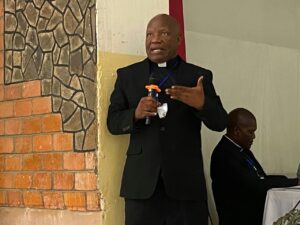
The installation of the First Female Archbishop of Canterbury: What is the stance of the Anglican Church in Africa? Is this consistent with Apostolic succession?
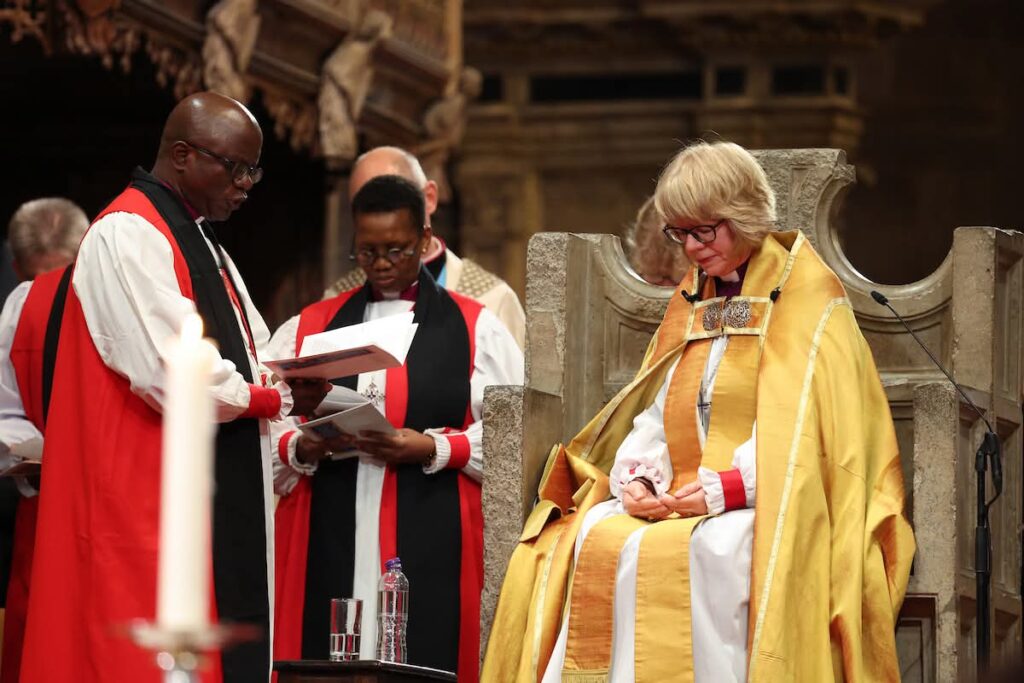
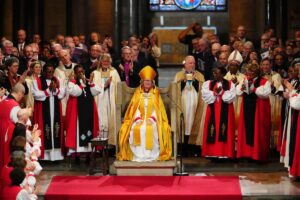
The Installation of Most Revd and Right Hon Dame Sarah Mullally as the 106th Archbishop of Canterbury in Canterbury Cathedral. The service is attended by more than two thousand people including senior members of the Royal Family and the Government, Anglican clergy and leaders from across the Church of England and Anglican Communion, and diverse guests including faith leaders, charities, healthcare workers and school children. Wednesday 25th March 2026. Photo: Neil Turner for Lambeth Palace
By William E. Vwapu
The installation of Sarah Mullally as the 106th Archbishop of Canterbury marks a historic turning point in the life of the Anglican Communion. For the first time in over fourteen centuries, a woman now occupies the See of Canterbury, the symbolic centre of Anglican unity. This development has generated both celebration and concern, particularly across Africa, where Anglican provinces remain deeply attentive to Scripture, tradition, and catholic order.
As an Anglican priest in Zambia, I approach this moment with both theological conviction and pastoral sensitivity, shaped by the realities of the Global South and the ongoing conversations within our Communion.
WHAT IS THE STANCE OF THE AFRICAN ANGLICAN CHURCH?
To begin with, I would like to state that I am not the spokesperson of the Anglican Church in Africa and that its stance on this matter is not monolithic, but there are some broad patterns and similarities. Many provinces such as Nigeria, Uganda, Kenya and to a greater extent Central Africa, my province, hold firmly to a conservative reading of Scripture, especially on matters of doctrine, sexuality, and ecclesial order. Others such as Southern Africa have embraced the ordination of women to various degrees.
On the question of women’s ordination, Africa is divided but not silent. Some provinces fully ordain women as priests and bishops, others permit women deacons but not priests, and some resist women’s ordination altogether. My province has until recently not allowed the ordination of women. In our province, so far only the Diocese of Botswana has ordained some women deacons. We are yet to see how the new law will be implemented by the different dioceses in the Church of the Province of Central Africa.
Therefore, the appointment of Sarah Mullally as ABC is received across Africa with a mixture of affirmation, caution, and in some quarters, rejection. The deeper concern for many, a view I also share, is not simply that she is a woman, but that her broader theological positioning, particularly on matters of sexuality and blessing of same-sex unions, may widen the already fragile relationship between the Church of England and the Global South.
WHAT IS APOSTOLIC SUCCESSION?
At the heart of the question lies the doctrine of Apostolic Succession. In Anglican understanding, apostolic succession refers to the continuity of the Church’s ministry through the historic episcopate, bishops ordained in an unbroken line tracing back to the apostles. This succession is not merely institutional, it is sacramental and spiritual, ensuring the faithful transmission of the Gospel, the sacraments, and the Church’s teaching authority. But here we must ask a critical question: Is apostolic succession “sexually” transmitted?
The answer, both theologically and logically, is no. Apostolic succession is not a biological inheritance. It is not passed through male lineage, nor is it dependent on gender. Rather, it is conferred through the laying on of hands, prayer, and the invocation of the Holy Spirit within the Church. The grace conferred in ordination is the work of God, not the property of male anatomy.
If that is the case, then the argument that only men can validly receive or transmit apostolic ministry becomes less about succession and more about interpretation of Scripture and tradition.
CAN WOMEN RECEIVE THE GRACES OF THE HOLY SPIRIT?
Scripture testifies abundantly that the Holy Spirit is poured out on all flesh, sons and daughters alike (Acts 2:17). But Jesus didn’t appoint women apostles. Yes, there are so many things which we do in the church today which Jesus never did probably because his time and culture never permitted. Women were disciples of Jesus, witnesses to the resurrection, leaders in the early Church, and co-workers in the Gospel. The New Testament presents women not as passive recipients, but as active participants in the mission of Christ.
If we accept that women can receive the gifts (charismata) of the Holy Spirit, women can serve Christ faithfully as disciples, and women can be set apart for ministry, then the next question follows naturally:
WHY SHOULD WOMEN NOT BE ORDAINED AS DEACONS?
Indeed, many Anglican provinces, including in Africa, already ordain women to the diaconate. But ordination to the diaconate is not a separate or lesser calling; it is the first order of Holy Orders, part of a threefold ministry: deacon, priest, and bishop.
If a woman may validly receive the grace of ordination as a deacon, then on what theological grounds can she be barred from priesthood? And if from priesthood, why from the episcopate? This raises a compelling line of reasoning. If women can be ordained deacons, and deacons may be ordained priests, and priests may be consecrated bishops, then why not archbishops, and even Archbishop of Canterbury?
The grace of God does not diminish or change as one ascends the orders; it is the same Spirit who calls, equips, and sends.
IS THERE ROOM FOR DEVELOPMENT IN ANGLICAN DOCTRINE?
Anglicanism has historically held together Scripture, tradition, and reason. While some argue that tradition has consistently excluded women from Holy Orders, others point out that tradition has also developed over time in response to deeper understanding of the Gospel.
The Church of England’s decision to ordain women as priests in 1994 and later as bishops in 2014, reflects such development. It does not claim that the apostles ordained women as bishops, but rather that the principle of apostolic ministry which is, faithful proclamation, sacramental stewardship, and pastoral oversight, can be embodied by women as well as men.
Thus, within Anglican doctrine, the ordination of women is not universally accepted, but it is argued to be consistent with apostolic succession, understood as continuity of faith and ministry rather than male lineage.
CONCLUSION
From where I stand, as an Anglican priest in Zambia where women leadership is accepted at highest level in society, I remain convinced that the question before us is not simply about gender, but about faithfulness, clarity, and unity within the Anglican Communion.
I affirm, without hesitation, the ordination of women as deacons, priests, and bishops. If the grace of the Holy Spirit is given without partiality, then it cannot be restricted on the basis of sex. Apostolic succession, properly understood, is not biologically or “sexually” transmitted. It is sacramentally conferred through the Church by the power of the Spirit. Therefore, I see no inherent contradiction in a woman serving even as Archbishop of Canterbury.
However, as I argued in my earlier reflections on the appointment of Sarah Mullally, this moment cannot be viewed in isolation. It comes within a wider theological and ecclesial context that deeply troubles many of us in the Global South. The real tension is not merely about a woman occupying the See of Canterbury, but about what her broader theological positions may signal for the future of Anglican doctrine and identity.
For many African Anglicans, the pressing concern is whether the Church of England is moving away from what we regard as the clear teaching of Scripture, particularly on matters of sexuality, marriage, and the boundaries of Holy Orders. In that sense, the debate about women’s ordination is often overshadowed by deeper anxieties about doctrinal integrity and ecclesial direction.
Thus, while this appointment represents progress and inclusion in one area, it simultaneously raises fears of discontinuity and fragmentation in another. The danger is that what is celebrated in one part of the Communion may be experienced as theological departure in another, thereby widening the already fragile bonds of unity.
What is needed at the moment is not triumphalism by the feminists, nor reactionary rejection by those opposed to women ordination, but careful, prayerful leadership at the apex of the Communion. The Archbishop of Canterbury must strive to offer clarity without ambiguity on matters of doctrine and practice. She must exercise pastoral sensitivity toward all, including those who dissent. She should engage in genuine listening to the voices of the Global South. She should also endeavor to safeguard the unity of the Communion, even amid deep disagreement.
Ultimately, this moment calls the Anglican Communion back to its foundations of Scripture, tradition, and reason held together in humility. It calls us to recognize that unity does not mean uniformity, but neither can it survive without shared theological boundaries.
So, while I welcome the historic nature of this appointment, I also approach it with sober realism. The future of Anglicanism will not be determined simply by who occupies Canterbury, but by whether we can hold together truth and grace, conviction and compassion, diversity and unity.
The real question before us is not only who can be ordained, but what kind of Church we are becoming.
https://www.facebook.com/reel/4573757699613738/?mibextid=CDWPTG