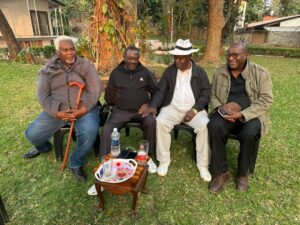
Former Presidents and Vice Presidents

Musterd Phiri (left) and Isaac Mwanza (right).
…Rethinking Section 7 Bill No. 5 of 2026.
By Musterd Phiri and Isaac Mwanza
INTRODUCTION
Bill No. 5 of 2026, currently before Parliament, seeks to prescribe benefits for former Presidents and Vice Presidents of the Republic of Zambia. It is, at face value, a well-intentioned piece of legislation designed to honour the immense service rendered by individuals who have occupied the highest offices in the land. It recognizes the weight of leadership, the sacrifices made, and the national responsibilities borne by such office holders.
However, embedded within this framework lies a deeply controversial clause. Section 7(1)(b), mirroring the current Benefits of Former Presidents Act, provides that a former President forfeits benefits upon re-engaging in active politics.
This provision is neither novel nor accidental. It is rooted in Zambia’s political history, a history that should caution against repeating past mistakes. The law itself emerged in a context shaped by political rivalry and consolidation of power. During the presidency of Frederick Chiluba, amendments to the benefits regime were effectively used to bar Kenneth Kaunda from enjoying benefits should he continue to participate in active politics. At the time, Kaunda’s political re-engagement was perceived as a threat to Chiluba’s authority, and the law became a tool to constrain that influence.
What Chiluba perhaps did not anticipate, however, is that the same legal framework he helped shape would later operate against him. After leaving office in 2001, Chiluba’s own entitlement to benefits became the subject of legal and political contestation, with some benefits withdrawn or challenged. The law, once used as a shield, became a sword.

This historical cycle underscores a fundamental truth: laws crafted to target individuals or moments in time often outlive their creators, and in doing so, expose their inherent injustice.
Today, Zambia stands at a different constitutional moment. There is no immediate former President in view as the law is being shaped. This is precisely why clarity of principle is required. The country must resist the temptation to legislate for hypothetical political convenience and instead legislate for enduring constitutional justice.
At this stage, it is expected that President Hakainde Hichilema and the current leadership confront a simple but unavoidable reality: when their own time in office comes to an end, they too should not be constrained from participating in politics under the threat of losing benefits.
It was wrong then. It is wrong now. And it will be wrong in the future.
THE PRINCIPLE OF SERVICE REWARD
Benefits accorded to former Heads of State are not acts of generosity, nor privileges contingent upon future conduct. They are acknowledgments of past service, grounded in the sacrifices made while holding office.
To condition such recognition on political silence is to fundamentally distort its purpose. Service rewards are retrospective, not prospective. They honour what has been given, not what may come.
The historical experience of Zambia demonstrates the danger of departing from this principle. When benefits become conditional, they cease to be recognition and instead become instruments of control.
Consider the analogy of a retired teacher denied her pension because she seeks election to local office. Such a condition would be universally condemned as unjust. The same logic applies to former Presidents and Vice Presidents: their benefits are earned, not negotiable.
Once service has been rendered at the highest level, it cannot be undone. Its value cannot be diminished by future political participation. To suggest otherwise is to deny both logic and history.
COMPARATIVE JURISDICTIONS
(a) UNITED STATES OF AMERICA
In the United States, benefits under the Former Presidents Act of 1958 are not conditional on political inactivity. Former Presidents retain pensions, security, and institutional support regardless of future political engagement.

Historical and contemporary practice affirms this principle. Grover Cleveland returned to office after a break, while Donald Trump remained politically active after leaving office. In neither case were benefits withdrawn.
The American approach is clear: service once rendered is permanently recognized.
(b) MALAWI
A similar position is evident in Malawi. Peter Mutharika returned to active politics without forfeiting his entitlements.
Malawi’s framework reflects a mature democratic understanding: political participation and recognition of past service are not mutually exclusive.
Zambia’s current framework stands in contrast. By conditioning benefits on political abstention, it creates a paradox: democracy encourages participation, yet the law punishes it.
THE DEMOCRATIC PARADOX
Democracy thrives on participation. To penalize former leaders for engaging in politics is to silence experienced voices and weaken the marketplace of ideas.
The Zambian historical experience reinforces this concern. The use of the benefits law during the Chiluba–Kaunda era illustrates how such provisions can be weaponized to suppress political competition.
A law that can be used to silence one former President can be used against any other. It is not a safeguard of democracy; it is a latent threat to it.
True democracy does not fear the return of former leaders. It trusts citizens to decide.
CONSTITUTIONAL CONSIDERATIONS
The Constitution guarantees equality before the law and the right of every citizen to participate in political life. Conditioning benefits on political inactivity creates a discriminatory class: former Presidents are effectively penalized for exercising rights available to all other citizens.
This is constitutionally indefensible.
The historical application of the law further reveals its incompatibility with constitutional values. A provision born out of political expediency cannot form the basis of a just and enduring legal framework.
Rights are not conditional upon silence. They are permanent and universal.
A CALL FOR REFORM
The continued existence of this provision in both the current law and Bill No. 5 of 2026 is unnecessary and unjustified.
Zambia does not need such a law. Its historical origins are politically tainted, its application has been inconsistent, and its effect is fundamentally undemocratic.
Reform must therefore go beyond mere adjustment, it must involve removal of the offending principle altogether.
Benefits must be decoupled from political activity.
Recognition of service must be permanent and unconditional.
Democracy must allow full participation without penalty.
The lesson from history is unmistakable: a law designed to restrict one individual will inevitably ensnare others.
CONCLUSION
Bill No. 5 of 2026 presents an opportunity for Zambia to correct a historical wrong.
The experience of Frederick Chiluba and Kenneth Kaunda demonstrates the dangers of conditional benefits. What was once used as a political tool ultimately proved unjust in principle and unsustainable in practice.
At a time when no immediate former President is the target, Zambia has the rare opportunity to legislate with objectivity and foresight. The current leadership, including Hakainde Hichilema, must recognize that they too will one day stand on the other side of this law.
No former President should be forced to choose between recognition of past service and participation in democratic life.
It was wrong then.
It is wrong now.
And it will be wrong in the future.
Zambia must therefore reject conditionality and affirm a simple, enduring principle:
service to the Republic is honoured permanently, not politically negotiated.
________
DISCLAIMER: The views expressed in this commentary are those of the authors, law scholars, and do not reflect the views of any institution or organization with which they may be associated or affiliated.