China & USA in Zambia: The scramble for critical minerals
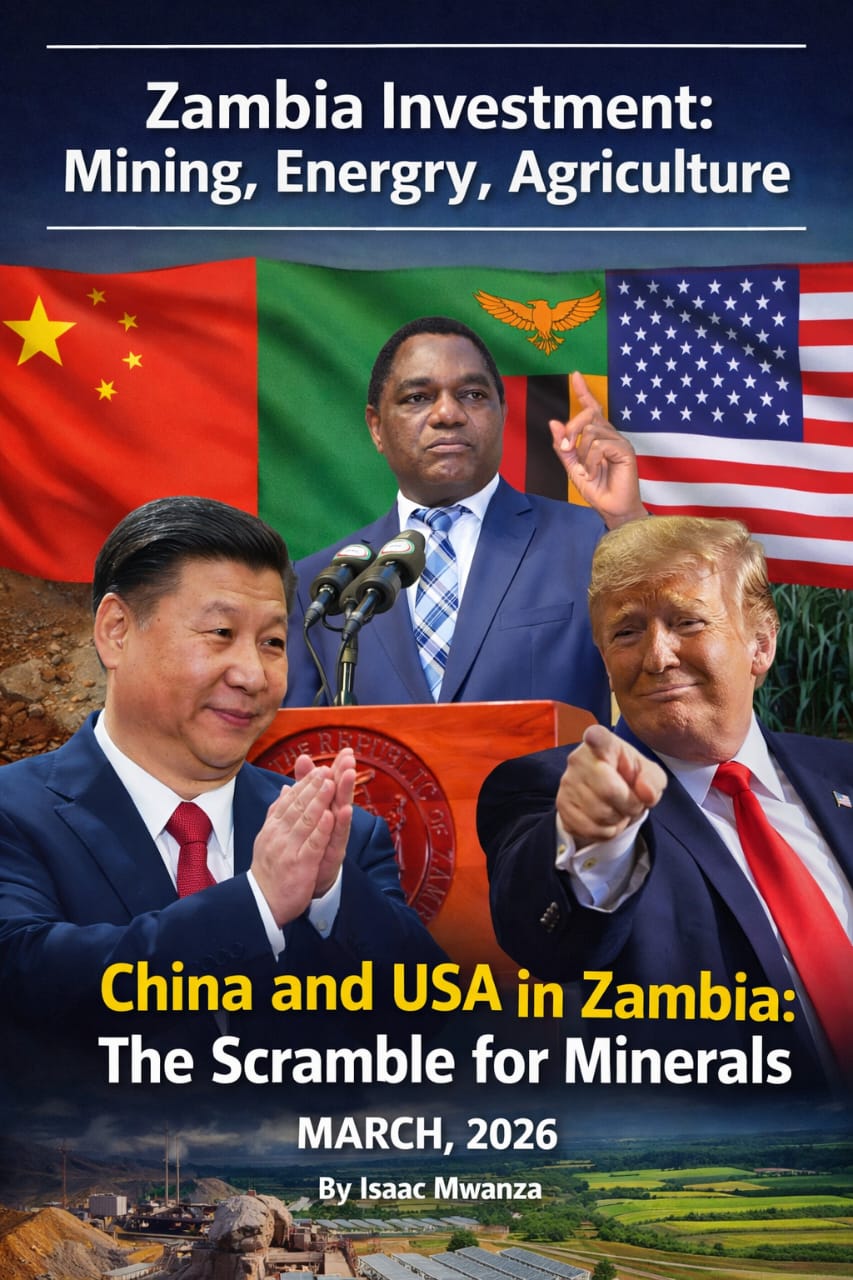
China, USA, two elephants fighting over Zambian minerals.
By Isaac Mwanza, Executive Director, Zambian Civil Liberties Union (ZCLU)
….Zambia needs China just as much as it needs Western partners such as the United States, the United Kingdom, and others…The growing interest by global powers to trade and invest in Zambia should not be turned into a zero-sum contest where one partner is pitted against another… any suggestion, if at all it is true that there should be preferential treatment for American investors on the basis that Chinese companies are securing more contracts, must be approached with caution and ultimately rejected.
INTRODUCTION
THE debate around the Zambia–United States controversial Memorandum of Understanding (MoU) is ultimately about more than one agreement. It reflects a broader shift in global power dynamics, where Africa and Zambia, in particular, have become a key arena of strategic competition. But Zambia is not merely a passive participant in this contest. It has agency.
A couple of editorial comments by local media outlets keep raising important concerns about the MoU reportedly under consideration between Zambia and the United States. To a significant extent, those concerns are valid. The questions around transparency, sovereignty, and the broader implications of such an agreement deserve serious public scrutiny.
However, the current debate risks becoming narrowly framed if it is viewed only through the lens of immediate political anxieties. This article seeks to build on those editorials by placing the discussion within a broader historical and geopolitical context, particularly the long-standing role of China in Zambia and the region, and what that means for present-day policy choices.
Rather than viewing the situation as a choice between China and the United States, Zambia must adopt a pragmatic and self-interested approach. Its goal should be to extract maximum value from all partnerships while safeguarding national interests and ensuring that investments contribute to sustainable development.
A CONTEST OF INFLUENCE OR A QUESTION OF HISTORY?
There is little doubt that the proposed MoU must be understood, at least in part, as a strategic move by the United States to counter the growing influence of China in Africa. Zambia, given its mineral wealth and strategic location, is central to this competition. Yet, to fully appreciate why China appears to hold an “upper hand” in investment and influence, one must look beyond current geopolitics and examine history.
The relationship between China and Zambia was forged during a time when Zambia faced significant geopolitical and economic challenges. A defining moment was the construction of the TAZARA Railway in the 1970s. Under the leadership of Kenneth Kaunda, Zambia sought alternatives to trade routes controlled by hostile regimes in Southern Africa. Western powers declined to finance the project.
China stepped in, providing funding, expertise, and labour to build a railway that connected Zambia to the Tanzanian port of Dar es Salaam. This was not merely an infrastructure project, it was an act of strategic solidarity that helped sustain Zambia’s economy and political independence.
China’s support extended into the broader liberation struggles of Southern Africa, where Zambia played a frontline role. During this period, China aligned itself with anti-colonial movements, reinforcing a perception of partnership rooted in shared struggle rather than transactional engagement. This historical memory continues to shape attitudes toward Chinese investment today.
History explains why China has a strong foothold. The present demands that this relationship evolves responsibly. The future, however, will depend on Zambia’s ability to set clear rules, enforce them consistently, and engage all partners on equal terms.
In contrast, Western engagement, including that of the United States, has often been characterized by conditionalities tied to governance, economic reforms, and human rights. While these conditions serve legitimate purposes, they have sometimes been perceived as restrictive or slow-moving, and often designed to tie into the larger western economy, primarily as a supplier of basic commodities rather than to serve Zambia’s economic growth and interests.
China’s model, which emphasizes rapid infrastructure development with few overt political conditions, has therefore appeared more responsive to the immediate needs of developing nations or governments.
At the same time, it is important to acknowledge the substantial and life-saving contribution that the United States has made to Zambia over the past 60 years, beginning in 1965 when the UN imposed economic sanctions on Zambia’s former federation partner and main regional trading partner, Southern Rhodesia which, at the time, supplied the bulk of Zambia’s consumer goods including nearly all processed foods.
Although Zambia was exempted from the trade restrictions in view of the historical economic relationship between the two countries, Zambia chose to observe the sanctions in full in order to bring maximum pressure to bear on Southern Rhodesia which had illegally declared independence from Britain under a white minority settler government. The sanctions led to immediate economic pain for Zambia which now had to find other sources for the goods and services previously obtained from Southern Rhodesia.
The United States was one of the first countries to respond to the crisis, providing financial support to pay for the longer transport routes and helping Zambia through what was a serious fuel crisis between 1966 and 1969. It was a heroic response by the US and it helped Zambia to get through the crisis until China built the TAZARA railway in a record time of only 4½ years, bringing relief and a rapid shift in Zambia’s trade from the South to East Africa.
The construction of the TAZAMA pipeline and the INDENI refinery during the same period stands as a powerful example of how international cooperation helped Zambia overcome a moment of severe economic vulnerability in its early years of independence.
Between 1966 and 1969, Zambia faced crippling fuel shortages that threatened to paralyze its economy, particularly the mining sector, which was the backbone of national revenue. These shortages were not accidental, they were the direct consequence of shifting geopolitical realities in Southern Africa.
Following the imposition of United Nations sanctions against Rhodesia in 1965, long-established fuel supply routes were abruptly disrupted. The British Royal Navy enforced a blockade on the Mozambican port of Beira, through which fuel had traditionally flowed to the region.
Before this disruption, petroleum products for Southern and Northern Rhodesia, as well as Nyasaland, were largely refined at a facility in Umtali (now Mutare), established in 1962 by the London Rhodesia Company (LONRHO). This refinery, located approximately 600 miles from Beira, had reliably supplied the region.
However, once sanctions were imposed, Rhodesia diverted and impounded fuel shipments intended for Zambia. When existing reserves were depleted, Rhodesia went further and imposed an embargo on fuel transiting through its territory, leaving Zambia with only minimal supplies, just enough to keep the mines operational.
The situation worsened dramatically in April 1966 when fuel storage tanks in Kitwe were set ablaze, deepening the national crisis. Faced with an existential threat to its economy, Zambia was compelled to rethink its entire fuel supply strategy.
It was in this context that the Zambian government made the strategic decision to establish an alternative supply route independent of hostile territories. The solution was ambitious: the construction of a pipeline from the Tanzanian port of Dar es Salaam to Zambia. This project would not have been possible without substantial international support.
The TAZAMA pipeline project was financed through a World Bank loan of approximately $68 million and constructed by Italian contractors, reflecting strong global backing for Zambia’s economic stability. Alongside the pipeline, the INDENI refinery was developed in Ndola. This facility was jointly financed, in part, by the Italian National Energy Company, ENI. The name “INDENI” itself symbolizes this partnership, combining INDECO (the Industrial Development Corporation of Zambia) and ENI.
Construction of the pipeline began in 1968 and was successfully completed in 1971, marking a turning point in Zambia’s economic independence. Through the combined efforts of international financial institutions and foreign partners, particularly Italy, Zambia was able to secure a reliable and sovereign fuel supply route.
Ultimately, the TAZAMA and INDENI projects illustrate how strategic foreign assistance, when aligned with national priorities, can play a transformative role in safeguarding a country’s economic resilience and sovereignty.
Cumulatively, over the past 25 years, official American support has amounted to approximately $8 billion, with nearly $7 billion directed toward the health sector. This investment has had a profound impact on public health outcomes, strengthening Zambia’s capacity to respond to disease and improving the quality of life for millions of citizens.
A major pillar of this support has been programs such as PEPFAR, which has played a critical role in the fight against HIV/AIDS and, alongside malaria interventions, has quite literally kept many Zambians alive through the provision of life-saving drugs and treatment. Without such sustained support, the country’s health indicators would likely have been far worse.
In addition, the United States has provided significant funding through the Millennium Challenge Corporation, including a compact of approximately $355 million focused on improving water supply, sanitation, and drainage systems, particularly in Lusaka. This program has been widely regarded as a success, contributing to improved public health and urban infrastructure.
Currently, American support to Zambia stands at around $450 million, although about $50 million has reportedly been withdrawn due to concerns relating to the theft of donor-supported medical supplies. This support has April 30 as its ending point and support under the MOU is expected to step in, if it is signed between the two governments.
These contributions must be acknowledged with appreciation. However, they should not be weaponised, directly or indirectly, as leverage to compel Zambia into agreements whose full implications remain unclear. Development assistance, however generous, should not be used to pressure sovereign decisions or to destabilize long-standing partnerships, including Zambia’s historical and strategic relationship with China. Cooperation must remain rooted in mutual respect, not obligation.

One critical dimension that cannot be ignored is the perception among many Zambians regarding Chinese engagement. A significant driver of negative sentiment has been the limited investment in people-to-people relations. Western nations have, over time, invested heavily in educational exchanges, scholarships, cultural programs, and civil society partnerships that have helped Africans better understand their values, systems, and long-term commitments to the continent. This has fostered a sense of familiarity and, in some cases, affinity.
By contrast, Chinese engagement has often been perceived as predominantly economic focused on infrastructure, trade, and resource extraction with less visible emphasis on social and cultural integration. As a result, many citizens view Chinese presence through a narrow lens of profit rather than partnership.
This does not mean Chinese investment is without challenges. Concerns around labour practices, environmental compliance, and community relations are real and must be addressed. But it does explain why China enjoys a level of trust and familiarity that cannot be easily displaced by new entrants, regardless of their economic strength.
MAKING INVESTMENT & COOPERATION WORK FOR ZAMBIA
The current moment presents Zambia with an opportunity not to choose sides but to redefine the terms of engagement with all partners. The debate over the MoU should not be reduced to a binary contest between China and the United States. Instead, it should focus on how Zambia can leverage competing interests to advance its own development priorities.
Changing this narrative will require a deliberate shift. China must deepen its engagement with the people of Zambia and Africa more broadly, not only through government-to-government relations but also through meaningful interaction with communities, academic institutions, youth, and non-state actors. Expanding scholarships, cultural exchanges, language programs, and support for local initiatives would go a long way in building mutual understanding and trust.
Addressing concerns around Chinese investment is a critical part of this process. There is a need for deliberate efforts to ensure that Chinese investors are fully aligned with Zambia’s legal and social expectations. This includes structured training on Zambian labour laws, environmental regulations, and criminal law to reduce compliance gaps. Many disputes arise not only from negligence but also from differences in regulatory culture, which can be bridged through targeted orientation.
Corporate social responsibility must also be strengthened. Investments should translate into tangible benefits for local communities through employment, infrastructure, and social services. When communities see direct value, public perceptions shift from suspicion to partnership.
Equally important is engagement. Chinese firms should work more closely with labour unions, local civil society organisations, and community leaders. These platforms provide opportunities to address grievances, explain operational challenges, and build trust. Transparency in agreements and operations will further enhance accountability and public confidence.
At the same time, Zambia must strengthen its own institutional framework. Laws must be enforced consistently, regardless of the origin of the investor. Encouraging joint ventures with local businesses can promote skills transfer and local participation in the economy. Investing in human capital development will ensure that Zambians move into skilled and managerial roles within these enterprises.
The same standards must apply to Western investments. If the United States seeks deeper engagement through instruments such as the proposed MoU, it must do so in a manner that respects Zambia’s development priorities and sovereignty. Transparency, mutual benefit, and respect for local systems should be non-negotiable principles for all partners.
Ultimately, sustainable partnerships are not built on contracts alone but on relationships. If China is to consolidate its position as a long-term partner in Zambia’s development, it must be seen not only as an investor but as a stakeholder in the well-being of the people.
CONCLUSION
Zambia’s path forward must be guided by pragmatism, balance, and an unwavering focus on national interest. The country needs China just as much as it needs Western partners such as the United States, the United Kingdom, and others. Each of these partners brings different strengths, whether in infrastructure, finance, governance support, or human capital development, and Zambia stands to benefit most when it engages all of them constructively rather than selectively.
The growing interest by global powers to trade and invest in Zambia should not be turned into a zero-sum contest where one partner is pitted against another. Such an approach risks undermining Zambia’s own leverage. Instead, this competition should be harnessed to create better outcomes for the country i.e. more investment, better terms, higher standards, and broader opportunities for citizens.
Equally, any suggestion, if at all it is true that there should be preferential treatment for American investors on the basis that Chinese companies are securing more contracts, must be approached with caution and ultimately rejected. Zambia’s policy framework should not be driven by pressure to “balance” influence through favouritism. What should be pursued instead is a genuinely level playing field, where all investors, whether from China, the United States, the United Kingdom, or elsewhere, operate under the same transparent rules, standards, and expectations.
In this regard, the responsibility lies equally with Zambia. The country must define clear investment rules, enforce them consistently, and ensure that decisions are guided by long-term national development goals rather than short-term geopolitical pressures. Fair competition, regulatory certainty, and institutional integrity will naturally attract quality investment from all partners without the need for preferential treatment.
Ultimately, Zambia’s success will not be measured by which global power has greater influence within its borders but by how effectively it uses these relationships to improve the lives of its people. A balanced, principled, and self-confident approach to international partnerships is not only desirable but also essential.
(The author, Isaac Mwanza, is Executive-Director of the Zambian Civil Liberties Union (ZCLU), an organisation dedicated to promoting humanitarian justice, constitutionalism and democracy, human rights for all and the rule of law)