Off-Grid Fund targets 1.9 million connections in six African countries
…Burkina Faso, Democratic Republic of Congo (DRC), Liberia, Mozambique and Uganda as Zambia pushes rural electrification roll-out
By Francis LUNGU
Thursday, March 19, 2026 – Lusaka, Zambia
The Beyond the Grid Fund for Africa (BGFA), managed by the Nordic Environment Finance Corporation (NEFCO), says it is making steady progress in expanding electricity access across rural Africa, with Zambia among the key beneficiary countries.
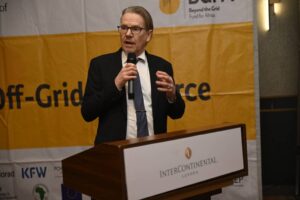
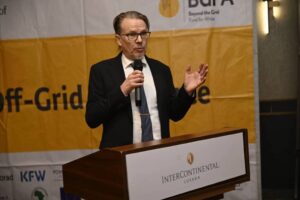
Speaking in an interview on the sidelines of the 2026 Off-grid Taskforce work plan main meeting in Zambia, BGFA Senior Project Manager Kari Haemekoski said the fund is playing a pivotal role in supporting private sector-led off-grid energy solutions aimed at reaching underserved communities.
“Our role is to support private sector companies that are providing off-grid electricity access,” Mr. Haemekoski explained.
“We are managing a programme that operates in six African countries, including Zambia, and focuses on delivering energy to areas beyond the reach of the national grid.”
The BGFA initiative started in Zambia as a pilot in 2018 and has since been scaled to other Sub-Saharan African markets.
Apart from Zambia, the programme is supporting rural electrification initiatives in Burkina Faso, Democratic Republic of Congo (DRC), Liberia, Mozambique and Uganda.
Out of the 1.9million targeted rural connections in these six countries, Zambia will get 1 million.
The beneficiary countries were selected to expand access to solar home systems, mini-grids, and other off-grid energy solutions for underserved rural communities.
The BGFA programme operates through two main tracks: direct contracting of companies to deliver electricity connections, and institutional support through platforms such as the Off-Grid Taskforce.
The latter aims to strengthen coordination and policy support within the energy sector.
Haemekoski revealed that the programme has committed approximately 110 million Euros in subsidies, with an ambition to leverage two to four times that amount in private sector investment.
“We are using relatively limited subsidies to crowd in private financing. The idea is to make the model cost-effective and sustainable,” Haemekoski said.
The initiative, which is expected to run until 2028, has already reached roughly halfway towards its target of delivering 1.9 million electricity connections in the six African countries.
According to Haemekoski, progress so far indicates the programme is on track to meet its goals.
A key feature of the BGFA model is its competitive “reverse auction” system, where companies bid for subsidies, with those requesting lower funding receiving higher evaluation scores.
This approach, he noted, has enhanced efficiency and encouraged innovation among participating firms.
Despite the progress, challenges remain – particularly in reaching the most remote rural communities.
“The biggest challenge is the ‘last mile’—serving very remote areas where costs are higher and returns are lower,” Haemekoski said. “In such cases, slightly higher subsidy levels may be required to make projects viable.”
Haemekoski added that the programme includes mechanisms to support smaller, local companies by allowing them to access relatively higher subsidy levels, ensuring inclusivity in the sector.
The BGFA initiative builds on earlier pilot projects launched in Zambia about a decade ago, with full-scale contracts under the current programme signed approximately five years ago.
Looking ahead, Haemekoski said discussions are underway for the future of the programme beyond 2028, particularly in alignment with emerging funding frameworks such as the World Bank-backed ASCENT-Zambia programme.
“If the [BGFA] programme does not continue in its current form, we hope that other financing mechanisms, including from the World Bank, can take over and build on what has been achieved,” Haemekoski said.
As Zambia continues to pursue universal energy access, initiatives like BGFA are expected to play a critical role in bridging the electricity gap and powering rural development.