KoBold Metals’ Ms Makayi shares the company’s exciting plans in Part 2 of this exclusive interview
It’s been a busy year for KoBold Metals. The exploration company has made new investments in mineral exploration, shared findings from its airborne geophysics surveys in the name of ‘open data’, and hit another new drilling record at Mingomba where it hopes to build the biggest copper mine in Zambian history.
In Part 2 of this exclusive interview, KoBold Metals Africa’s CEO Ms. Mfikeyi Makayi shares some of the company’s exciting plans, talks about mining’s economic contribution to Zambia, and tells us how a lifelong commitment to her country helped to shape her career.
***
What are some of your priorities as CEO that you’re most excited about at the moment?
Our three priorities are to build our global discovery machine, grow our portfolio of projects, and find innovative technological solutions to accelerate exploration efficiently and responsibly.
I’m excited about three key areas of our work: Digitize, Explore, and Develop.
In terms of digitization, over a year ago we embarked on a joint project with the Zambian Government through the Geological Survey Department. The aim is to digitize the geological archives to ensure that the country preserves historically-collected scientific knowledge – and also to advocate for making this accessible to the public. Access to publicly available data for research, educational and commercial purposes is a common practice globally, and leads to more exploration and mining investments. This is an area Zambia – and parts of Africa – has not utilized well in the opportunities to attract capital into our countries.
We also released data from our own Zambia Airborne Geophysics surveys that were flown over a tenement of ours – which is something we hope the Government will do too. The data we published on this page has been viewed 1,430 times and downloaded 538 times over the past eight months.
The vast and varied datasets gathered by governments and public institutions can provide a foundation for future exploration. This information ranges from regional geology and historical drill results, to high-resolution satellite imagery and geophysical surveys.
Publicly available information significantly reduces the initial capital burden of exploration and allows companies to rapidly evaluate large tracts of land, even in frontier areas with little recent activity. In an era where the pace and precision of discovery are increasingly driven by data quality and availability, open data sets the stage for exploration teams to make informed, transparent, and efficient decisions. We believe that by making high-quality data public, we accelerate not just our work – but the growth of the entire ecosystem around us.
In terms of exploring, we’ve continued to make investments in mineral exploration and, jointly with ZCCM-IH, we’ve logged yet another new drilling record at Mingomba. The team officially passed the 100,000 metre mark in total meters drilled at Mingomba in July this year.
We also partnered with Tertiary Minerals at the Konkola West project, drilling one of the deepest holes on the Zambian copperbelt which was over 2,700 metres deep. Beyond Zambia, our entry into the DR Congo presents an opportunity to consolidate the amazing geology and talent between the DR Congo and Zambia. Our greenfield exploration work in southern Namibia also continues, with a team of geoscientists gaining understanding on the mineral systems there.
Lastly, Mingomba is moving quickly into plans for construction, and our mine development key team members have been hired. We’re focused on fostering a strong corporate culture, and building a team with a mindset of excellence.
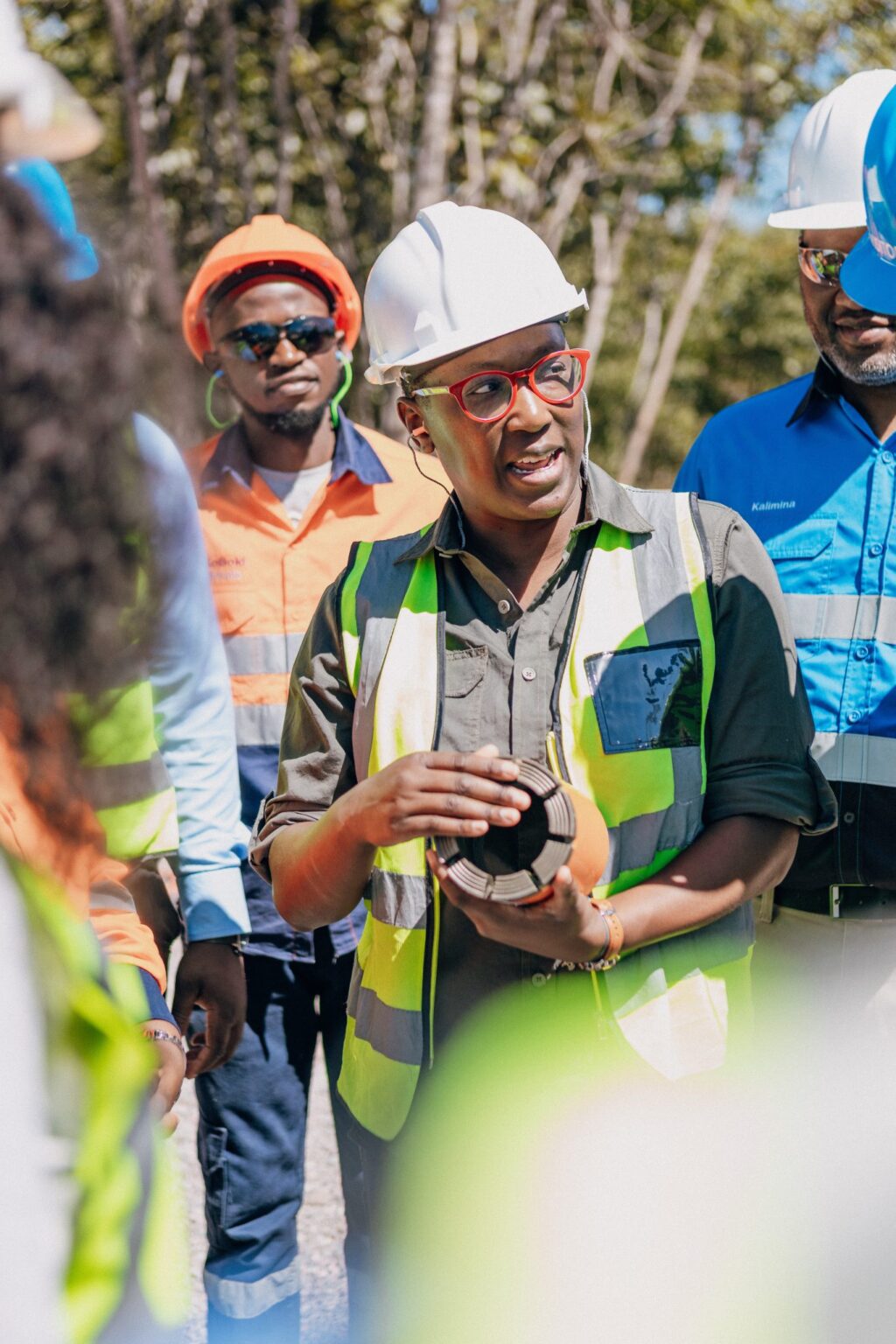
KoBold Metals Africa’s CEO Mfikeyi Makayi
During the groundbreaking ceremony at Mingomba, Co-Founder and President of KoBold Metals Josh Goldman called you “a leader with a lifelong commitment to her country.” You studied in the US and the UK before returning to Zambia. Was returning to Zambia to contribute the skills and know-how you gained abroad always part of the plan?
I’m incredibly proud to be Zambian and African, and I returned because it was always the goal. That’s the whole point: our families, or our nation, send their people out for training, as part of nation-building. At the time, I thought maybe I’d get more work experience in the US before returning, but nothing is linear. The 2008 Global Financial Crisis happened and companies were folding, so there were no opportunities in the US at that time.
Now that I’m here and I’ve charted a path for myself, I can see the opportunities that encourage multinationals to come to Africa – and they aren’t always obvious to Zambians. Going in the other direction is within people’s right, of course. The question is how to create an environment that encourages people to stay and develop their countries when they have something to offer.
Relocating to another province or smaller town for economic reasons is difficult for many but, if I’d stayed in Lusaka, I don’t know where my career would have gone. Moving to Solwezi in 2010 opened so many doors. Eventually, I moved to Ndola, Kitwe and now Chililabombwe and immersed myself in living in mining towns. I’ve enjoyed living on the Copperbelt. People will always move – and moving regionally can also change everything.
“Now that I’m here and I’ve charted a path for myself, I can see the opportunities that encourage multinationals to come to Africa – and they aren’t always obvious to Zambians. (…) The question is how to create an environment that encourages people to stay and develop their countries when they have something to offer.”
We could draw a parallel between the advantages of people moving where they’re needed and goods moving where they’re needed. What are your thoughts on the recently-signed Statutory Instrument (SI) on Local Content?
Mfikeyi Makayi: ‘A lifelong commitment to Zambia’
There are many layers and complexities to ‘local content’. One of these is understanding procurement and strategic sourcing. Some materials can only be sourced from specific parts of the world, so that has to be factored in. The real concern is ensuring that local suppliers have fair opportunities to participate.
Many mining houses already have supplier development programs and partnerships to encourage this. At KoBold, we’re in exploration – so we’re not operating at the scale of a large mine – but we do our best to source services locally where possible. That’s a no-brainer for industry.
Industry procurement must be intentional and inclusive, but it also has to be sustainable, practical, ethical, and not stifling to the investment climate. How can we systematically build a robust, competitive local industry in the supply of mining goods and services? It takes years and requires knowledge retention, including moving with innovation on products, product substitutes, and costs of production. The cost implications are driven by global commodity prices because the final products are not consumed here – and that can make a mine or mining business uneconomic if the laws do not factor this in.
Free market economics will always bump heads with industry protectionism – this has happened the world over. Ultimately, the question is: how much of the value generated by mining stays within Zambia? And how do we create a sustainable balance? That’s where the real debate lies. We also need a forward-looking diversified mining sector with adjacent industries that can withstand cyclical shocks which could otherwise force businesses into distress.
In spite of mining’s sizable economic contribution to Zambia, the narrative about mining not benefitting the country sufficiently is still pervasive. You will have seen firsthand from your time at Kansanshi the positive impact that mining has had on Solwezi and its surrounding communities. Similarly, KoBold has made it clear that the company intends to have an enormously positive impact on Zambia, through its commitment to – among other things – local partnerships across the value chain and environmental protection.
Can you speak to the origins of this perception and the extent to which it reflects reality on the ground?
The perception matters. Zambia has been doing mechanised mining since the 1930s. Over the decades, we’ve seen nationalisation, privatisation, copper price crashes, and economic downturns and upturns. After all that, many people look around and ask, ‘What has mining actually done for us?’
There are two sides to the argument, and they both matter. Governance plays a huge role, too – it’s not just about the mining companies.
One thing I always tell people – especially those who understand finance – is to look closely at the taxes paid by the sector. The Extractive Industries Transparency Initiative (EITI) publishes data on what every mining company pays in taxes. That includes corporate income tax, withholding tax, PAYE – everything.
In a simplistic example, if a mining company employs 10,000 people, each of them is paying various taxes, and that money goes to the Revenue Authority. From there, it becomes part of the national budget, and is allocated to the industries and sectors that the Government is going to focus on for that next year. But here’s the real issue: many don’t know what’s in the national budget, and what areas will receive allocations to drive economic affairs. So it’s all too common to misunderstand both the problems and the solutions. It is our civic duty to understand our national ambitions and regional ambitions. As a relatively young democracy, young people need to spend time educating themselves on their civic responsibilities, how to inform themselves, and how to hold others accountable.
“Zambia has been doing mechanised mining since the 1930s. Over the decades, we’ve seen nationalisation, privatisation, copper price crashes, and economic downturns and upturns. After all that, many people look around and ask, ‘What has mining actually done for us?’ There are two sides to the argument, and they both matter. Governance plays a huge role, too – it’s not just about the mining companies.”
What needs to change for there to be better public understanding of mining’s role in Zambia’s economy?
We need more dialogue and awareness. The Government’s creation of the Public-Private Dialogue Forum was a great first step, and the media also has a role to play – but more Zambians need to engage in these forums. In countries with strong civic participation, citizens track local budgets and know how much is allocated to roads, schools, or healthcare. We need to move in that direction. Rather than relying on media headlines, people should be looking at tax reports and national budget allocations. If we don’t shift the conversation, the same frustrations people have had about mining for the past 70 years will continue into the future.
***
Look out for Part 3 of this exclusive interview, in which Ms Makayi tells us about the Mingomba project’s contribution to Zambia, shares lessons that she gained during the course of her career, and offers advice for those hoping to succeed in the mining industry.