Election Observation Mission to Zambia General Elections,13 August 2026 Final ReportPage 7 of 93
I. EXECUTIVE SUMMARY
The 13 August 2026 general elections were a test of citizens’ democratic expectations for the
future. While the elections were competitive with numerous candidates standing at all levels,
fundamental democratic rights were restricted, especially those of assembly and expression.
Key incumbency advantages blurred the line between state and party, creating an uneven
playing field. While election day was calm overall, the situation deteriorated following the
nationwide six-hour suspension in counting and announcement of results ordered by the
Electoral Commission of Zambia (ECZ). At totalling centres, EU Election Observation
Mission (EOM) observers saw tabulation procedures deteriorate, with less public scrutiny after
that point. Serious incidents and procedural irregularities were noted by the EU EOM during
the totalling process, impacting its transparency and credibility. The ECZ declared the
presidential results on 18 August, but no full publicly available results have been posted by
them, undermining transparency.
The post-election period gave credence to concerns about the shrinking democratic space,
growing signs of government control, and the inadequate respect for fundamental rights and
due process. The environment was tense and turbulent, defined by a sequence of opaque
security-related actions. A raid by joint security forces on a property linked to the opposition
leader on 14 August resulted in the death of one former government minister and the arrest of
11 key opposition figures. This was followed by further arrests, including of the main
opposition candidate, Brian Mundubile, and his running mate, Makebi Zulu, both were charged
with treason and later sedition.
The prolonged lack of official information surrounding the raid and subsequent arrests and the
lethal use of force, which was purported to be motivated by national security considerations,
created the space for speculation and mounting public anxiety over who had been targeted,
their whereabouts, and the charges against them. The physical shutdown of access to the courts
from 24 to 26 August led to a curtailment of access to justice and electoral due process for two
out of the seven constitutionally provided days for filing petitions. Constitutional imperatives
to ensure that technicalities do not impede access to justice were not adequately safeguarded.
The lack of a timely, clearly communicated alternative mechanism for filing presidential
petitions also raised broader concerns regarding public confidence in state institutions, the
judiciary and the rule of law.
While the elections were conducted under a newly amended legal framework that provided an
adequate basis to conduct democratic elections, significant changes to the electoral system were
enacted as late as only three months before polling, contrary to international and regional good
practice, which reduced awareness of them. The amendments, along with other recent law
reforms, created new legal uncertainties surrounding effective inclusion of underrepresented
groups such as women, youth and persons with disability (PwD) and the exercise of
fundamental freedoms. Crucially, constitutionally mandated laws on political parties and on
political finance were not enacted, undermining transparency, public accountability and a level
playing field.
The elections were generally well-prepared by the ECZ, but there is an urgent need for
strengthened transparency and accountability mechanisms. Despite a compressed timeframe
due to late changes in the law, the ECZ managed operations until voting day in line with its
schedule and legal timelines. Delays in the publication of guidelines and regulations, however,
contributed to uncertainty over procedures to be followed, especially regarding election day
procedures and the use of technology. Delayed regulations, erroneous training materials, and EU Election Observation Mission to Zambia
General Elections, 13 August 2026
Final Report
Page 8 of 93
information stands in need of improvement. Late accreditation procedures effectively meant
that long-term observation methodologies were not fully accommodated and fundamentally
impacted the activities of citizen observer groups and the EU EOM.
Voter registration was inclusive and has seen improvements, but the process lacks adequate
robustness and continuous efforts. Some interlocutors criticised the late deployment of staff
and technical difficulties with the digital kits during the voter registration process. These
limitations in registration rates became apparent as the ECZ only reached 50 per cent of its
target of 3.5 million new voter registrations. ECZ improvements included an online pre-
registration portal enabling registered voters to also electronically inspect the Provisional
Register of Voters.
Voters were offered a genuine and competitive choice of contestants with 14 presidential
candidates (of whom only one was a woman). Candidate registration was inclusive, transparent,
and timely. A record number of independent candidates contested NA seats, many after failing
to secure party nominations. The lack of legal status for alliances left scope for uncertainty and
a lack of transparency and accountability for both candidates and voters.
The election campaign was defined by an unlevel playing field and police bias. For the first
time, the ECZ introduced a campaign calendar for presidential candidates, with the aim of
reducing potential violence. However, the calendar did not apply to the incumbent president
and vice-president and restricted other candidates’ freedom of movement and ability to
campaign. The unlevel playing field was further distorted by misuse of state resources and the
blurring of state functions and campaigning. Campaign-related violence, ‘cadreism’ (the
involvement of violent groups traditionally associated with political movements), and police
bias and detentions were commonplace during the campaign.
The media was able to operate with relative freedom throughout the campaign. Yet, there was
a chilling effect created by insecurity related to revisions of cyber laws in 2025. This led to an
increase in self-censorship, as reported by many interlocutors, and one prominent journalist’s
arrest. The EU EOM conducted a comprehensive qualitative and quantitative monitoring of 10
outlets showing the media environment during elections to be characterised by overwhelmingly
biased state-owned media coverage (96.2 and 90.5 per cent of airtime in favour of UPND on
ZNBC TV and Radio, respectively).
On social media platforms, false claims and discreditation of opponents persist amidst growing
self-censorship resulting from restrictive cyber laws. Social media extended the main
candidates’ reach and offered those with less resources a low-cost alternative to rallies and paid
broadcast. Ethnic and violent language was relatively limited during the campaign as noted in
EU EOM monitoring but did increase in the immediate post-election period. The iVerify
platform was consistent and professional in debunking false claims. Although numerous, false
claims did not show signs of coordinated and structured effort. Responsibility for identifying
speech offences and countering disinformation should rest outside the security sector.
Although significant legal reforms were undertaken in late 2025 and early 2026, by the time
the EU EOM 2026 was deployed, there was limited action on the 22 recommendations made
by the EU EOM 2021. This underscored a lack of effective political effort on key issues and
enduring gaps. Positively, an Access to Information (ATI) law was enacted in 2023 and the
offence of criminal defamation of the president was repealed in 2022, reflecting two key
uncertainty over candidate withdrawals exposed shortcomings in the ECZ’s work. Public EU Election Observation Mission to Zambia
General Elections, 13 August 2026
Final Report
Page 9 of 93
recommendations of the EU EOM 2021, but the impacts were muted by a lack of effective
implementation and other restrictive laws and practices.
Women’s participation as candidates in these elections was minimal. They contested at only
nine per cent across all levels of elections with no women candidates standing in more than
half of constituencies. Interlocutors reported gender-based harassment against some
candidates. Although there were 20 reserved seats created for women in the parliament,
women’s candidacy rates for the directly elected seats remained very low, with the reserved
seats possibly a contributing factor. The increase in seats won was only marginal, highlighting
the need for parties to nominate more women in constituency contests. Further concerted efforts
are needed to promote women’s participation and remove discriminatory measures.
Although fifteen parliamentary seats are now reserved for young people, legal gaps regarding
internal party selection and gender balance continue to impede equitable political participation.
Furthermore, while youth were active during the election, notably in the social media space,
persistent unemployment and political exploitation appeared to contribute to some degree of
youth disengagement, highlighting the need for comprehensive structural reforms. The absence
of age-disaggregated electoral data further hinders comprehensive analysis of youth
participation.
Persons with disabilities continued to face significant political and societal marginalisation,
despite some progress in the creation of five proportional representation reserved seats,
although it was unclear which disability groups would be represented and how they would be
selected. They struggle with societal prejudice, a lack of independent access to polling locations
and participation in public and political life. A lack of concerted effort to meaningfully redress
marginalisation persists, as demonstrated by aspects of recent law reforms.
Citizen observer organisations conducting both long- and short-term observation were active
and professional. Despite this, the capacity of citizen and international observer groups to apply
their methodologies was hampered by new and last-minute administrative accreditation
procedures and some ad hoc requests. This constrained opportunities for long-term observation
according to internationally accepted observation methodologies.
The EU EOM observed the opening of 39 polling stations (PS), voting in 419 PS, counting in
38 PS and tabulation at 64 totalling centres. Election day was calm overall, with polling staff
efficiently facilitating voting in polling stations observed by the EU EOM. The counting of the
ballots at PS was transparent where the EU EOM observed, conducted in the presence of party
and candidate agents. The ECZ provided limited public information during election day, with
only two online posts and two press briefings in the evening.
On 14 August, the ECZ unexpectedly declared a nationwide suspension of counting and
announcement of results, to be reviewed within 24 hours. While suspension was lifted after
six-hours, the scale of security concerns stated to underpin the decision was insufficiently
explained. A deteriorating tabulation process after this point saw many procedural omissions
and a lack of integrity safeguards as observed by EU EOM that should be explained to citizens.
Local observers further flagged results inconsistencies. The uncertainties were compounded by
the absence of polling station results published centrally by the ECZ. EU Election Observation Mission to Zambia
General Elections, 13 August 2026
Final Report
Page 10 of 93
Recommendations
The EU EOM offers 13 recommendations for improving the way elections are organised,
managed, and conducted in Zambia. Of these, eight are priority recommendations:
- Revise the electoral legal framework well before elections, through an inclusive,
consultative, and expert-driven process, to remove gaps and inconsistencies, enhance
transparency and legal predictability, and to better align with international commitments. - Ensure transparency throughout the electoral process in line with international standards
in decision-making and access to key information of public interest for all stakeholders.
This would include publication of all relevant regulatory instruments. - Protect freedom of assembly and equal campaign opportunities for all contestants by
discontinuing the role of the ECZ in issuing campaign timetables, ensuring that the pre-
eminent role of regulating campaign schedules lies with contestants. - Disengage state-owned media from direct government control and convert ZNBC into a
genuine public service broadcaster with editorial independence and balanced programming. - Align the Cyber Security and Cyber Crimes Acts with international commitments on
freedom of expression and privacy of communication. - Promote the public accountability of electoral authorities by guaranteeing the right of
unhindered access of observers to all aspects of the electoral process, underpinned by a
timely, transparent and less burdensome accreditation process. - Guarantee effective access to due process in electoral matters. Measures would include
realistic timelines for petitions in all court jurisdictions, including access and filing by
alternate means, consistency in rights of appeal before and after elections, and adopting
appropriate evidentiary standards. - Protect the will of the voter and the integrity of elections by ensuring consistent
arrangements for maintaining transparency during the results tabulation, such as projection
of data entry and prompt online posting of complete, PS-disaggregated preliminary and
final results, in an easily usable format.
II. INTRODUCTION
The European Union (EU) deployed an Election Observation Mission (EOM) to observe the
13 August 2026 general elections in Zambia following an invitation from the Ministry of
Foreign Affairs and International Cooperation of the Republic of Zambia. The EOM was
present from 29 June to 1 September 2026.
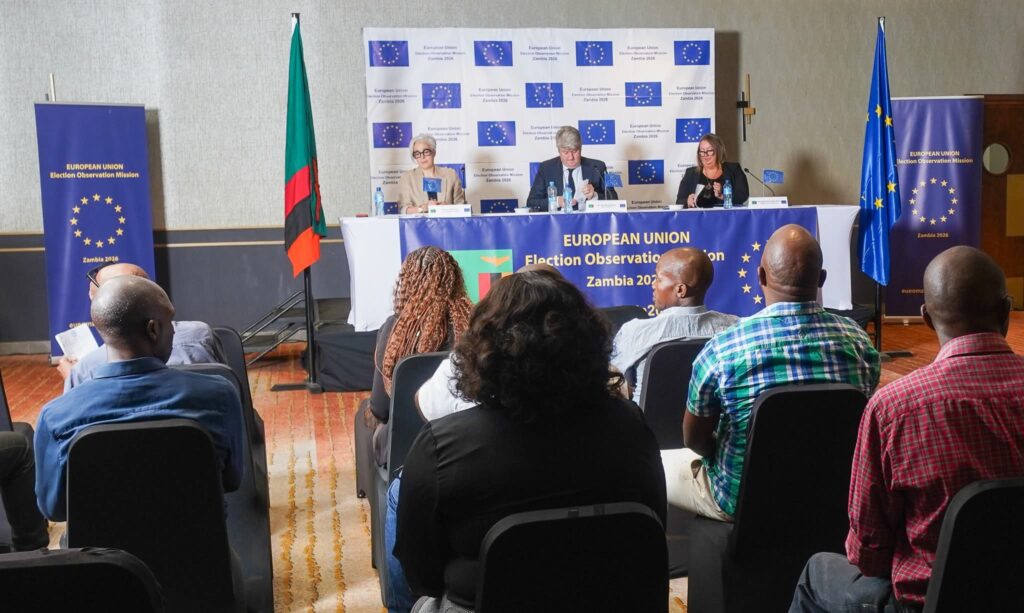
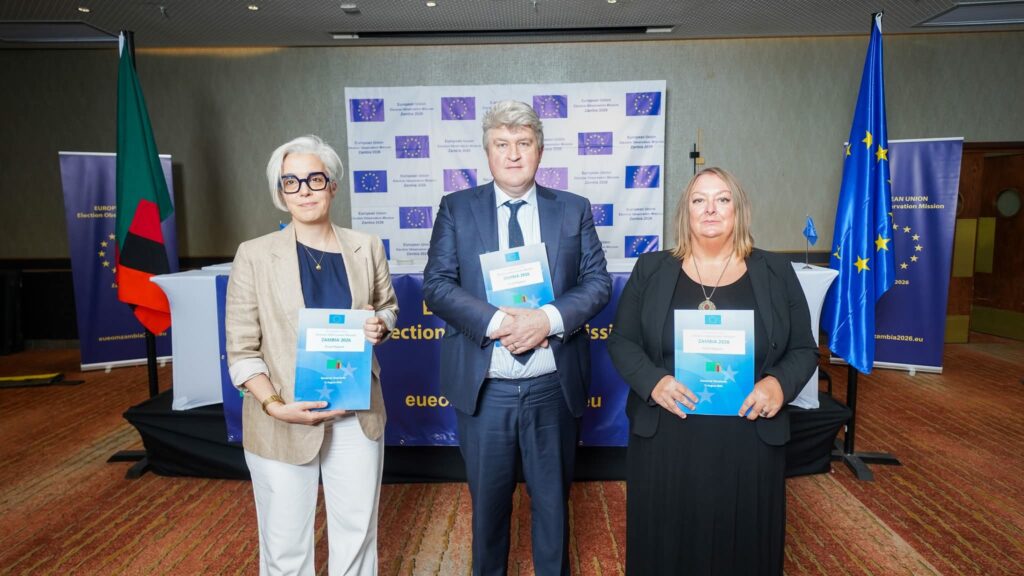
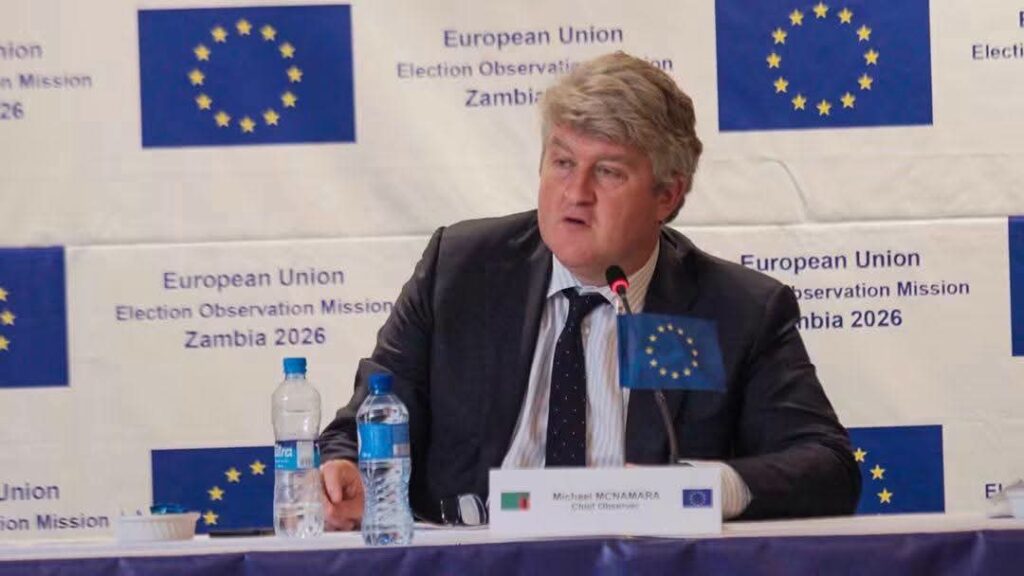
The EU EOM was led by the Chief Observer, Michael McNamara, Member of the European
Parliament from Ireland. The EU EOM comprised a core team of 11 experts based in Lusaka
and 32 long-term observers who arrived on 10 July and deployed to all 10 provinces of the
country. 32 short-term observers were present from 5 to 18 August and deployed throughout
the country.
For the election day, the EU EOM was reinforced with 12 locally recruited observers from
diplomatic representations of EU Member States. In total, the EU EOM deployed 100 observers
from 26 EU Member States, as well as from partner countries Canada and Norway. In addition,
a delegation of seven Members of the European Parliament (MEPs) was led by Reinhold
Lopatka, MEP from Austria.
The mission’s mandate was to observe all aspects of the electoral process and assess the extent
to which the elections complied with international and regional commitments for elections that
Zambia adhered to, as well as with national legislation. The EU EOM is independent in its EU Election Observation Mission to Zambia
General Elections, 13 August 2026
Final Report
Page 11 of 93
findings and conclusions. The mission followed an established methodology and adhered to
the “Declaration of Principles for International Election Observation”, endorsed under United
Nations auspices in October 2005 and now espoused by over 50 organisations.
III. POLITICAL CONTEXT
The 13 August 2026 general elections to elect the president, members of the National
Assembly, mayors and local councillors took place amid a shrinking democratic space and
growing signs of government overreach. Civil society organisations and opposition parties
accused the government of arbitrary and selective enforcement of the Public Order Act and
cyber laws, and of imposing significant restrictions on the fundamental freedoms of assembly,
association, movement and expression, which are essential to a genuine democratic process.
Significant constitutional reforms adopted in 2025 introduced important changes to the
electoral system, including the enlargement of the National Assembly (NA), an associated
constituency delimitation process leading to an increase in their number, introduction of
elements of proportional representation with reserved seats for vulnerable groups, and the
reshaping of local councils. Constitutional changes were criticised and controversial among
electoral stakeholders and led to at least one court challenge.1
Although there was a consultation process, many stakeholders considered that the incumbent-
driven reform process was designed to influence the elections’ outcome, with a limited space
for adequate, timely and meaningful public consultation, alongside unresolved concerns over
inclusion of women, youth and PwD affected by the reserved seat process. A Constitutional
Court (CC) ruling regarding the reform process triggered a revision in government’s approach
and appointment of a Technical Committee on Constitutional Amendments (TCCA) to conduct
nationwide consultations.2
The incumbent President Hichilema sought a second term as candidate of the UPND Alliance,
a coalition of around 15 parties led by his United Party for National Development (UPND).
The opposition was active but divided and the pre-election period was marked by obstacles to
opposition parties’ efforts to mobilise supporters. After loss of power in 2021, the leading
opposition party Patriotic Front (PF) collapsed due to leadership disputes, factionalism, the
death of former President Edgar Lungu, and administrative and judicial decisions that affected
its capacity to operate. As a result, the PF did not field any candidates.
Instead, Brian Mundubile, formerly of the PF, was adopted as presidential candidate for the
National Reconciliation Party for Unity and Prosperity (NRPUP) shortly before the official
nomination period in May. After joining forces with Makebi Zulu of the Pamodzi Alliance, a
rival former PF faction, Mr. Mundubile emerged as the main opposition candidate and created
a strong momentum for the opposition shortly before the elections. He represented the Tonse-
Pamodzi Alliance, a coalition of smaller parties, many with roots in the former PF and relying
on the PF structures throughout the country. Several opposition parties (Citizens First, Socialist
Party) fielded their own candidates. Despite 14 presidential candidates nominated, the contest
was dominated by Mr. Hichilema and Mr. Mundubile.
1 Munir Zulu and Anor v Attorney General (2025/CCZ/009) [2025] ZMCC 12 (27 June 2025) 2 The Government withdrew the draft bill just ahead of the Court issuing its ruling that public consultations
were a key requirement of constitutional reforms processes. EU Election Observation Mission to Zambia
General Elections, 13 August 2026
Final Report
Page 12 of 93
Alongside the president, citizens were to elect 266 NA members, including 40 reserved seats,
116 mayors / council chairpersons and 1,858 councillors. A record number of independent
candidates contested NA seats, many after failing to secure party nominations. Many parties
formed alliances to field a joint presidential candidate and to agree on distribution of NA
candidates. However, these alliances remained unstable, had no formal legal status, and
candidacies were legally linked only to their respective party.
Zambian voters saw the elections as an opportunity to express their primary concerns related
to economic hardship, unemployment, and rising living costs. Positive macroeconomic
developments, including reduced inflation and the restructuring of government debt have not
translated into tangible improvement of living standards for all. President Hichilema sought a
second mandate to continue his reform agenda and deliver on job creation and social
development, while the opposition criticised the government over economic hardship and
authoritarian tendencies.
IV. IMPLEMENTATION OF PREVIOUS EU EOM
RECOMMENDATIONS
The EU EOM 2021 Final Report offered 22 recommendations including 6 priorities to state
authorities and other electoral stakeholders aimed to improve various aspects of election
processes. The 2024 EU Election Follow Up Mission noted limited progress on those
recommendations, while also underscoring that all remained relevant.
Out of the 22 recommendations, only 1, namely, to enact a law on Access to Information, was
implemented. A recommendation to decriminalise the offence of defamation of the president
was adopted, but the impact was muted by similar offences included in other laws, like the new
Cyber Crimes and Cyber Security Acts.
No effective action was taken on six priority recommendations to adopt political party
legislation, to revise the cost and educational conditions of candidacy, to remove undue
campaign privileges for incumbents, to implement comprehensive campaign finance
accountability, and to formalise cooperation between the ECZ, civil society and main social
media platforms in relation to harmful online activities. In relation to the priority
recommendation on the public order act, while a Public Gathering Bill was passed by the
National Assembly, the Public Order Act remained on the statute books for the 2026 elections.
Partial implementation was noted on four recommendations, with some improvements in voter
education efforts, revisions of conditions for rescheduling polling post nominations, additional
polling premises, and new but inactive laws for state media. The remaining 10
recommendations were not adopted, including to decentralise ECZ structures, to guarantee
independent, transparent delimitation of electoral boundaries, to set reasonable limits on hourly
paid political advertising on broadcast media, and to embed in ECZ regulations transparent,
timely and inclusive procedures for accreditations of observers, party agents and media.
Various EU EOM Final Reports since 2001 reiterated several key recommendations, including
measures to promote a level playing field for campaigns, repealing the Public Order Act to
better protect fundamental freedoms of assembly and movement, and enacting effective
political finance law. Other recurring recommendations aimed to enhance stakeholder trust,
included transparent constituency delimitation procedures, prompt publication of polling
station level results, and to cease recording voter identification numbers on ballot paper EU Election Observation Mission to Zambia
General Elections, 13 August 2026
Final Report
Page 13 of 93
counterfoils. All previous EU EOMs called for the transformation of the ZNBC into a genuine
public service broadcaster and for concerted efforts for effective equal participation for women.
None of these key measures have been implemented.
V. LEGAL FRAMEWORK
An adequate legal framework was complicated by late reforms, contributing to legal
unpredictability in addition to existing gaps and weaknesses.
International and Regional Principles and Commitments
Zambia is a state party to the key United Nations (UN) and African regional instruments
pertinent to the conduct of democratic elections.3 It also subscribes to various political
declarations on inclusion and good governance.4 Accordingly, the state must ensure the right
and opportunity to participate freely in public affairs and government, directly or through freely
chosen representatives. This includes key obligations to eliminate discrimination against
women in political and public life.5 The state is bound to ensure the right to vote by universal
and equal suffrage and secret ballot, and to stand in genuine inclusive elections conducted by
independent, and impartial national electoral bodies. The state also undertakes to facilitate full
cycle observation of elections and ensure a political environment free of violence, intimidation,
and discrimination, as well as guaranteeing an impartial and independent judiciary.
During the 2026 elections, various compliance shortcomings were observed with Zambia’s
undertakings either due to some gaps in regulations or because of arbitrary administrative
actions. Legal deficiencies included severe penalties for derogatory speech based primarily on
the identity of an impugned person.6 Significant gender representation gaps endure,7 though
implementation of gender parity must never be treated as subsidiary to other priorities.8
Oversight and public disclosure of campaign finance remains a fundamental area where
Zambia is yet to properly regulate.
9 Importantly, on at least two occasions during the post-
election day period, “security concerns” were invoked, restricting access to key election
3 Zambia is a member of the United Nations (UN), African Union (AU), Commonwealth (CW), Southern
African Development Community (SADC) and the Common Market for Eastern and Southern Africa
(COMESA). Key UN commitments are the International Covenant on Civil and Political Rights (ICCPR), the
International Convention on the Elimination of Racial Discrimination (ICERD), the Convention on the
Elimination of all Forms of Discrimination against Women (CEDAW), the Convention on the Rights of
Persons with Disabilities (CRPD) and the UN Convention against Corruption (UNCAC). African Union
treaties include African Charter on Human and Peoples’ Rights (ACHPR), the Protocol to the African Charter
on Human and Peoples’ Rights on the Rights of Women in Africa (ACHPR-PW), the African Charter on
Democracy, Elections and Governance (ACDEG), the AU Convention on Preventing and Combating
Corruption (AUCCC). SADC commitments include the Protocol on Gender and Development (SADC-PGD)
and the Protocol against Corruption (SADC -PC). International treaties need to be passed into domestic law
to have binding force in the courts. 4 E.g. The Lusaka Commonwealth Declaration on Racism and Racial Prejudice 1979; Harare Commonwealth
Declaration 1991; SADC Principles and Guidelines Governing Democratic Elections (Revised 2015) (SADC
Principles). 5 CEDAW, Article 7. 6 UN Human Rights Committee (HRC) General Comment (GC) No. 34 (Article 19, freedom of expression)
singles out Zambia in its concluding observations (CCPR/ZMB/CO/3, para. 25). 7
positions, including legislatures and electoral administrations. Under CEDAW GC No. 40, achieving parity-
based representation by 2030 is a binding, non-subsidiary requirement. 8 CEDAW General Comment No. 40 9 UNCAC, Article 7(3) – administrative measures to enhance transparency in the funding of candidates for
public office and political parties.
In the SADC-PGD, member states commit to achieving at least 50 percent women in political decision-making EU Election Observation Mission to Zambia
General Elections, 13 August 2026
Final Report
Page 14 of 93
procedures without clear justifications.10 Amid various allegations of security threats, there
were incidents of arrests of journalists and political opponents for treason, sedition, or breach
of official secrets laws, at times raising concerns around the proportionality and necessity of
such actions. Zambia was also an early signatory of the Malabo Convention,
11 in force since
2023, yet in 2025 the state enacted cyber laws that do not align with that convention’s standards
on free speech.
The constitutionally designated Human Rights Commission (HRC) and Anti-Corruption
Commission (ACC), aim to support the implementation of treaty commitments, enhance
transparency and accountability, and promote the protection of fundamental freedoms. At key
stages of the 2026 elections, the HRC was instrumental in advocating for accountability and
issued statements calling for compliance with the Constitutional rights of persons detained
without charge and due process and more effective police co-operation in that regard.
12 Still,
both bodies’ operational capacity and effectiveness could be enhanced through more robust
legal and budgetary independence and mechanisms. 13
Constitutional Human Rights
The Constitution (as amended in 2016) provides a broad, rights-protective framework,
including fundamental freedoms of expression, assembly, association and movement, the right
to personal liberty and protection of the law. However, contrary to international commitments,
freedom of opinion may be curbed based on “public morality”.14
Some affirmative steps were made with regards to the right to seek information, a key
component of freedom of expression, with the enactment of the Access to Information (ATI)
Act in 2023,15 and the repeal in 2022 of the offence of criminal defamation of the president.
However, their impact was muted as defamation remains a criminal offence in the 2025 Cyber
Crimes Act.
16 The law reintroduces criminal liability for reputationally damaging statements
made online, there is a continued use of Penal Code provisions on sedition,17 and the Public
Order Act (POA) also entails arbitrary implementation.
10 A state may not treat human rights as subsidiary to national security without clearly defined legal limits,
including strict proportionality including applying less intrusive measures to achieve the same protective
function. 11 African Union Convention on Cyber Security and Personal Data Protection. 12 See e.g. https://hrc.org.zm/wp-content/uploads/2026/08/Hrc-Statement-over-closure-of-Court-permises-
24.08.2026.pdf 13 The ACC and the HRC are established under their own legislation of 2012 and 1996 respectively. The ACC
is viewed as weakened by a lack of accountability to parliament, dependency on the prosecution service to
take cases, and weak sanctioning framework. Although the HRC issued strong statements calling for
accountability and due process in the aftermath of the elections, they lack power to compel police compliance
and disclosures. A new law for the HRC enacted in 2024, with potential to strengthen the institution, has yet
to be commenced. The Ministry of Justice may promote adherence to and observance of international law to
contribute to good governance. 14 “[…] article 19 requires protection of the right to hold opinions without interference. This is a right to which
the Covenant permits no exception or restriction. 15 The ATI gives effect to the right to access information as guaranteed under the United Nations Convention
against Corruption and the African Charter on Human and Peoples’ Rights, designating the HRC as the
institution responsible for oversight, including hearing and determining appeals against decisions of
information holders, with further recourse to the High Court. 16 The Law Association of Zambia (LAZ) filed a petition before the High Court challenging the 2025 Cyber
Security and Cyber Crimes Acts on the grounds that the laws grant excessive surveillance and search powers
that risk chilling free expression and political debate. No ruling had been issued as of the Mission’s departure. 17 Section 60 prescribes a penalty of up to seven years imprisonment for seditious intention. EU Election Observation Mission to Zambia
General Elections, 13 August 2026
Final Report
Page 15 of 93
Institutional safeguards were somewhat strengthened in 2024, as the Human Rights
Commission (HRC) Act broadened the HRC’s mandate, alongside its existing constitutional
functions to include monitoring compliance with the ATI Act. However, the EU EOM noted
credible reports of ATI requests facing undue hurdles or institutional silence. The 2024
amendments also empowered the HRC to institute proceedings before courts. The ATI’s
accompanying regulations were finalised in March 2026, formally bringing the ATI into
operation, a positive legislative development that has yet to be matched by effective
implementation. As the enforcement authority for access to information, the HRC stated that it
has been publicly monitoring compliance with the law since it came into operation in 2025.
The EU EOM was directly informed of multiple formal requests for information submitted
under the Act.
Multiple detentions during the pre- and post-election period raised significant human rights
concerns. The existing formal avenues for redress, including habeas corpus applications to the
High Court, complaints to the HRC and constitutional due process guarantees on arrest, proved
difficult to invoke. The HRC’s constitutional mandate to investigate such matters was
undermined by limited enforcement powers and inconsistent cooperation from the police. The
pattern of arrests raises significant concerns, with cases in which individuals were not brought
before a court within 24 hours of arrest, as required by law, restricting the right to liberty and
contrary to the prohibition of arbitrary arrest and detention.18
The closure of courts nationwide in the final days of the constitutionally mandated presidential
petition filing window raised serious concerns regarding the practical accessibility of judicial
redress and rule of law mechanisms. The absence of a judiciary-led public explanation on either
the security rationale or a reopening timetable, left stakeholders unable to receive judicial
remedy on these constitutionally time-bound proceedings.
Electoral Legislation
The domestic electoral legal framework offers an adequate basis to conduct democratic
elections. However, several gaps, weaknesses, and ambiguities impact transparency,
independence, and legal predictability. There are important legal vacuums, notably on
contestants’ financial accountability and the meaningful inclusion of women, youth, and
persons with disabilities (PwD). Also, major legal reforms enacted late in the electoral cycle,
contrary to best international practice, contributed to uncertainty and added further
complexities to the law.
The 1991 Constitution, the Electoral Process Act (EPA) with an embedded Electoral Code of
Conduct, and the Electoral Commission of Zambia Act (ECA) constitute the bedrock of the
framework.19 Together with other regulatory instruments, they govern election administration
by the ECZ and define the rights and duties of stakeholders.20 Various other laws governing
information, media, and public gatherings also have implications for participation.21 Crucially,
18 Article 9 of the ICCPR further guarantees the right to be informed of the reasons for arrest and the right to
challenge the lawfulness of detention before a court. Article 6 of the African Charter on Human and Peoples’
Rights, to which Zambia is a State Party, affirms the same due process guarantees at the regional level. 19 These instruments have been variously amended since 2016. The Constitution (as amended in 2016). The
Electoral Process Act (EPA) (2016). The EPA (Amendment) Act 2026. The ECZ was established by the
Constitution in 1996 and the Electoral Commission of Zambia Act No. 25 of 2016 (as amended by the Electoral
Commission Act (amendment) No, 5 of 2019). 20 ECZ Regulations database 21 Access to Information Act (ATI) 24 of 2023, ZNBC Act, 26 of 2025 and the Independent Broadcasting
Authority (IBA) Act 25 of 2025, Public Order Act 1955, Cyber Security Act 3 of 2025 and Cyber Crimes Act
4 of 2025. EU Election Observation Mission to Zambia
General Elections, 13 August 2026
Final Report
Page 16 of 93
constitutionally mandated laws on political parties and political finance remain unenacted,
undermining transparency, public accountability, and the scope for a level playing field.22
Reforms in 2025, adapted after a Constitutional Court intervention,23 entailed key changes to
the Constitution and later to the Electoral Process Act in 2026.24 The amendments increased
National Assembly membership by introducing 70 new single-seat constituencies and reserved
seats for marginalised groups.25 Among some positive measures aimed at a level playing field,
government ministers now resign 90 days before elections. Still, members of parliament who
are no longer sitting due to dissolution are deemed to serve right up to the election eve.26
These legal enactments came as late as three months before polling, contrary to international
and regional best practice regarding the timing of substantive legal reforms.27 The late reforms
introduced new legal uncertainties, including discrimination and unequal treatment of
appointees to reserved seats due to an unrestricted power of recall by the political party to
whom the MP belongs. This power of recall also seems to go against constitutional grounds of
vacancy, while the reserved seat mechanism gave no opportunity for voters to understand who
would represent them before elections.
The changes also introduced a potential future complexity where a presidential election goes
to a second round. Parliament must convene before reserved-seat members can be assigned,
which can only happen following a president’s inauguration. Further, the new law mandates
that the Constitutional Court must fully trial, hear, deliberate, and write a final, unappealable
presidential election petition within a restrictive 14 days of filing. This strict time constraint
stands in conflict with the constitutional right to a fair hearing. Other incoherencies in due
process include the absence of High Court appeals to nominations petitions, although results
petitions remain appealable.
22 Such legislation emerged in various draft stages since 2017 but never came before parliament. On 2 April
2026, the Constitutional Court ordered the government to enact legislation for political parties within 12
months, noting its absence was unconstitutional. Legal Resources Foundation Ltd v The Attorney General
(2025/CCZ/0020) [2026] ZMCC 9 (2 April 2026). 23 After its initiation, the Constitutional court ruled the Bill 7 process unconstitutional. Although the decision
emerges only a day after the bill was withdrawn, the decision was perceived as forcing the Executive to change
tack and appoint a Technical Committee on Constitutional Amendments (TCCA) for nationwide consultations.
The TCCA process had just a month to work and lacked a clear legal framework. Its REPORT was published
on 5 December, only 10 days before Bill 7 passed and thus limiting time for public scrutiny. Munir Zulu and
Celestine Mukandila v Attorney General (2025/12/2015-CCZ-009) and The Law Association of Zambia v The
Speaker of The National Assembly (2025/CCZ/0015) [2025] ZMCC 24 (28 November 2025). Civil Society
organisations also criticised of the governments approach. 24 Constitution of Zambia (Amendment) Act, 2025 Act No. 13 of 2025. The act was initiated by government as
Bill 7 and published in the Government Gazette just prior to submission to the NA in May 2025. See also,
Electoral Process (Amendment) Act, 2026 (Act 12) 25 The reforms were passed on 15 December 2025 by 100 per cent of attendees or 135 (of 167 members) (81%),
with no objections or abstentions) , drawing allegations of parliamentary vote-buying. One allegation was
reportedly raised as complaint to the ACC. The governing UPND party won 82 of the 156 constituency seats
in 2021. The new total maximum membership increases from 167 to 280. See below, Electoral System. 26 Members of parliament (MPs) were also reinstated to local councils, reversing previous legal exclusions and
raising new concerns for devolution of powers and conflicts of interest. The Constitution (2016) (Article 153)
excluded MPs from local councils to promote decentralisation. 27 SADC principles (e.g. sections 4.1 and 7.1) encourage adherence to best practices internationally. Several
regional approaches (e.g. ECOWAS) propose limiting substantive legal reforms within six months before an
election. The Venice Commission suggests a cut-off of up to one year prior. EU Election Observation Mission to Zambia
General Elections, 13 August 2026
Final Report
Page 17 of 93
Various aspects of the recent reforms required some revisions to bring them into line with the
Constitution, some of which were pending during the course of the elections.
28 This includes
the handling of the death of a candidate before polling and the procedures for dealing with
reserved seats at the local council level. Finally, other issues gave rise to uncertainty and
inspired actions seeking judicial clarity, including the impacts of various candidates and
presidential running mates withdrawing after nominations. The Constitutional Court noted that
the electoral calendar operated to prevent legal challenges to independent candidates, advising
revised timelines to avoid such legal loopholes.29
RECOMMENDATION: Revise the electoral legal framework well before elections, through
an inclusive, consultative, and expert-driven process, to remove gaps and inconsistencies,
enhance transparency and legal predictability, and to better align with international
commitments.
Electoral System and Constituency Delimitation
The presidential election is conducted on a joint ticket with a presidential running mate, and
the winner requires an absolute majority (50 per cent plus one) of the valid vote. If no candidate
reaches the threshold, the law foresees a second-round vote within 37 days.30 The unicameral
parliament (NA) seats are filled through a combination of first-past-the-post (FPTP) contests
in 226 single seat constituencies and, for the first time in 2026, a party-list system for 40
reserved seats (20 for women, 15 for youth, and 5 for persons with disability), allocated through
proportional representation (PR) based on presidential candidates’ results nationally in the first
round.31 The reserved seats are allotted to political parties after the declaration of presidential
results but only assigned to the successful parties’ candidates after the presidential
inauguration.32 The president may also nominate up to 11 additional NA members, but without
clearly defined selection criteria.33 Local contests, including for district level council
chairpersons/ mayors and ward-based councillors, are conducted on a first-past-the post (FPTP)
basis. The 2025 legal reforms also introduced reserved seats on local councils, set at 18 per
cent of each council size and varying between a statutory minimum of three such seats, rising
to seven in the largest councils.34
A central pillar of the 2025 constitutional reforms was the enlargement of the NA and, by
necessity, the delimitation of the required 70 new FPTP constituencies. The ECZ is
constitutionally mandated to review, name and delimit constituencies and ward boundaries at
28
29 Zambian Civil Liberties Union and Ors v Attorney General and Anor (2026/CCZ/010) [2026] ZMCC 22 (31
July 2026) 30 The second-round schedule overlaps with the timeline for distributing reserved seats and inauguration of a
new parliament, meaning in a second-round scenario parliament could be inaugurated without reserved seats
holders being appointed. 31 The parliamentary electoral system is constitutionally designated as a Mixed Member Proportional
Representation System (Article 47(2) as inserted by Act 13). Each category of reserved seat has its own quota
determined by dividing the total valid presidential vote by the relevant number of seats in each category. A
highest remainder method applies to the allotment. Political parties that do not reach the threshold, do not
qualify for any reserved seats even if they achieve the highest remainder. 32 Seats must be allotted to designated candidates no later than 7 days after inauguration. 33 The number of nominees increased from 8 under the Act 13 reforms. The final three members of the NA
include the Vice President, Speaker and First Deputy Speaker. 34 The electoral systems for the various elective offices are constitutionally prescribed, with some elaboration in
electoral law and regulations.
The EU EOM sought access to revised regulations but was unable to obtain same. EU Election Observation Mission to Zambia
General Elections, 13 August 2026
Final Report
Page 18 of 93
least every 10 years. This had not been carried outsince the adoption of the 2016 Constitution.35
The 2025 reforms entailed the ECZ having to act within a restricted timeframe before the 2026
polls. The new constituencies were announced at the end of April 2026 with less than four
months to the elections and barely four weeks before the official start of the campaign.36
Although the ECZ decisions seemed broadly accepted, EU EOM interlocutors often
complained of inadequate public consultation and were frequently sceptical as to how the ECZ
reached its decisions given the absence of public access to the granular data or relevant
preparatory reports.37
The ECZ has limited capacity to achieve broad national equal representation as the criteria
delimiting boundaries must follow specific constitutionally mandated criteria. These
considerations include history, diversity, cohesiveness, population density and projections, and
geographical considerations, as well as means of communication. Electoral areas must also
remain within administrative districts, which are, in turn, confined within provinces. Efforts to
achieve an approximate population equality across constituencies and wards is constrained by
the need to ensure adequate representation for urban and sparsely populated areas. Such
complexities contribute to an enduring inequality of the vote contrary to international
standards. While the 2026 delimitations reduced the number of voters per seat in some urban
areas, the overall impact saw only marginal overall improvement in the equality of the vote –
meaning that, significant gaps persist between the most and least populated districts.38
RECOMMENDATION: Strengthen protections for the equality of the vote by adopting
clear, transparent and genuinely consultative mechanisms for delimitation of electoral
boundaries underpinned by the timely and transparent publication of all materially relevant
data and decision-informing report.
VI. ELECTORAL ADMINISTRATION
Conduct of elections highlighted scope for strengthened transparency and accountability
mechanisms.
Structure and Composition of the Election Administration
Most stakeholders expressed confidence in the effectiveness of the ECZ and trust in the
impartiality of the institution, especially at local levels, prior to the elections. A compressed
timeframe due to late changes in the law put pressure on the ECZ in implementing these
elections. It also led to delays in the publication of guidelines and regulations, contributing to
uncertainty over procedures to be followed, especially regarding election day procedures and
the use of technology. Delayed regulations, erroneous training materials, and uncertainty
stemming from candidate withdrawals exposed shortcomings in the ECZ’s work.
The ECZ has the mandate for voter and candidate registration, constituency boundary
delimitation, and voter education. Furthermore, it is to provide information and advice to state
institutions on electoral matters, as well as conducting research, and to liaise with political
35 Following a detailed review in 2019, the ECZ proposed new boundary delimitations of constituencies, wards
and of polling districts, including an increase of the number of national assembly constituencies to 246. These
and revised proposals were not adopted in time for the 2021 elections. 36 The ECZ notified of its decision on Facebook, but the link to official notice on the parliamentary webpage
was not working at the date of writing. 37 See for example – CCMG report 38 For example, several constituencies in North-Western province showed less than 15,000 registered voters,
while in several urban areas, notably Lusaka, there were significantly higher densities of voters per
constituency – in some cases as high as 125,000. EU Election Observation Mission to Zambia
General Elections, 13 August 2026
Final Report
Page 19 of 93
parties. In addition, the ECZ has the legal authority to issue regulations and guidelines and a
duty to enforce the code of electoral conduct embedded in the EPA. The ECZ must ensure that
electoral processes are non-discriminatory, transparent and credible.
The ECZ is composed of five members appointed by the president, subject to ratification by
the NA, for a seven-year term, renewable once.39 The current ECZ composition, appointed
between 2020 and 2026, comprises two women, including the chairperson. A chief electoral
officer (CEO), appointed by the commissioners, is responsible for the ECZ management and
administration and for implementing its decisions, supported by a permanent secretariat, with
professional staff. Some opposition parties publicly expressed concerns about the ECZ’s
independence stemming from the presidential nomination of all commissioners. Independence
and impartiality of an election administration are crucial elements of international standards
for democratic elections.
40 However, the appointment system of commissioners has been in
place since the establishment of the ECZ.
Although the Constitution provides for decentralised, permanent structures at the provincial
and district levels, PTO…