‘2022 Fiscal Budget falls short’-Miles Sampa ……….Initiate legislation to hype revenue gains
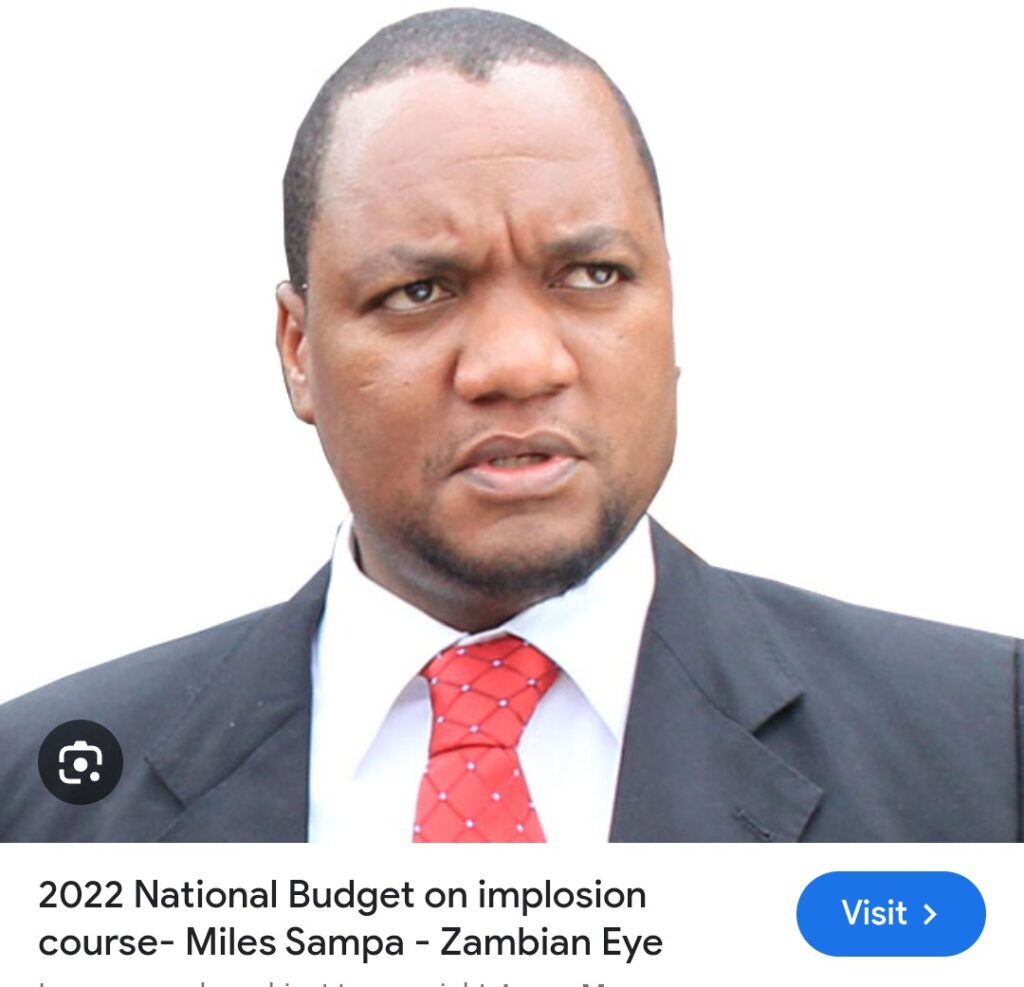
2022 Fiscal Budget falls short’-Miles Bwalya Sampa
By Jeff Kapembwa
Lusaka——–Execution of the 2022 budget for the fiscal year risks failure if stringent regulations including induced ‘Domestic Resource Mobilisation’ initiatives are not applied amid increasing global demand for Zambia’s widely endowed natural resource-copper, Lusaka lawmaker and former Deputy Minister, Miles Sampa says.
On 30 0ctober, finance minister Situmbeko Musokotwane unveiled a K173 billion budget dubbed: ‘Growth, Jobs and Taking Development Closer to the People.’ The Government envisions spending K173.0 billion this year, equivalent to 37.1 percent of Gross Domestic Product.
Revenues and grants are estimated at K100.7 billion representing 21.6 percent of GDP. The gross financing of K72.3 billion, translates to a budget deficit of 6.7 percent of GDP, will be raised from external and domestic sources, including a drawdown on the Special Drawing Rights (SDRs).
However, opposition lawmaker Sampa, a former deputy minister at the Ministry of Commerce Trade and Industry and finance, fears for its success in the absence of oversight.
He contends that while the ‘2022 budget was the best ever pronounced (verbal declaration) in the history of Zambia’, it was biased towards remunerations and not for economic growth as espoused by most citizens.
The budget in its current form was at risk of collapse as noted in the first quarter 2022 performance. The Expenditure side has far outweighed anticipated and actualized Revenues mopped from both local and foreign sources.
Citing the concessions or tax holidays made to the mining sector in which among others the Mining Revenue Tax (MRT) and other incentives have been extended to mining companies to allow for sector growth it was imperative to apply laws that govern and regulate tax avoidance.
The S1 33 and S1 55 introduced between 2012 and the subsequent years seeking to seal all tax avoidance loopholes created in the mining sector by various players did well for economic growth. The current budgetary execution, the lawmaker fears, is bound to fail in the absence of optional revenue mobilization streams.
Given that the bigger income lines heavily depended on external loan, it was imperative for the Zambia Revenue Authority as well as the Ministry of Finance to MOF to revisit the budget before the cycle fails to materialize.
Sampa argues that unless the two regulations were revisisted or similar laws applied to seal all revenue leakages from the companies ‘allergic to tax remittance’ and allow Zambia to get something for its people out of the God given massive Copper deposits beneath the country may lose revenue.
“Concessions to ‘allow the Mines to expand production’ is a dream while Mine owners mint and maximize the externalizing of Copper funds untaxed. As it is, We just have to wait for them (Mine owners) to feel sorry for us and decide to declare a bit of profits so we can get a bit of our money.”
The lawmaker fears that without such regulations the surge in copper prices ($10,350/mt), all the foreign owned mines in Zambia will have their end of year Profit & Loss Statements show huge losses while citing the Ukraine Russia war as an excuse despite not selling our copper to either nation.
It was imperative for the country to induce other homegrown solutions to encourage Domestic Resource Mobilisation, Zambia risks remaining a ‘weeping’ nation in the World.
“My take before and now. For as long as we don’t tax our Mines fairly and we don’t know what is underground, dug out and exported, our people shall remain in poverty while our minerals are being used to develop the West.
In or around 2013, then Zambia’s finance minister Alexander Chikwanda revoked the two Statutory Instruments-S1 33 and SI 55 to seal various loopholes that paved the way for externalization of profits from the extractive industry and allow supervision by the Central Bank.
Under S1 33, the Bank of Zambia under the laws, Volume 20, Cap 360 was mandated to regulate all currency exchanges and transactions to discourage externalization of foreign currency out of the country and ensure self-sustenance-a move which allowed for the flourishing of reserves.
Under S1 55, by way of the Act empowered the Bank of Zambia, to monitor balance of payment transactions and regulate charges in the financial sector.
Enacted on 1 July, 2013, the regulation was ideally to monitor all balance of payments. The Bank was tasked to, among other roles, regulate and monitor transactions made in foreign currency.
It sought to monitor the Payments of Balance by accumulated revenues funds of circulation beneficial for Facilitate, ensure full compliance by all players in the economy and provide sanctions where one flouted the law.
Although some mining companies contested the new law, some interest groups supported the Government’s decision to regulate.
The Act was deemed as a barrier to money laundering and tax evasion while transparency and accountability was sought to increase retention of reserves.